First Seen
2025-01-05T21:04:06.501093+00:00
detailed-analysis (gemma3_27b-it-q8_0)
Okay, let's unpack this meme from the perspective of "Millenihilism," a blend of millennial ennui and nihilistic outlook. Millenihilism thrives on irony, absurdity, and a sense of impending doom, often expressed through humor that acknowledges the pointlessness of striving within late-stage capitalism. Here's a breakdown, hitting on the relevant theoretical lenses:
Visual Description
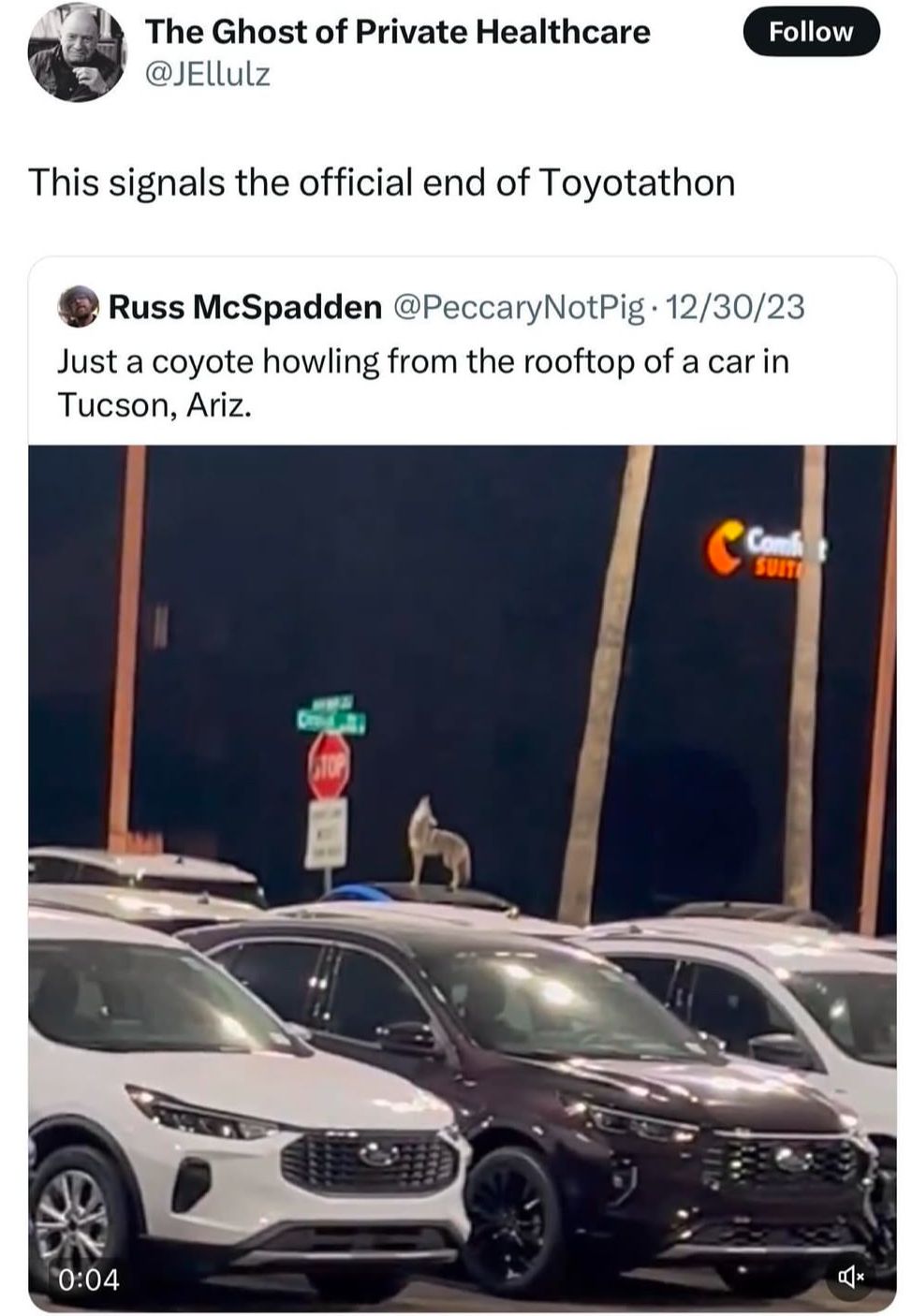
The image shows a grey Toyota SUV parked in front of a building with orange walls. A coyote is standing on the hood of the SUV, seemingly howling. The surrounding environment includes a stop sign and what appears to be a commercial area. The image is raw and unpolished—seemingly a snapshot from everyday life. A timestamp is present, labeling the date as 12/30/23. This lack of aesthetic curation is key to the Millenihilist aesthetic, rejecting polished, aspirational imagery.
Postmodernism
This meme operates powerfully within a postmodern framework. Here’s how:
- Rejection of Grand Narratives: The statement "This signals the end of Toyotathon" is deliberately nonsensical. Toyotathon is a local car sales event. It's a trivial, localized promotion. The meme equates this minor event with the end of something (left purposefully vague) – a parody of the grandiose claims of progress, history, and meaning that postmodernism critiques. There’s no logical connection, and that’s the point.
- Simulacra and Simulation: The coyote howling on the car can be interpreted as a simulacrum – a copy without an original. The "wild" coyote on a mass-produced vehicle is a jarring juxtaposition. It’s a simulation of a natural scenario imposed on a hyper-real, consumerist environment. It questions authenticity. Is the howl genuine, or a performance within the spectacle of modern life?
- Irony and Pastiche: The entire meme functions on layers of irony. It’s not actually about the end of Toyotathon, but rather a meta-commentary on the absurdity of caring about such things. It’s a pastiche of disconnected elements (coyote, car, local event, existential announcement) thrown together with no apparent cohesion.
Critical Theory
This meme subtly engages with critical theory, specifically regarding the culture industry and the alienation of modern life.
- Commodification of the Natural: The coyote, a symbol of the American Southwest and natural wilderness, is placed on a product of the automotive industry. This illustrates how capitalism increasingly encroaches on and commodifies even natural spaces and wild creatures. The coyote becomes a part of the spectacle of consumerism.
- Alienation: The image evokes a sense of alienation. The coyote's howl feels desperate, unmoored from any meaningful context. It's a cry into the void, reflecting the feeling of meaninglessness that can result from living within a highly commodified and alienated society.
Millenihilist Core
The meme resonates with Millenihilism because it encapsulates several key tenets:
- Acceptance of Decay: Instead of fighting against the perceived decline of everything, Millenihilism embraces the absurdity of it all. The "end of Toyotathon" isn’t a tragedy, it’s just…something that happened, and it’s fitting that it be signaled by a coyote.
- Dark Humor as Coping Mechanism: The humor is dark and self-deprecating. It’s a way to acknowledge the bleakness of the world without succumbing to despair. The joke isn’t funny in a traditional sense; it’s funny because it’s profoundly, disarmingly true to a certain worldview.
- Sense of Powerlessness: The coyote isn’t doing anything to change the situation, it’s just howling. This reflects a Millenihilist feeling of helplessness in the face of large-scale systemic issues. There's a resignation to the inevitable.
In essence, the meme is a darkly humorous commentary on the futility of striving within a consumerist society, the encroachment of capitalism on the natural world, and the general sense of existential dread that permeates contemporary life. It’s a snapshot of Millenihilism in action: recognizing the abyss and laughing (or, at least, wryly acknowledging it).
simple-description (llama3.2-vision_11b)
The meme is a screenshot of a tweet from @JEllulz, with the caption "This signals the end of Toyota's involvement in the 2024 IndyCar Series, the final event of which will be held in 2024. The tweet includes a photo of a coyote sitting on top of a car in a parking lot, with the caption "Just a coyote howling from the rooftop of a car in Tucson, Arizona." The tweet is being shared as a joke, implying that the coyote is somehow related to the end of Toyota's involvement in the IndyCar series.
detailed-analysis (gemma3-27b-vision)
Okay, let's break down this tweet and its accompanying image through the lenses you've requested. It's a quirky image, so some of these analyses will stretch a bit to apply, and some will be more fruitful than others. I will note where a section isn't particularly strong due to the content.
Please note: These analyses are interpretations, and others are possible. I’m offering one reading, based on the provided frameworks.
---
Visual Description
The image shows a street scene in Tucson, Arizona. Several cars are present, including a large, black SUV in the foreground. The distinctive feature is a coyote standing on the roof of one of the cars. It appears to be looking upwards and 'howling'. In the background, a fast food restaurant, 'Comb's Southern Kitchen', is visible. There's a traffic sign, possibly a school zone sign, visible in the background as well. The image appears to be a still frame from a video (there’s a timestamp indicating “0:04”). The lighting suggests daytime and perhaps a slightly hazy or overcast sky.
Foucauldian Genealogical Discourse Analysis
The image and tweet can be examined through a Foucauldian lens by looking at the discourses it evokes, and how these discourses have changed over time. The "coyote" itself is a potent symbol with a long history in Indigenous cultures of the Southwest, often representing trickery, adaptability, and a connection to the land. The modern Western discourse around coyotes often frames them as pests, predators, or even a symbol of wildness encroaching on civilized space.
The “howl” itself can be read as a disruption of the expected order – the orderly line of cars, the commercial space of the restaurant, the predictability of suburban life. The genealogy of the "coyote howl" would trace how it moved from a natural sound associated with wilderness to a cultural symbol capable of provoking anxiety, awe, or even amusement.
The tweet’s pronouncement of the “end of Toyotathon” is a bizarre juxtaposition, seemingly unrelated to the image. It could be interpreted as a disruption of marketing language— a rejection of consumerism and the endless cycle of sale events.
Critical Theory
From a critical theory perspective, the image reveals power dynamics related to space and control. The cars represent the dominance of the automobile and car-centric urban planning, prioritizing movement and private ownership over pedestrian or natural space. The coyote on the car is a temporary, visual re-appropriation of that space— a claim by the "wild" on the domain of the "civilized." This can be seen as a micro-level rebellion against the constraints of the modern built environment.
The 'Toyotathon' comment highlights the all-pervasiveness of commercial ideology, even intruding upon an apparent scene of wildness. The image, read critically, could be a commentary on the increasing encroachment of capitalism into all aspects of life.
Marxist Conflict Theory
From a Marxist perspective, the image presents a conflict between nature and the forces of production. The coyote, representing the natural world, is superimposed on the product of industrial labor—the car. This juxtaposition visually embodies the exploitation of nature inherent in capitalist production. The car, as a commodity, represents the ownership of means of production and the resulting alienation of people from the natural world.
The tweet's reference to "Toyotathon" reinforces this conflict by highlighting the relentless drive for profit maximization and the commodification of even basic needs (transportation). The image could symbolize a challenge to the capitalist system, with the coyote representing the forces that resist commodification.
Postmodernism
The image is inherently fragmentary and ironic, qualities central to postmodern thought. The juxtaposition of the wild coyote on a mundane suburban car, combined with the bizarre tweet about the end of a sales event, defies a coherent narrative. The image embraces pastiche – a blend of seemingly unrelated elements.
The lack of a clear "meaning" is also a hallmark of postmodernism. The viewer is left to interpret the image through their own lens, without a definitive message being imposed. The tweet amplifies this ambiguity, adding another layer of unresolvable tension. The image seems to revel in its own absurdity.
Queer Feminist Intersectional Analysis
This is the most difficult lens to apply convincingly. However, one could argue that the coyote, as a non-normative creature disrupting the order of things, embodies a kind of "queer" resistance to established power structures. Traditionally, nature is often relegated to the space outside and "Other" from the culture, much like queers and feminists have historically been.
The coyote disrupting the "order" of cars and commerce could be a metaphor for challenging patriarchal structures. One could also read the coyote as a figure defying rigid categorization – existing in a space between wild and domesticated, challenging binary oppositions.
However, this analysis relies on a significant stretching of the frameworks, and the image doesn’t inherently lend itself to these interpretations without a deliberate reading.
---
Hopefully, this provides a nuanced breakdown of the image and tweet from the requested theoretical perspectives. Let me know if you'd like me to elaborate on any particular point or explore alternative interpretations.
simple-description (llama3.2-vision)
The meme is a screenshot of a Twitter post with a photo of a car dealership's parking lot at night. In the center of the photo, a person has placed a fake coyote on the roof of a car, as if it's howling at the moon. The text above the photo reads "Just a coyote howling from the roof of a car in Tucson, Arizona."