First Seen
2024-10-30T05:10:13.804170+00:00
simple-description (llama3.2-vision_11b)
The meme is a screenshot of a text conversation between two people, where one person is pretending to be a driver who has just been involved in a car accident. The conversation is full of absurd and exaggerated statements, such as "I was just driving and then I saw a chicken" and "I'm not even kidding, I'm still shaking". The meme is a humorous example of a Millenihilism, a category of internet culture that emphasizes absurdity and absurd language.
detailed-analysis (gemma3-27b-vision)
Okay, let's break down this meme/screenshot with the requested theoretical lenses. It's a surprisingly rich little piece for what appears to be a simple internet joke!
---
## Visual Description
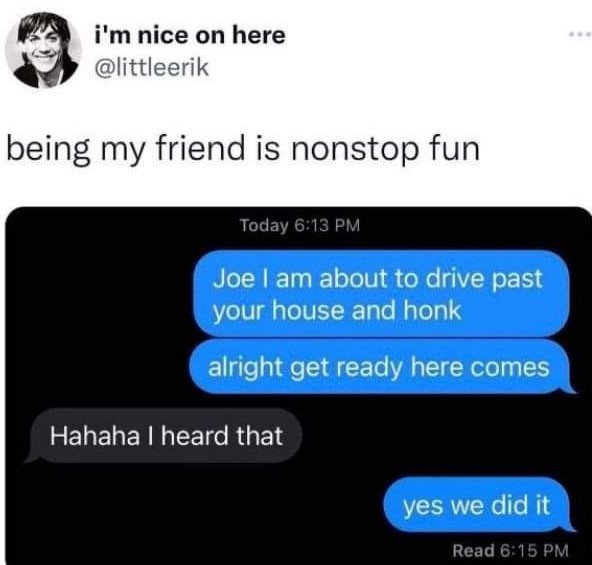
The image is a screenshot of a Twitter post with a text conversation embedded within it. The Twitter handle is "@littleerik" and the account profile image is a cartoonish rendering of a person. The text above the conversation reads "being my friend is nonstop fun." The embedded text exchange is between two people, presumably "@littleerik" and "Joe." The exchange consists of:
1. "@littleerik" writing "Joe I am going to drive past your house and honk"
2. Joe replying "alright get ready here comes"
3. "@littleerik" replying "Hahaha I heard that"
4. Joe replying "yes we did it"
The conversation is overlaid on a black background. The timestamps indicate a time frame of around 6:13 PM to 6:15 PM. The general aesthetic is casual and playful, indicative of online, informal communication.
---
## Foucauldian Genealogical Discourse Analysis
This seemingly trivial exchange reveals a fascinating power dynamic operating through discourse. Foucault would be interested in how honking becomes a symbol laden with meaning through repetition and normalization.
Power/Knowledge: The act of driving by to honk isn't inherently about conveying a message. Instead, the power lies in the ability to disrupt Joe's space, even playfully. The 'permission' granted by Joe ("alright get ready") reaffirms this power dynamic. It's not an act of imposition, but a negotiated imposition* within their relationship. The joke works because it relies on shared understanding of this dynamic.
Discourse & Subjectivity: The repetitive nature of this act (implied by the shared joke) establishes a discourse—a way of talking about and relating to each other. This discourse constructs Joe as someone who expects to be driven past and honked at, and "@littleerik" as the one who performs* the honking. These roles become part of their interaction and, potentially, their understanding of each other.
* Genealogy: Tracing the "genealogy" of this practice (if possible) could reveal its origins and how it’s become a recurring ‘inside joke’. Was it a spontaneous act? A reaction to something else? The history of the practice illuminates the relationship.
---
## Postmodernism
This meme is a perfect example of postmodern playfulness and the breakdown of traditional meaning.
Irony and Parody: The humor relies heavily on the absurdity* of the act itself. Driving by someone’s house just to honk is a nonsensical gesture, deliberately divorced from any logical purpose. This embrace of the irrational and illogical is a hallmark of postmodern aesthetics.
Simulacra and Simulation: The honking isn’t about a 'real' message; it's a performance of friendship, a signifier that points to nothing beyond itself. It’s a "simulacrum"—a copy without an original—that’s become a part of their relationship. The act becomes* the meaning.
* Deconstruction of Communication: The meme mocks the very idea of meaningful communication. The 'message' is empty, yet it generates a response and reinforces a bond. This challenges the notion that communication always has to be about conveying information.
---
## Critical Theory
Applying a critical theory lens, we can see how this seemingly harmless exchange operates within broader societal structures.
* Everyday Resistance: Driving by to honk could be viewed as a small, playful act of resistance against the norms of everyday social interaction. It’s a deliberate break from conventional ways of communicating, creating a unique micro-culture within their friendship.
* Subversion of Social Norms: The act of honking, typically associated with communication (warnings, greetings), is detached from its conventional function. This disruption of expected behavior is a common tactic in critical analyses of culture.
* Power dynamics and relationality: The joke is also an example of an intimate relationship. Critical theorists might want to analyse the dynamic of playfulness and disruption and the ways those behaviours create and maintain bonds of affection.
Important Note: The richness of these analyses relies on interpreting the meme. Different readers might find different meanings and emphases. These are just a few possible readings based on the theoretical frameworks.
simple-description (llama3.2-vision)
This meme is a screenshot of a conversation between two people, with the first person asking if the second person is ready to leave. The second person responds with a sarcastic and playful message, implying that they're not ready to leave and are instead going to continue enjoying their time. The message is humorous and lighthearted, with the phrase "I'm not leaving" being a common way to express reluctance to leave a situation.