First Seen
2024-04-02T21:47:10.336910+00:00
simple-description (llama3.2-vision_11b)
The meme is a screenshot of a Twitter post from an account called "Millenihilism" (a play on "millennium nihilism") that reads: "I don't care if I have millenium nihilism. I'm still going to enjoy my cheese fries." The meme is a humorous take on the concept of millenium nihilism, a philosophical and cultural movement that emerged in the late 20th century, characterized by a rejection of traditional values and a focus on individualism and self-empowerment. The meme pokes fun at the idea of millenium nihilism by applying it to a mundane and lighthearted context, such as enjoying cheese fries.
detailed-analysis (gemma3-27b-vision)
Okay, let's break down this Twitter post through the requested theoretical lenses.
Visual Description
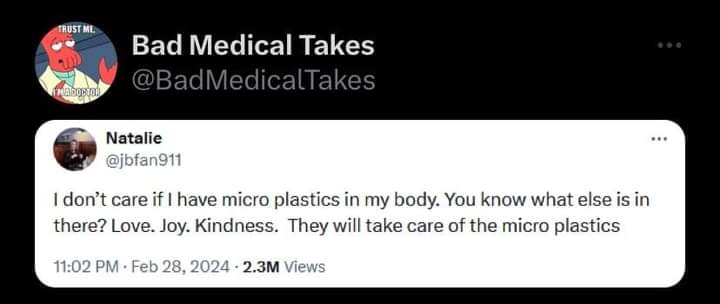
The image is a screenshot of a Twitter post. The account “BadMedicalTakes” has a profile picture of an anthropomorphic lobster with the phrase “Trust Me” superimposed on it. The post itself is from user @jbfan911. The text of the post reads: “I don’t care if I have micro plastics in my body. You know what else is there? Love. Joy. Kindness. They will take care of the micro plastics.” The post is timestamped 11:02 PM, Feb 28, 2024, and has garnered 2.3M views. The overall aesthetic is somewhat ironic and uses contrasting ideas (environmental toxicity vs. positive emotions) to generate a message.
---
Foucauldian Genealogical Discourse Analysis
This post provides fertile ground for a Foucauldian analysis.
Discourse of Health & Wellbeing: The post implicitly critiques the dominant biomedical discourse focused on quantifiable threats to health (like microplastics). This discourse often positions the body as a site of vulnerability, requiring constant monitoring and control. The post, instead, privileges "love, joy, and kindness" as powerful* forces within the body.
* Power/Knowledge: The ‘BadMedicalTakes’ account, by framing this as a take, is challenging expert knowledge, creating a counter-discourse. The post doesn’t deny the presence of microplastics, but re-frames how they are understood. It challenges the notion that medical science is the sole or even primary means of addressing health issues, highlighting the agency of subjective states.
Genealogy: We can trace the historical shift from seeing health primarily as the absence of disease, to a more holistic understanding that incorporates mental and emotional wellbeing. This post taps into the latter, suggesting that positive affects are active* forces. It doesn’t necessarily ‘deny’ microplastics but repositions them in relation to these forces. It challenges the linear progression of medical science and offers a different way of understanding health.
---
Critical Theory
This post resonates with themes of alienation and the commodification of the body often found in Critical Theory.
Commodification & Control: The preoccupation with microplastics in the body* can be seen as another manifestation of the rationalizing forces of late capitalism. The body is treated as a vessel, a container to be filled and protected from external threats. The post attempts to resist this commodification, suggesting that interiority (love, joy) has more potency.
The Rationalizing Project: The focus on detecting and removing* microplastics exemplifies the drive to control and dominate nature, as theorized by Horkheimer and Adorno. This post offers a quiet resistance—a refusal to be consumed by anxiety around environmental toxins and a prioritization of inner resources.
* False Consciousness: The post implicitly suggests that the intense focus on individual exposure to microplastics might be a distraction from larger systemic issues (e.g., corporate pollution, unsustainable consumption) – an instance of how attention is diverted from the source of harm.
---
Postmodernism
This post embodies several postmodern characteristics.
* Deconstruction of Grand Narratives: The post undermines the idea that science can offer a complete or definitive account of health. It suggests that subjective experience and emotional states are equally (if not more) important.
* Irony and Playfulness: The juxtaposition of a serious environmental threat (microplastics) with abstract emotional states (love, joy) is inherently ironic. It deliberately destabilizes the usual frameworks for understanding health risks.
* Subjectivity and Relativism: The post privileges personal experience and emotional wellbeing. The assertion that “love, joy, and kindness” can counter microplastics is not presented as a scientifically verifiable claim, but as a matter of subjective truth.
* Hyperreality: The post hints at a detachment from 'reality'. It presents a sense that emotional and subjective experiences can override tangible physical concerns.
---
Queer Feminist Intersectional Analysis
While not overtly focused on gender or sexuality, an intersectional reading can yield insights.
* Care & Embodiment: Feminist theories of care emphasize the importance of nurturing the body and attending to its needs. The post can be read as a call to prioritize emotional wellbeing as a vital form of self-care—a way to resist the anxieties generated by environmental threats. It re-centers the body as a site of emotion and agency.
* Emotional Labor & Vulnerability: Often, emotional labor falls disproportionately on marginalized groups (women, people of color, queer individuals). To suggest that emotions can actively counteract harm, can be seen as a reclaiming of emotional strength in the face of systemic precarity.
* Ecofeminism: There's a potential connection to ecofeminist thought, which emphasizes the connection between the domination of women and the domination of nature. The post challenges the logic of control and domination, advocating for a more nurturing approach to both the body and the environment.
I hope this breakdown is helpful! Let me know if you’d like me to elaborate on any of these theoretical perspectives.
tesseract-ocr
oe Ce Bad Medical Takes e Natalie co | don’t care if | have micro plastics in my body. You know what else is in there? Love. Joy. Kindness. They will take care of the micro plastics 1:02 PM - Feb 28, 2024 - 2.3M Vi
simple-description (llama3.2-vision)
The meme is a screenshot of a Twitter post from the account "Bad Medical Takes" with the username "Natalie" (not the actual name). The text reads: "I don't care if I have microplastics in my body. You know what they are? They will take care of the microplastics."