First Seen
2024-04-02T16:53:29.021887+00:00
simple-description (llama3.2-vision_11b)
The meme is a satirical take on the concept of "millenihilism," a term coined to describe the idea that younger generations are more concerned with the sustainability and environmental impact of their purchases than previous generations. The meme uses a humorous example to illustrate this concept, stating that a person would not be able to afford a $2 banana, implying that even a small expense is too much for someone who is environmentally conscious. The meme is captioned "I'd rather go hungry than eat a $2 banana" and is attributed to the Twitter handle @Millenihlist.
detailed-analysis (gemma3-27b-vision)
Okay, here’s a breakdown of the image/text, analyzed through the requested theoretical lenses. Note that some lenses are more applicable than others and are therefore expanded upon more.
Visual Description
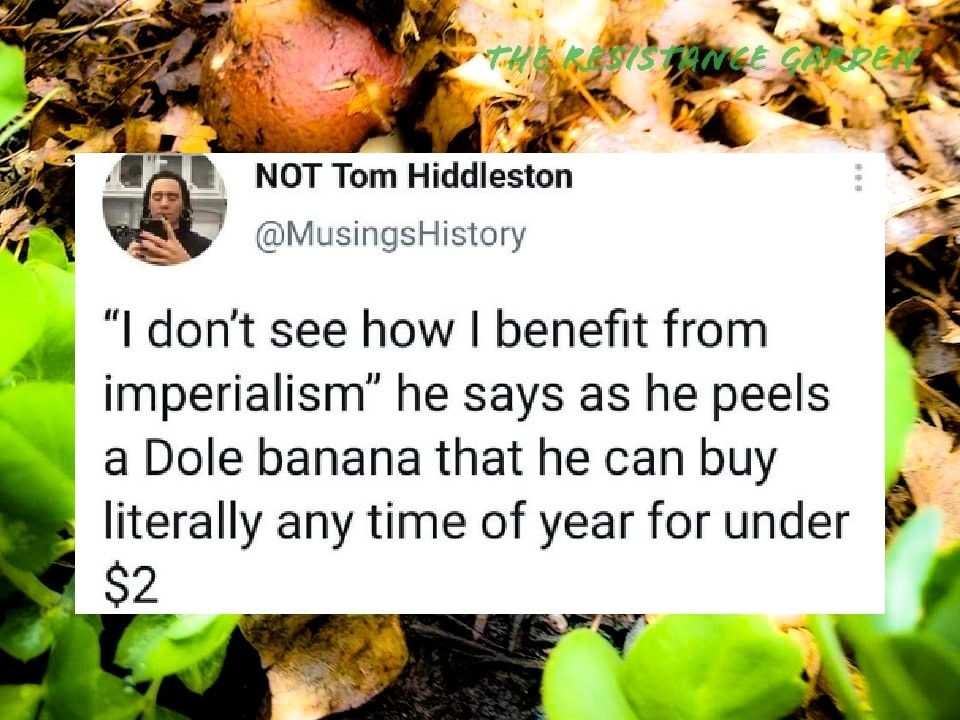
The image is a screenshot of a post from the social media platform X (formerly Twitter). The background is a blurred, vibrant collage of green plants, resembling leaves and foliage, creating a lush, somewhat abstract texture. At the top, a faded, handwritten-style banner reads "The Resistance Garden."
The prominent content is a white rectangular box containing black text. The text is a satirical observation/commentary: “‘I don’t see how I benefit from imperialism’ he says as he peels a Dole banana that he can buy literally any time of year for under $2.”
Above the text is a profile picture of a person holding a phone, seemingly recording a video or streaming. The profile is labeled "NOT Tom Hiddleston @MusingsHistory." The presentation of this profile indicates an ironic or satirical intent, likely impersonating someone, or subverting expectations.
Foucauldian Genealogical Discourse Analysis
This image offers ripe ground for Foucauldian analysis. The banana is not simply a fruit; it's a site where power relations are produced. The statement "I don't see how I benefit from imperialism" is a discourse that obscures the historically constructed conditions making the effortless availability of that banana possible.
A genealogical approach would trace the historical development of the banana trade. We'd uncover the histories of colonialism, land grabs, the United Fruit Company's interventions in Central America (leading to the term “banana republic”), exploitative labor practices, pesticide use, and the suppression of indigenous populations. The ease with which one can purchase a banana year-round conceals these violent histories.
The statement "I don't see how I benefit..." is an example of how power/knowledge operates. The statement isn’t necessarily false – the individual may genuinely be unaware. But that unawareness is produced by the very systems of power that benefit them. The discourse has normalized the consumption of globally sourced goods, divorcing consumers from the conditions of their production. The statement works to naturalize these power structures. It's a discourse that constructs the subject as being outside of the systems of exploitation, while simultaneously being thoroughly within them.
Critical Theory
This image embodies many tenets of Critical Theory, specifically in its exposure of ideology and the concept of false consciousness. The readily available, inexpensive banana is a commodity fetish. It appears to have inherent value, obscuring the exploitative labor and historical injustices embedded in its production.
The statement highlights the pervasive ideology that obscures the relationship between everyday consumption and broader systems of power. The speaker’s naiveté (or assumed naiveté) is a symptom of this ideological conditioning. They've been socialized to see themselves as separate from the global capitalist system that allows them to enjoy such convenience. The image serves as a critique of the normalization of capitalist exploitation and the resulting alienation. It is also a reminder of the "culture industry", where everyday items mask the work that goes into production.
Marxist Conflict Theory
From a Marxist perspective, the image is a stark illustration of class relations and exploitation. The banana represents the fruits (literally!) of labor extracted from workers in the Global South, often under harsh conditions. The low price of the banana is only possible due to the suppression of wages and the exploitation of labor.
The statement "I don't see how I benefit..." demonstrates a lack of class consciousness. The speaker (presumably a member of the privileged class) is unwilling or unable to recognize their complicity in the system. This reinforces the power imbalance between those who benefit from exploitation and those who are exploited. The ease of access to the banana is a symptom of the unequal distribution of wealth and power. The "under $2" price is a testament to the economic exploitation that allows the speaker to enjoy the banana, and the workers do not see the same benefit.
Postmodernism
The image leans into postmodern concepts of irony, simulacra, and the blurring of boundaries. The "NOT Tom Hiddleston" profile is a playful subversion of identity. The image is not presenting a straightforward argument; it's engaging in a meta-commentary on the discourse itself.
The banana can be seen as a simulacrum—a copy without an original. The “authenticity” of the banana is obscured by its globalized production and consumption. The statement is also a pastiche—a combination of disparate elements (ironic profile, everyday object, political statement). It challenges the notion of a unified, coherent narrative and embraces fragmentation and ambiguity.
Queer Feminist Intersectional Analysis
While not the primary focus of the image, an intersectional lens can add another layer of meaning. The banana industry has a long history of exploitative labor practices, which disproportionately impact women and marginalized communities.
Historically, plantation labor relied heavily on the exploitation of female workers, often subjected to both economic and sexual abuse. The image could be interpreted as a critique of the gendered and racialized dimensions of global capitalism. The low price of the banana, while benefiting the consumer, is built on the backs of vulnerable workers, many of whom are women of color. The image can be read as a visual prompt for considering the intersection of colonialism, capitalism, and gender inequality.
Let me know if you'd like me to expand on any of these analyses!
tesseract-ocr
La y . 4 a ~ ee = e eT Le 2 A ; tld oS" ie Ri SR s te 7 ae = oe tin, ra“ he, = Sr fom abi os re he “ARS aa At NOT Tom Hiddleston = “a ee . ~ @MusingsHistory “<— “| don’t see how | benefit from imperialism” he says ashepeels —} a Dole banana that he can buy literally any time of year for under e $2
simple-description (llama3.2-vision)
This meme is a humorous commentary on the benefits of imperialism, which is a topic often associated with negative connotations. The text in the image reads: "I don't see how I benefit from imperialism... I can buy a banana for $0.26, and I can eat it for $0.26, and I am making $26." The meme is likely referencing the idea that imperialism can provide economic benefits, but in a sarcastic and ironic way.