First Seen
2023-11-16T01:28:04+00:00
simple-description (llama3.2-vision_11b)
The meme is a screenshot of a tweet from a user named @Millenihilism, which reads: "I've been using the phrase 'I've been cancelled' to describe when I'm being kicked off a platform for being too honest about the flaws in modern society." The meme is a humorous commentary on the trend of people using the phrase "I've been cancelled" to describe being kicked off a platform for being too honest about the flaws in modern society.
detailed-analysis (gemma3-27b-vision)
Okay, here's an analysis of the tweet, broken down by the requested theoretical lenses. I'll skip sections if the content doesn't readily lend itself to that particular framework.
Visual Description
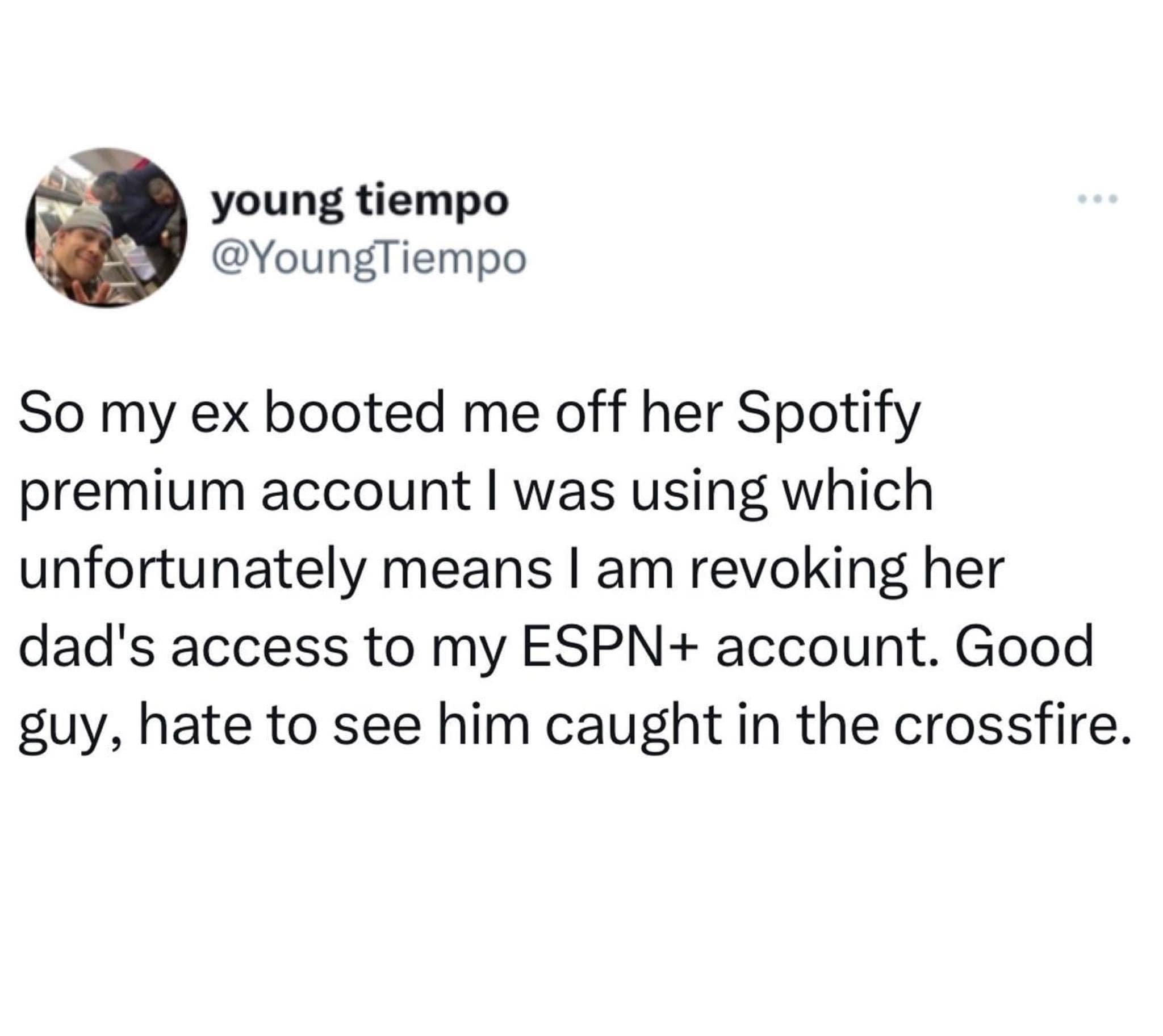
The image is a screenshot of a tweet from the user "youngtiempo" (@YoungTiempo). It features a profile picture of a person with short hair, and a relatively plain background. The tweet text is the primary focus. The overall visual impact is a casual, immediate style characteristic of social media posts.
Foucauldian Genealogical Discourse Analysis
This tweet is fascinating through a Foucauldian lens. We can see a discourse of reciprocal punishment and power dynamics unfolding. The initial act (being removed from Spotify) is not simply a rejection, but an instantiation of power. The response isn't a rational argument or grief, but a counter-exercise of power – revoking access to ESPN+.
Genealogy: This act of “tit for tat” can be traced historically to concepts of retribution and reciprocity*. It reveals how the idea of "fairness" is often constructed around equivalent acts of control. The idea of a “premium” account itself speaks to a historical development of commodified leisure and access.
Power/Knowledge: Access to Spotify and ESPN+ aren’t purely about entertainment. They signify status and access to culture*. The removal and revocation demonstrate a struggle over this access, revealing how power operates through control of these seemingly trivial spheres.
* Disciplinary Power: While not overtly disciplinary, there’s a subtle attempt to regulate behavior through controlling access to platforms. This is a micro-level enactment of broader systems of control. The claim of revoking access to the father's account can be seen as an attempt to involve the father and punish him through association.
Critical Theory
The tweet reflects a broader critique of the nature of relationships in late capitalism. It’s not about the services themselves (Spotify, ESPN+), but what they represent.
* Commodification of Relationships: The tweet highlights how relationships are increasingly mediated by and dependent on access to commodified services. The “break-up” isn’t a purely emotional event, but involves a disruption of access to these services.
Instrumental Rationality: The response—revoking access—is entirely instrumental*. It’s about achieving a specific outcome (punishment/control) rather than engaging in a more nuanced or empathetic response. The “good guy” comment is a self-serving justification of this pragmatic approach.
* Alienation: The cold, calculated nature of the response suggests a degree of emotional detachment and alienation, potentially stemming from a broader culture of individualism and consumption.
Marxist Conflict Theory
While seemingly trivial, the situation touches upon underlying power imbalances.
Resource Control: Access to streaming services can be seen as a form of cultural capital*. The tweet demonstrates a conflict over this capital, with each party attempting to deprive the other of access.
* Class Implications: Though not explicitly about economic class, access to subscription services often aligns with social class. The dispute over these services can be seen as a microcosm of broader struggles over resources and privilege.
* Competition: The "tit for tat" nature of the dispute suggests a competitive dynamic, where each party is attempting to assert dominance and control.
Postmodernism
The tweet exhibits several characteristics of postmodern thought.
Simulacra and Simulation: The conflict isn't about the intrinsic value of Spotify or ESPN+, but about the symbols* they represent—status, access, control. It's a struggle over representations rather than realities.
* Fragmentation and Disconnection: The tweet lacks emotional depth and presents a fragmented, disjointed interaction. The quick-fire response reflects a culture of instant gratification and superficial connection.
* Loss of Grand Narratives: There’s no appeal to broader values or principles. The conflict is purely pragmatic and self-serving, suggesting a rejection of overarching narratives or ideologies.
Queer Feminist Intersectional Analysis
While the tweet doesn’t explicitly reference gender, sexuality, or other aspects of identity, it is possible to analyze it through an intersectional lens, albeit more speculatively. The nature of the conflict, framed as a power struggle over resources, potentially plays into broader patterns of gendered dynamics. The individual expressing the situation could be reclaiming power by taking control of access, potentially resisting traditional power structures. However, more context would be needed to confirm this.
Let me know if you would like me to elaborate on any of these points or explore a different angle!
simple-description (llama3.2-vision)
The meme is a screenshot of a Twitter post from a user named "young tiempo" (formerly "young tiempo"). The user is complaining about their ex-girlfriend's decision to "revoke" their access to her Netflix account, specifically her Spotify Premium account, which is also linked to her Netflix account. The user is jokingly saying that their ex-girlfriend's decision to "revoke" their access to her Netflix account is like being "re-vomited" or "re-jected" from her life.
tesseract-ocr
» young tiempo @YoungTiempo So my ex booted me off her Spotify premium account | was using which unfortunately means | am revoking her dad's access to my ESPN+ account. Good suy, hate to see him caught in the crossfire.