First Seen
2023-11-10T07:38:41+00:00
simple-description (llama3.2-vision_11b)
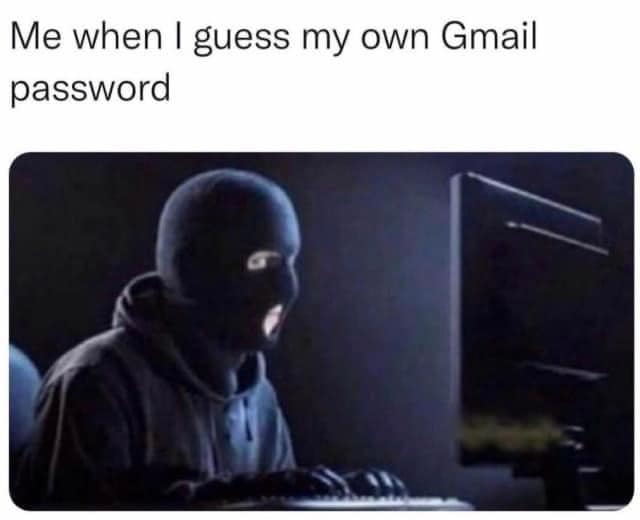
The meme is a humorous representation of the frustration and anxiety that comes with trying to guess a password, especially a complex one. The image depicts a person sitting in front of a computer, looking worried and stressed, with the caption "Me when I try to guess my own password". This meme is relatable to the category of Millenialism, which often pokes fun at the struggles and quirks of the Millennial generation, in this case, the struggle of trying to remember a complex password.
detailed-analysis (gemma3-27b-vision)
Okay, here’s an analysis of the image/meme, broken down into the requested sections. Please note that not every theoretical framework will naturally apply, and I'll explain where that is.
Visual Description
The image shows a person seated in front of a computer screen, silhouetted in darkness. The person is wearing a black balaclava or ski mask that obscures most of their face, leaving only the eyes visible. The room appears to be dimly lit, and the scene has a clandestine or suspicious atmosphere. The lighting is dramatic, creating strong contrasts between light and shadow. The image's caption reads "Me when I guess my own Gmail password". This immediately establishes a humorous irony – an everyday act of forgetting and regaining access is presented as something requiring secrecy and perhaps even criminal intent.
---
Foucauldian Genealogical Discourse Analysis
This image lends itself well to a Foucauldian analysis, particularly through the concept of panopticism and biopower.
Panopticism: The image evokes the feeling of being watched, even though we don't know who* is watching. The darkness and obscured face create a sense of surveillance. The person is 'self-monitoring' in a way, attempting to access something they have control over (their email), but the act is performed as though it were illicit. This reflects the pervasive feeling of being under constant observation in the digital age. Our data is being tracked, collected, and analyzed, and even when we're simply accessing our own information, we are participating in this system.
Biopower: The password itself functions as a point of control over digital identity. Passwords are integral to the way we’re ‘governed’ within online systems. Access to Gmail is not just access to email, but access to data, communication, and potentially vital services. The act of trying to guess a forgotten password highlights the power structures that govern our digital lives. We are defined* by our data, and our access to that data is controlled by these passwords.
The image isn't showing a literal instance of surveillance, but it represents the feeling of being constantly monitored and controlled within the digital realm.
---
Critical Theory
The meme can be read through the lens of Critical Theory, particularly in relation to the culture industry and the alienation of the self.
* The Culture Industry: The meme itself is a product of the 'culture industry', a mass-produced form of entertainment designed to create conformity and distract from underlying social issues. While humorous, it normalizes the everyday anxieties of digital life and the constant need to manage online identities.
Alienation: The image evokes a sense of alienation from one's own identity. The person is attempting to access something they should* know – their own password. The obscuring mask symbolizes a detachment from the self, a feeling of being disconnected from one's own digital identity. The act of forgetting the password and resorting to guesswork can be seen as a symptom of the increasing fragmentation of the self in the digital age.
---
Marxist Conflict Theory
While present, this theory is a bit of a stretch for the content of the meme.
* Power Dynamics: A very tenuous Marxist reading might see the password as a form of digital property, controlling access to information and communication. Those with the “correct” password (the “bourgeoisie” in this case) have access, while those without (the “proletariat”) are excluded. However, this is a weak application, as the problem is more individual forgetfulness than systemic class conflict.
---
Postmodernism
This meme resonates strongly with several postmodern concepts.
Simulacra and Simulation: The image is a simulation of a criminal act. The person is engaging in a harmless activity (trying to access their email) but presenting* it as something more sinister. This blurring of reality and representation is a core tenet of postmodernism. The act of trying to regain access to the account could be considered a form of 'hyperreality' – the inability to distinguish between reality and its simulation.
* Deconstruction of Identity: The mask obscures the face, fragmenting the subject's identity. The internet encourages the construction of multiple online personas, and this image reflects the fluidity and instability of identity in the digital age.
* Irony and Parody: The meme’s humor stems from the ironic juxtaposition of a mundane task and a dramatic presentation. This playful irony is a hallmark of postmodern culture.
---
Queer Feminist Intersectional Analysis
This framework is a limited fit, but it’s possible to draw some connections.
* Digital Surveillance & Vulnerability: For marginalized communities, the potential for digital surveillance and doxxing is particularly acute. The anonymity implied by the mask could be interpreted as a response to the risks of online harassment and abuse. However, this is a subtle connection.
* Reclaiming Agency: There's a tiny possibility to see the image as a reclaiming of agency – the individual is taking control of their digital identity, even if it involves a slightly mischievous act. But this reading is far-fetched.
In conclusion: The meme, though seemingly simple, allows for a fairly complex analysis through the lenses of Foucauldian discourse, Critical Theory, and especially Postmodernism. It highlights anxieties around surveillance, identity, and the blurring of reality in the digital age. It’s a bit of a stretch to apply Marxist or Queer Feminist frameworks, but those are possibilities as well.
simple-description (llama3.2-vision)
This meme is a humorous take on the frustration of trying to guess one's own email password. The image depicts a person sitting in front of a computer, struggling to recall their password. The text above the image reads, "Me when I guess my own Gmail password".
tesseract-ocr
Me when | guess my own Gmail password A a ra | ‘ J > >)