First Seen
2023-10-13T05:58:07+00:00
simple-description (llama3.2-vision_11b)
The meme is a humorous commentary on the concept of Millenihilism, which is a philosophical idea that argues that the future of humanity will be a dystopian, nihilistic, and hopeless place. The meme is a visual representation of this idea, with a picture of a futuristic cityscape with a massive, sprawling metropolis with a dark and ominous tone. The text above the image reads "I'm not saying the future of humanity will be a dystopian, nihilistic, hopeless place... but I'm not saying that either."
The image is likely a reference to a popular internet meme or joke, and the text is a play on the idea that the future of humanity will be a dystopian, nihilistic, and hopeless place, but the speaker is also saying that they are not saying that either, implying that the future of humanity will be a dystopian, nihilistic, and hopeless place.
detailed-analysis (gemma3-27b-vision)
Okay, let's analyze this meme-like image through the lens of the requested theoretical frameworks. It's a layered image communicating a feeling of being stuck in a weird transitional moment, so there's quite a bit to unpack.
1. Visual Description
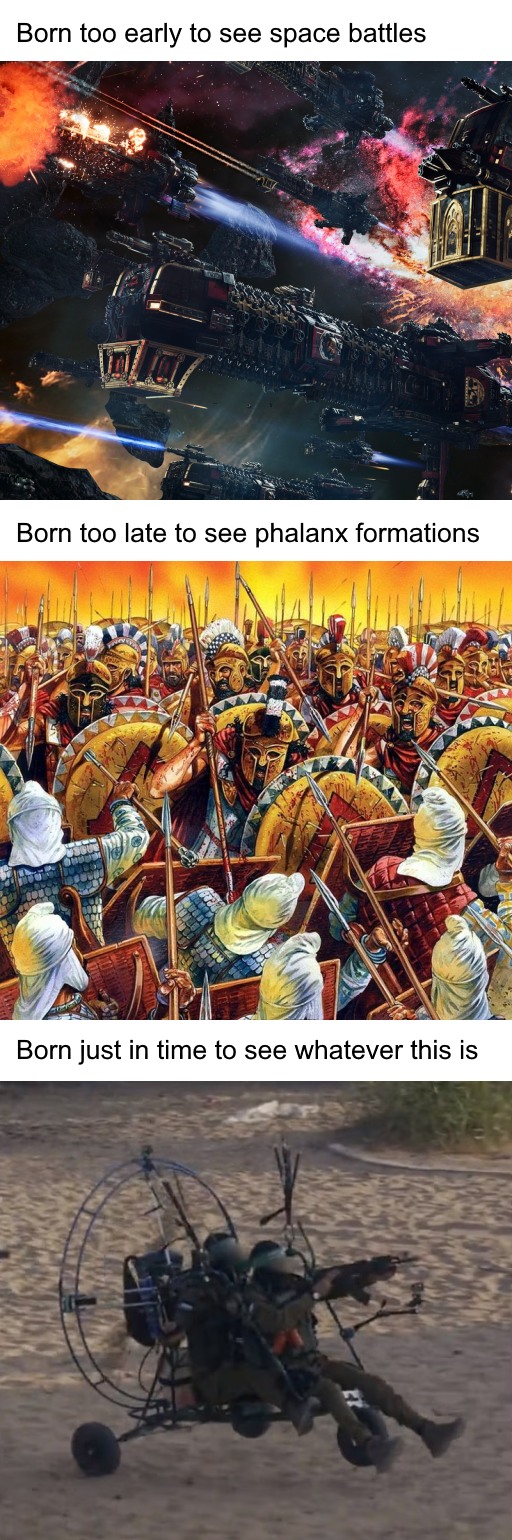
The image is composed of three distinct panels arranged vertically.
* Top Panel: A depiction of a futuristic space battle. Large, vaguely Star Wars-esque capital ships are engaged in combat, with energy weapons and explosions visible against a backdrop of stars and nebula. The imagery is reminiscent of science fiction illustrations from the 20th/21st century.
* Middle Panel: A vividly painted scene of a classical phalanx formation in ancient warfare. Soldiers are densely packed together, forming a shield wall, with spears and swords raised in attack. The aesthetic is classical painting, likely inspired by depictions of Greek or Macedonian armies.
* Bottom Panel: A black and white image of a modern, experimental, or uniquely designed vehicle. It resembles a self-balancing mobility device or a prototype for a personal transport system. The function isn't immediately clear, appearing somewhat awkward and unfinished.
The text layered over each panel reads, “Born too early to see space battles,” “Born too late to see phalanx formations,” and “Born just in time to see whatever this is.” The juxtaposition is the central comedic/philosophical element.
2. Foucauldian Genealogical Discourse Analysis
This meme can be viewed through Foucault's lens as a commentary on the shifting discourses surrounding history, technology, and power.
Discontinuities: The image highlights the radical discontinuities* between historical periods and their associated modes of warfare/technology. The phalanx represents a specific, localized form of power relying on close-order formation and individual strength. Space battles represent a decentralized, technologically mediated power, distanced from physical confrontation. This “whatever this is” vehicle suggests a potential disruption of traditional power structures, and a new type of mobility and societal organization.
Genealogy: A genealogical approach would trace the historical development of these formations. How did the phalanx emerge from prior forms of combat? How did the technological advancements leading to space warfare arise? The "whatever this is" device then represents a break from established lines of technological evolution. This is not merely progress*, but a series of ruptures and reconfigurations.
Power/Knowledge: The meme implicitly critiques the notion of a linear progression of "progress." Each panel represents a particular regime of truth* – a way of understanding warfare, power, and technological potential. The feeling of being “stuck” between these regimes suggests the limitations of each, and the impossibility of achieving a perfect or unified understanding.
3. Critical Theory (Frankfurt School)
The image resonates with themes central to Critical Theory.
Alienation: The experience of being "too early" or "too late" for certain historical moments speaks to a sense of alienation* from the past and the future. The individual is disconnected from both the solidity of traditional forms and the potential of technological advancement. They are adrift in a moment of transition.
Commodification of Time & Experience: The meme can be seen as a cynical commentary on the way time itself is commodified* in contemporary culture. The desire for authentic historical experiences (seeing a phalanx formation, witnessing a space battle) is framed as a consumer desire, unattainable and ultimately unsatisfying.
Culture Industry: The meme-format itself is a product of the culture industry,* a readily consumed and often superficial form of expression. The image satirizes the desire for "epic" experiences that are often manufactured or mediated through entertainment.
4. Marxist Conflict Theory
From a Marxist perspective, the image can be interpreted as highlighting shifts in modes of production and resulting conflicts.
* Technological Determinism: The progression from phalanx to space battle reflects a shift from physical labor and limited technology to advanced technology and increasingly complex systems of production. Each mode of warfare represents a different level of material advancement and control over the means of production.
* Class Conflict: The phalanx formation relies on a relatively egalitarian (albeit disciplined) army of citizens. Space battles, conversely, require a highly specialized, technologically advanced military-industrial complex. This implies a shift towards a more stratified society where power is concentrated in the hands of those who control technology and resources.
* "Whatever This Is" as a Symbol of Technological Unemployment/Surplus Population: The weird vehicle could also represent the consequences of automation and technological unemployment. A society that has advanced beyond the need for traditional labor may create a "surplus population," exemplified by the awkwardness and lack of clear purpose of the vehicle.
5. Postmodernism
The meme is a postmodern artifact.
Pastiche & Intertextuality: The image deliberately mixes elements from vastly different historical periods and cultural contexts. It's a pastiche – a playful combination of styles and eras. This creates a sense of intertextuality*—each panel references other cultural texts (historical paintings, science fiction films).
Fragmentation & Loss of Grand Narratives: The image actively rejects any notion of a linear, progressive history. It underscores the fragmentation of experience and the loss of grand narratives*—the idea that history has a coherent direction or purpose.
Irony & Self-Referentiality: The meme is inherently ironic—it makes a humorous commentary on the impossibility of truly connecting with the past or the future. It's also self-referential*—it acknowledges its own status as a mediated, constructed image.
6. Queer Feminist Intersectional Analysis
This is the most challenging lens to apply, but some interesting points can be made.
Deconstructing Historical Masculinity: The phalanx formation, historically composed of male soldiers, embodies a specific form of masculinity* centered on strength, discipline, and collective action. The image subtly deconstructs this by placing it in juxtaposition with futuristic, potentially non-gendered forms of technology.
Marginalization & Temporal Displacement: The feeling of being "out of time" can be seen as a metaphor for the experience of marginalization*—the feeling of being excluded from dominant historical narratives or social structures. The meme resonates with the experiences of those whose voices and stories have been historically silenced.
Reimagining "Progress": Intersectional feminism is critical of the notion of "progress" when it perpetuates existing power imbalances or excludes marginalized groups. The meme challenges us to consider who* benefits from technological advancements and what is lost in the process.
Let me know if you'd like me to elaborate on any of these points or explore other theoretical frameworks.
simple-description (llama3.2-vision)
This meme is a humorous comparison between the experiences of a person born in the 21st century and those of ancient civilizations. The image is divided into four panels, each featuring a different scene: a space battle, a historical battle, a futuristic vehicle, and a person in a medieval-style battle. The text above each panel reads: "Born too early to see [insert experience], born too late to see [insert experience], born too early to see [insert experience], born just in time to see [insert experience]."
tesseract-ocr
Born too early to see space battles ine a eo = ~~ Pe bos ¥ ie ee UE 15:5 “el aa ‘SS: 7 (ail, : : ee Ae eet iS = Pe = Born too late to see phalanx formations Ps Pea | He So NL Nt | Hi Lut] Po pede cp hae sae ig ee aa pe BS ai E pia FA a Wes >. Y re rai ATR sgl ae en ai en. te sia NT Ji a iS ail Ae \ XM =] by) [| On IPSs dae Pr tka WN ee e ee \ Pee aie. i ES a ik ; <1) MAN OS ea Fr “ree “en ea \4i Ss gee mes n XK = oe 9 @ "eS ad: SINS ' ¢ Bae 7- Row |» | 4 aver ms 7 SS Yy, “Wi Pes, Y —) Pele 7 Las D I A, TM ME Born just in time to see whatever this is ees = FE 2. SS ———s—. | == es Sh =: = a