First Seen
2023-10-02T03:11:13+00:00
simple-description (llama3.2-vision_11b)
This meme is a commentary on the perceived sense of entitlement and nostalgia among millennials. The image shows a screenshot of a tweet that reads: "i can literally hear the sound of the world burning for the 12th time this year." The tweet is likely a humorous exaggeration of the common millennial complaint about how often the world seems to be ending, with a tongue-in-cheek tone that pokes fun at the idea that millennials are constantly worried about the apocalypse.
detailed-analysis (gemma3-27b-vision)
Okay, here's an analysis of the tweet, broken down into sections based on the theoretical lenses you requested. I will only include sections for those lenses where the content readily lends itself to that analysis.
---
Visual Description
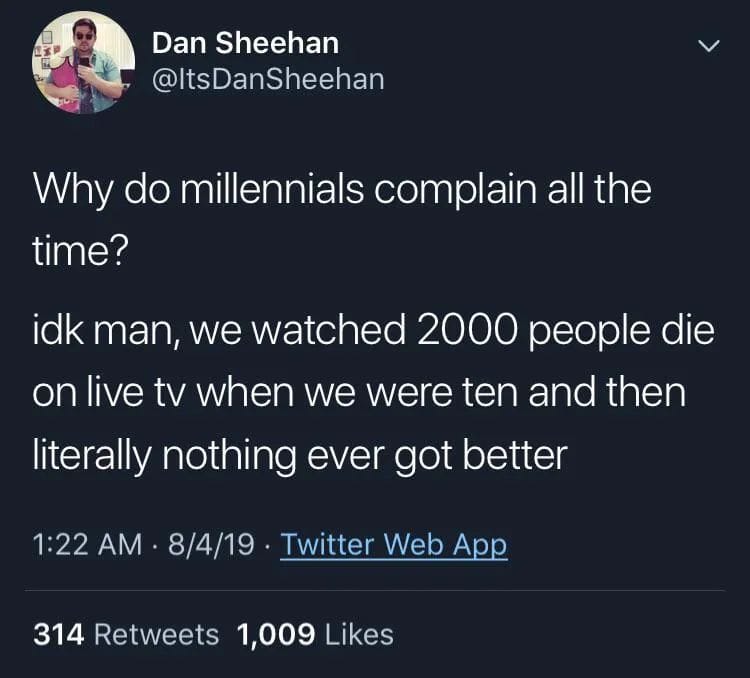
The image is a screenshot of a Twitter post. The profile picture shows a man with a patterned shirt and glasses. The text asks why millennials complain so much and follows up with the statement “idk man, we watched 2000 people die on live tv when we were ten and then literally nothing ever got better.” Below the tweet text, the timestamp (1:22 AM, 8/4/19), the platform it came from (Twitter Web App) and the interaction statistics (314 retweets, 1009 likes) are visible. The background is plain black, and the text is in white. It’s a minimalist, direct presentation of a concise opinion.
---
Foucauldian Genealogical Discourse Analysis
This tweet can be read through a Foucauldian lens to expose how the experience of witnessing 9/11 (implied by "2000 people die on live tv") has produced a particular discourse around millennial identity and complaint.
Power/Knowledge: The tweet suggests that the trauma of 9/11 (and the subsequent wars, security state expansion, and economic policies) has become a foundational truth for millennials. This truth is not objective, but a product of power relations. The media’s coverage of 9/11 (and how it was framed) constructed a narrative, and this narrative has shaped millennial understandings of the world. The feeling of continuous disappointment (“nothing ever got better”) is a discourse* generated by these power dynamics.
Genealogy: A genealogical approach would trace the historical conditions that led to the association between millennials and complaint. It's not just that millennials are complainers, but that the category* of “millennial complainer” was constructed through media representation, cultural narratives, and the socio-political climate. The trauma of witnessing 9/11, the subsequent economic downturns, and the broken promises of the "war on terror" have collectively contributed to the emergence of this category.
* Discipline/Surveillance: The framing of "complaining" itself becomes a way to discipline the millennial population. By characterizing their dissatisfaction as merely "complaining," it dismisses legitimate grievances and silences critique. The expectation to "move on" or "be positive" is a form of surveillance that enforces conformity and discourages resistance.
---
Critical Theory
The tweet embodies central themes of Critical Theory, particularly those relating to trauma, disillusionment, and the failure of progress.
* Ideology and False Consciousness: The tweet subtly suggests a critique of the dominant ideology that promises progress and improvement. The claim that “nothing ever got better” challenges the myth of linear historical advancement. It exposes the disconnect between the rhetoric of progress and the lived reality of millennials, who have experienced a series of crises.
Mass Culture and the Spectacle: The reference to watching the events of 9/11 on television points to the role of mass media in shaping perception and experience. The event wasn't just a tragedy; it was mediated* through the spectacle of television, turning tragedy into a form of entertainment or a constant presence in the background of everyday life. This constant exposure, combined with the lack of meaningful change, contributes to the disillusionment expressed in the tweet.
* Pathologies of Modernity: The tweet hints at the psychological and emotional toll of living in a modern, traumatized world. The inability to feel optimism or hope is not a personal failing but a symptom of larger societal problems. It suggests that the structures of modernity themselves are generating a sense of anomie and despair.
---
Marxist Conflict Theory
The tweet can be interpreted through the lens of Marxist conflict theory, highlighting the class-based contradictions that shaped the millennial experience.
* Alienation: The statement that “nothing ever got better” can be read as a profound expression of alienation. Millennials, having come of age in a period of economic precarity, stagnant wages, and increasing inequality, may feel disconnected from the systems that govern their lives. They may experience a sense of powerlessness and lack of agency, leading to frustration and disillusionment.
* Class Struggle: The events of 9/11 and the subsequent "war on terror" had significant economic consequences, often disproportionately impacting working-class and marginalized communities. The tweet implicitly highlights the ways in which the burdens of these crises were unevenly distributed, while the benefits accrued to a small elite.
* False Consciousness: There's a subtle implication that the promise of the "American Dream" has failed millennials. The statement suggests that the prevailing narrative of progress and opportunity is a form of ideological control that masks the underlying structural inequalities.
---
Postmodernism
The tweet resonates with postmodern themes of skepticism, fragmentation, and the rejection of grand narratives.
* Rejection of Metanarratives: The claim that "nothing ever got better" directly challenges the idea of historical progress—a central tenet of Enlightenment thought and a cornerstone of many modern ideologies. It suggests that there is no overarching narrative that can explain or justify the millennial experience.
* Fragmentation and Loss of Meaning: The tweet implies a sense of disillusionment and loss of faith in traditional institutions and values. The inability to find meaning or hope in the world is a hallmark of postmodern subjectivity.
* Hyperreality: The act of watching 9/11 on television can be interpreted as an example of hyperreality—a condition in which the representation of reality becomes more real than reality itself. The mediated experience of tragedy blurs the boundaries between the real and the simulated, creating a sense of detachment and alienation.
---
I hope this detailed analysis is helpful! Let me know if you would like me to expand on any of these sections or explore different theoretical frameworks.
simple-description (llama3.2-vision)
The meme is a sarcastic commentary on the common perception that younger generations are more entitled and complaining. The text reads: "Why do millennials complain all the time? I don't know, I think it's because we're all just trying to survive the apocalypse."
tesseract-ocr
Dan Sheehan 7 os UL B-TatS alto ar-1a Why do millennials complain all the time? idk man, we watched 2000 people die on live tv when we were ten and then literally nothing ever got better 1:22 AM - 8/4/19 - Twitter Web App 314 Retweets 1,009 Likes