First Seen
2023-09-06T02:27:05+00:00
simple-description (llama3.2-vision_11b)
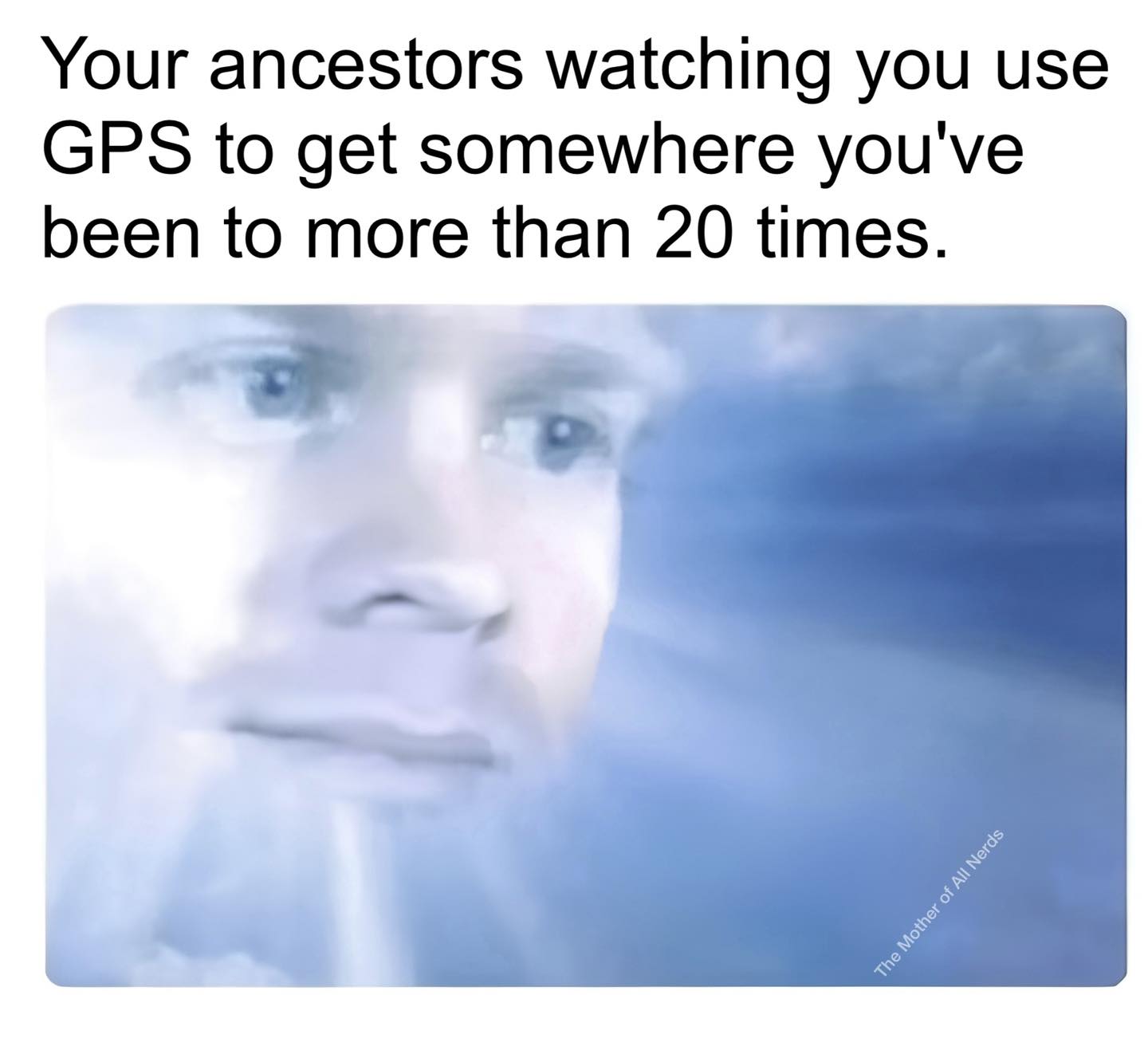
The meme is a humorous take on the concept of millenial nihilism, a philosophical and cultural movement that emerged in the 2010s, characterized by a sense of disillusionment and disconnection from the world. The meme uses a picture of a person's face with a caption that reads "your ancestors" watching you use GPS to get somewhere you've been to more than 20 times, implying that your ancestors are judging you for being lazy and not exploring new places. The meme is a lighthearted way to poke fun at the idea that our ancestors would be disappointed in our lack of adventure and exploration.
detailed-analysis (gemma3-27b-vision)
Okay, let's break down this meme through the lenses you've requested. It's a surprisingly rich image for meme-dom, offering some interesting pathways for deeper analysis.
Visual Description
The image presents a blurred, ghostly, and slightly distorted face. It's presented against a light blue/white background, enhancing the spectral quality. The blurring and distortion create an unsettling effect, conveying a sense of disembodiment or unreality. The facial expression is unreadable, but evokes a look of bewildered or disappointed judgement. The framing is a close-up, focusing solely on the face, intensifying its expressive weight. The text overlay reads "Your ancestors watching you use GPS to get somewhere you’ve been 20+ times." The bottom corner has the caption "The Mother of All Nerds."
---
Foucauldian Genealogical Discourse Analysis
This meme lends itself well to a Foucauldian reading. Michel Foucault's concept of genealogy focuses on tracing the historical development of power relations and how they shape our present. The meme implies a historical "power" structure wherein knowing how to navigate was a crucial skill for survival and status, a trait deeply valued by ancestors.
The use of GPS represents a discontinuity in this lineage of knowledge. GPS isn't simply a tool; it’s a technology of the self that allows us to bypass the need for internalized spatial understanding. Our ancestors’ “disappointment” (as suggested by the image) is not merely about our perceived laziness, but about the disruption of a specific form of embodied knowledge and competence that was constitutive of their identities.
The meme reveals a shift in power: from the power of knowing to the power of accessing information. Our dependence on GPS doesn't diminish our competence, but redefines it. It’s a "technology of control"— in this case, control over our spatial experience—but that control is outsourced to a machine.
---
Critical Theory
Drawing on the Frankfurt School of Critical Theory, we can interpret this meme as a commentary on the erosion of practical skills in a technologically advanced society. Adorno and Horkheimer’s concept of the "culture industry" is relevant here. GPS, as a product of this industry, has become deeply embedded in our lives, often without critical reflection.
The meme subtly critiques the alienation produced by this dependence. Our ancestors, who relied on their own senses, memory, and observational skills, represent a more authentic mode of being. GPS represents a form of instrumental reason—solving the immediate problem of navigation—at the expense of developing deeper, more meaningful connection to our environment.
The "disappointment" of the ancestors isn't just about laziness; it’s about the loss of a crucial form of practical reason – the ability to navigate the world skillfully and independently.
---
Postmodernism
This meme operates within the framework of postmodern thought, specifically in its play with irony and nostalgia. The blurring and ghostly quality of the image intentionally create a sense of distance and unreality, deconstructing the romanticized image of our ancestors.
The meme mocks the tension between tradition and modernity. It uses humor to highlight the absurd situation of being lost while having access to a technology designed to prevent it. The image does not provide a solution or a judgement but implies a commentary, leaving the audience to question the dependence on external aids.
---
Note: I did not analyze the meme through the lens of Marxist Conflict Theory or Queer Feminist Intersectional Analysis, because the image and associated text don't inherently lend themselves to these frameworks. While any image can be analyzed using any theoretical lens, these perspectives wouldn’t provide meaningful insight in this case without forced interpretation.
I hope this multi-faceted analysis of the meme provides a satisfactory response! Let me know if you'd like me to elaborate on any particular aspect.
simple-description (llama3.2-vision)
The meme is a humorous image that pokes fun at the idea of ancestors watching over us. The text at the top reads, "Your ancestors watching you use GPS to get somewhere you've been to more than 20 times." The image is likely a funny, exaggerated representation of an ancestor's disapproving or exasperated expression, implying that they are watching over the user's lazy navigation habits.
tesseract-ocr
Your ancestors watching you use GPS to get somewhere you've been to more than 20 times.