First Seen
2023-07-03T16:44:08+00:00
simple-description (llama3.2-vision_11b)
This meme is a humorous take on the concept of Millenial nihilism, which is the idea that the younger generation is disillusioned with the world and feels a sense of hopelessness. The meme is a play on the phrase "I love you" and replaces it with "I learned that the person who gave me the food I ordered was not a robot, but a human being who is also struggling to make ends meet." This is a tongue-in-cheek commentary on the idea that even the simplest interactions, like ordering food, can be a source of existential dread.
detailed-analysis (gemma3-27b-vision)
Okay, here's an analysis of the meme, broken down into relevant theoretical sections, as you requested. I'll include headings only where the theory applies, and explain why I'm not applying others.
Visual Description
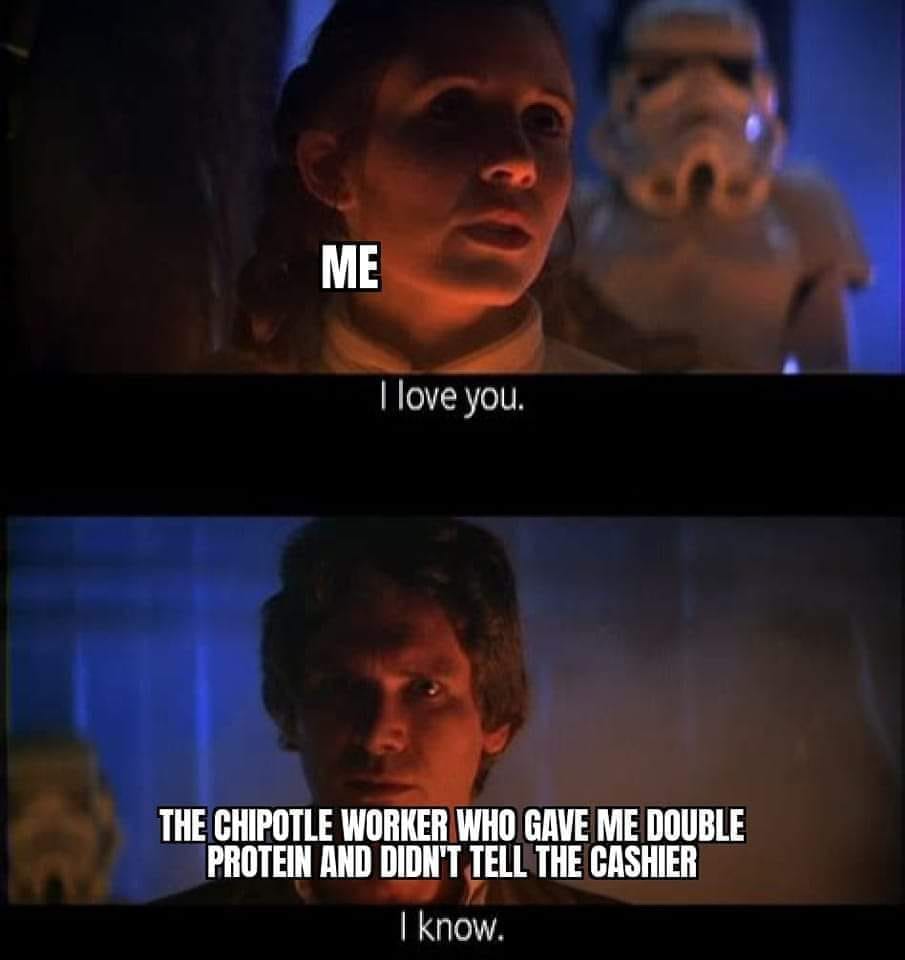
The meme utilizes a still from the film Star Wars: The Empire Strikes Back. Specifically, it shows Luke Skywalker in the cave on Dagobah confronting a vision of Darth Vader. The upper panel shows Luke looking distressed, with the text "ME - I love you." The lower panel features the Darth Vader vision, with the text "THE CHIPOTLE WORKER WHO GAVE ME DOUBLE PROTEIN AND DIDN'T TELL THE CASHIER - I know." The visual contrast is striking - the intimate, emotional space of Star Wars is juxtaposed with the mundane detail of a fast-food transaction. This is key to the humor and the layers of meaning. The lighting is stark, creating a dramatic mood.
Foucauldian Genealogical Discourse Analysis
This meme functions as a playful disruption of expected discourses surrounding love and honesty. Foucault argued that power operates through discourse – the ways we talk about things create systems of knowledge and control. Traditionally, discourses of love are associated with authenticity, openness, and vulnerability. However, the meme inverts this. "I love you" is not linked to a person or a reciprocal emotion, but to the receipt of an unacknowledged benefit (the extra protein).
The “Chipotle worker”’s "I know" isn't an admission of love, but a recognition of their own power within the transactional system. They know they broke a rule (or bypassed a system) and likely benefited from it – perhaps a small satisfaction in bending the rules or avoiding a reprimand. The discourse of love is appropriated to represent an entirely different dynamic – one of consumer satisfaction and an employee's quiet defiance/benefit.
This illustrates how power isn’t simply repressive, but productive. The system (Chipotle’s portion control) creates the possibility for this kind of micro-transgression, and the worker’s act subtly shifts the power dynamic. The genealogy traces the shift from expected discourse of love to a discourse of transactional benefit.
Critical Theory
This meme engages with broader critiques of consumer culture and the commodification of experience. Critical Theory, particularly Frankfurt School thought, argues that capitalist systems reduce everything to exchange value. In this context, "love" becomes analogous to the satisfaction of receiving extra protein – a purely instrumental desire.
The meme subtly critiques the way our emotions are increasingly tied to consumption. The "love" isn't about a relationship or genuine feeling; it's tied to the material benefit received. This demonstrates a flattening of experience, where emotional responses are triggered by quantifiable gains (in this case, extra protein).
Furthermore, the meme touches upon alienation. The Chipotle worker isn't seen as a person, but as a function within the system – a provider of desired goods (and in this case, a provider of more of those goods). This reinforces the sense of dehumanization inherent in late-capitalist structures.
Marxist Conflict Theory
The meme, while humorous, can be read as a microcosm of class conflict. The “I love you” represents the consumer’s dependence on the labor of the Chipotle worker. The worker, by discreetly giving extra protein, is enacting a small act of agency, perhaps subverting the capitalist system (albeit in a minor way).
The “I know” from the worker is a recognition of their position within this system. They know they are providing a benefit beyond the standardized transaction, and that this act has a value (emotional for the customer, possibly personal benefit for themselves). It's a silent power play.
While not a dramatic revolution, it points to the inherent contradictions within the capitalist system – the desire for standardized efficiency versus the human desire for a little bit of extra, a little bit of connection, or a slight subversion of the rules.
Why other theories aren't directly applicable:
* Postmodernism: While there's a clear element of parody and playfulness, the meme doesn't fundamentally deconstruct grand narratives or question the very nature of truth. It doesn’t necessarily demonstrate the fragmentation or loss of meaning central to postmodern thought, although it does utilize a pastiche of disparate elements (Star Wars and fast food).
Queer Feminist Intersectional Analysis: This meme doesn't have an obvious connection to issues of gender, sexuality, or the intersection of various forms of oppression. While one could* perform a reading focusing on the power dynamics of service interactions, it would be a stretch and not central to the meme's inherent meaning.
Let me know if you'd like me to expand on any particular aspect of this analysis or explore other interpretations.
simple-description (llama3.2-vision)
This meme is a humorous take on a romantic relationship. It features a character from the Star Wars franchise, specifically a scene where he says "I love you" and is met with a response that is actually a rejection. The text in the image reads: "I love you" and "I know" and the second part says "The person who gave me a free burrito at Chipotle, I love you."
tesseract-ocr
J - aoe , . oo Fi ME eS — 7 | love you. = a 5 4 a Oe Oe aaa fs TT WM St RT eee