First Seen
2023-05-10T21:03:36+00:00
simple-description (llama3.2-vision_11b)
The meme is a humorous commentary on the nostalgia for outdated technology and aesthetics of the 1980s and 1990s, specifically the rise of the "millennial" generation's fascination with retro culture. The image shows a person sitting on a couch, wearing a pair of 80s-style sweatpants and a denim jacket, with a caption that reads "your grandma just saw this couch in 1987 and said 'I HAVE SEEN BETTER'".
detailed-analysis (gemma3-27b-vision)
Okay, let's break down this image of the couch through various theoretical lenses.
1. Visual Description
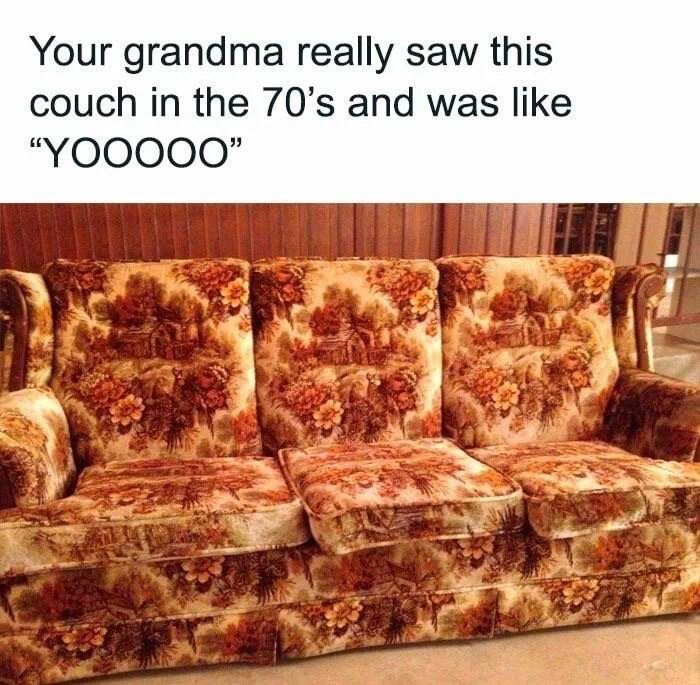
The image depicts a four-seater couch, strongly evocative of late 1960s or 1970s interior design. The couch is upholstered in a patterned, floral fabric – a blend of autumnal browns, oranges, and creams. The pattern is quite busy and large-scale, and the fabric appears to be a textured, potentially velvet or velour. The couch has high, rounded backs and somewhat generously proportioned arms. The overall aesthetic is one of formality and a certain level of mid-century/early 70s "traditional" taste, leaning heavily into the warm color palette popular during that era. It appears to be in relatively good condition, suggesting it might be an antique or a well-preserved vintage piece.
2. Foucauldian Genealogical Discourse Analysis
We can trace the discourse around this couch through Foucault’s lens. The couch doesn't exist in isolation; it’s embedded in a historical network of power/knowledge.
Discipline & Normalization: This couch represents a particular normalization* of domestic space in the mid-20th century. It's designed to promote a specific kind of social behavior (formal seating, 'good' posture, family gatherings in a specific configuration). It is a symbol of "good taste" within a certain socioeconomic class and period. Deviating from the style would mark one as outside of accepted social norms.
Genealogy of "Comfort": We can trace the genealogy of “comfort” as it relates to furniture. This couch suggests a "comfort" that is defined* by formality and display, rather than a more relaxed, individualized comfort. The high backs and structured form create a distance between individuals even while they're sitting together.
* Power Relations: The couch represents a subtle form of power in the domestic sphere. It asserts a particular aesthetic and lifestyle preference and reinforces social expectations. The family member who chose this couch held a degree of power within the household.
3. Critical Theory
This couch invites a Critical Theory analysis through the lens of the culture industry.
* Commodification of Taste: The couch represents the commodification of taste. It’s not simply a functional object; it's a symbol of status and belonging, marketed to a specific consumer base.
Repressive Desublimation: The couch and its aesthetic can be seen as a form of “repressive desublimation,” as described by Herbert Marcuse. While it appears* to offer comfort and pleasure, it does so within the constraints of societal norms and expectations.
* False Consciousness: Buying into this aesthetic (and displaying it in one's home) might perpetuate a “false consciousness” – a belief that this is what constitutes a comfortable and desirable life, obscuring other possibilities.
4. Marxist Conflict Theory
From a Marxist perspective, the couch speaks to class relations and material conditions.
* Signifier of Class: The couch, especially in its time, was likely a significant financial investment for many households. It served as a visible signifier of middle or upper-middle-class status.
* Means of Production: The manufacturing of this couch involved a complex system of labor and materials. The comfort enjoyed by the owners is built upon the often-unseen labor of the workers who produced it.
* Ideological Function: The couch can be seen as reinforcing the dominant ideology of domesticity and consumerism, promoting the idea that happiness is achieved through the acquisition of material possessions.
5. Postmodernism
In a postmodern reading, the couch could be seen as an example of pastiche or irony.
Nostalgia and Simulation: The image evokes a strong sense of nostalgia for a particular era. The couch is a simulation* of a past aesthetic.
* Death of Grand Narratives: The "YOOOOO" response suggests a rejection of the values and aesthetics associated with this couch, a disavowal of the "grand narrative" of traditional domesticity.
* Deconstruction of Taste: The couch, viewed through a postmodern lens, could be seen as challenging traditional notions of "good taste." Its very visual presence invites a questioning of what constitutes beauty or comfort.
Important Note: These are just interpretations. The specific meaning of the couch and its cultural significance will vary depending on the individual viewer and their own background and experiences.
simple-description (llama3.2-vision)
This meme is a humorous commentary on the outdated and retro aesthetic of a particular couch. The image shows a couch with a floral pattern and a style that was popular in the 1970s. The text above the image reads: "Your grandma really saw this couch in the 70s and was like 'YOOOOO'".
tesseract-ocr
Your grandma really saw this couch in the 70’s and was like “YOOOOO” _ Be Cae | | \ ee = 2) o a a Y Se = = ea “4 .