First Seen
2025-01-16T22:26:47.764830+00:00
detailed-analysis (gemma3_27b-it-q8_0)
Okay, let's break down this meme from the perspective of the "Meta" category, analyzing it through several theoretical lenses as you requested. Given the meme's core focus on the constructed nature of its premise, many of these lenses are quite relevant.
Visual Description
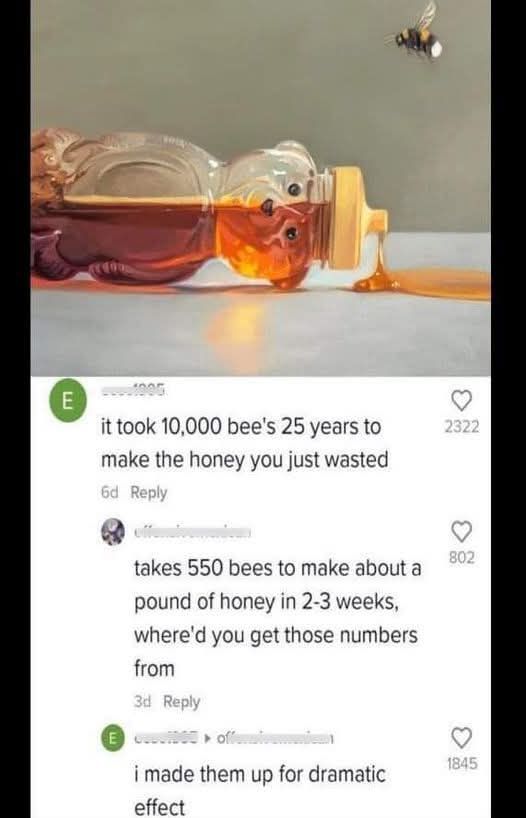
The image is a stock-photo style still life of a honey jar. Honey is spilling dramatically out of the jar, suggesting a careless or wasteful act. A single bee hovers near the jar, further emphasizing the effort and natural process involved in honey production. The lighting is warm and appealing, highlighting the golden color of the honey, yet there's a slightly unsettling aspect to the spillage. The composition overall aims to evoke a sense of preciousness and then subverts that with the imagery of waste.
Postmodernism
This meme is deeply rooted in postmodern concerns. The core joke relies on the reveal that the initial assertion about 25 years and 10,000 bees is entirely fabricated. This directly challenges the idea of objective truth. The first comment presents a "grand narrative" – a seemingly authoritative statement about honey production – only to have it immediately dismantled.
- Simulation and Simulacra: The initial comment creates a simulation of a "fact" about honey, a simulacrum, that has no basis in reality. The impact comes from the sudden awareness that it's not representing anything real.
- Deconstruction: The following comment deconstructs the initial statement, questioning its source and revealing its lack of grounding in reality.
- Irony & Playfulness: The meme uses irony and playful fabrication to highlight the arbitrary nature of meaning. The fact that the creator admits to making up the numbers for “dramatic effect” underscores this. Postmodernism embraces this kind of self-awareness and playful undermining of authority.
Foucauldian Genealogical Discourse Analysis
From a Foucauldian perspective, the meme exposes the power dynamics inherent in knowledge production and dissemination. The first comment attempts to exert power through the assertion of knowledge ("It took X bees Y years..."). It creates a discourse around honey production that implies a certain value or reverence for the effort involved.
- Power/Knowledge: This comment tries to establish a relationship between power and knowledge; by saying something is true, it attempts to make it feel authoritative.
- Genealogy: Examining the "genealogy" of this statement, we find it lacks a historical or empirical foundation. It's not derived from scientific study or traditional beekeeping knowledge. It's simply invented.
- Discursive Formation: The subsequent responses disrupt the discursive formation by questioning the source of the information, exposing its artificiality. The final comment reveals the power lies in the creation of the discourse, not in any external truth.
Critical Theory
The meme speaks to the ways in which narratives are constructed to elicit emotional responses and reinforce certain values. The initial statement seeks to induce guilt or shame in anyone who might "waste" honey.
- Ideology: The initial comment could be seen as propagating a certain ideology around the value of natural resources and the labor involved in their production. It subtly suggests that wasting honey is morally wrong because of the immense effort required to create it.
- False Consciousness: The reveal of the fabrication can be interpreted as a moment of breaking through "false consciousness" – recognizing that the emotional response was manipulated by an unfounded claim.
- Instrumental Reason: The second comment pushes back against this by demanding evidence, applying reason to deconstruct the emotive appeal.
Marxist Conflict Theory
While not central, a Marxist reading can be applied. The honey represents a product of labor (the bees, and by extension, the beekeeper). The initial comment frames the consumption of this product as a potential act of exploitation or disrespect towards that labor.
- Commodity Fetishism: The honey becomes a "fetishized" commodity, imbued with a symbolic weight far beyond its material value due to the constructed narrative of the bees' effort.
- Alienation: The meme hints at a potential alienation between the consumer and the production process. The dramatic, fabricated narrative attempts to force a recognition of the labor involved, but ultimately feels contrived.
Why "Meta" is the fitting Category
The meme's primary function isn’t to comment on bees, honey, or even environmentalism. It's a comment on comments. It’s a self-referential joke about the way people construct and present information online, and the ease with which narratives can be fabricated for emotional impact. It's about the act of making a claim and the subsequent interrogation of that claim. That focus on the structure of the interaction itself, the layers of commentary and revelation, is what places it squarely within the realm of "Meta."
Let me know if you'd like me to expand on any of these points, or analyze it from a different angle!
simple-description (llama3.2-vision_11b)
This meme is a screenshot of a Reddit comment, where a user responds to a post about the cost of a specific product, saying "I made them up for dramatic effect" in response to a claim that 10,000 bees would produce 10,000 pounds of honey in two years.
detailed-analysis (gemma3-27b-vision)
Okay, let's break down this image and the accompanying online exchange through the lenses you've requested. Note that some of these theoretical approaches are a stronger fit than others, and certain areas will be more interpretive than concrete.
1. Visual Description
The image displays a close-up of a small glass jar, presumably filled with honey. The honey is a rich amber color, appearing viscous and possibly including a few air bubbles. The jar is resting on a reddish-purple cloth or surface. A small wooden honey dipper (or spoon) is partially submerged in the honey, and a small yellow flower is to the upper right. The lighting is relatively soft, accentuating the color and texture of the honey. The overall aesthetic feels cozy and perhaps evokes ideas of natural sweetness or domesticity. The image is presented within a social media context (likely Instagram or a similar platform), as indicated by the likes/heart icons and comment threads below.
2. Foucauldian Genealogical Discourse Analysis
This image/comment thread offers a fascinating case study in how “truth” about something like honey production is constructed through discourse.
- Power/Knowledge: The initial comment ("it took 10,000 bees 25 years...") attempts to establish a regime of truth around the value of honey. It's not a statement about objective fact, but a claim that exerts a form of power by implying wasteful consumption on the part of the recipient of the honey. This power isn’t repressive, but productive - it creates a moral calculus about honey, assigning a high "cost" (in bee-years) and thereby influencing how the honey is viewed.
- Genealogy: The following comment challenges this claim, questioning the source of the numbers. It implicitly demands a genealogy of the knowledge—where did this claim originate? It pushes back against the arbitrary construction of value.
- Discursive Formation: The final response – "I made them up for dramatic effect" – reveals the whole construction as essentially arbitrary. It deconstructs the authority of the initial claim and exposes it as a performance, a deliberate manipulation of language to achieve an emotional impact. This destabilizes the “truth” about honey and highlights how meaning is created through social interaction, not inherent in the object itself.
3. Postmodernism
The exchange aligns strongly with many tenets of postmodernism.
- Rejection of Metanarratives: The initial comment gestures towards a kind of "grand narrative" about the sacredness of bee labor and the moral weight of consumption. However, the final response destroys this narrative, revealing it as a fabrication. This undermines any attempt to establish a universal, absolute truth about honey.
- Simulacra & Simulation: The made-up numbers operate as simulacra – copies without an original. The "truth" about honey becomes less important than the effect the numbers have. The image and comments contribute to a simulated reality where emotional impact outweighs objective accuracy.
- Deconstruction: The exchange is a miniature exercise in deconstruction. It challenges the very notion of a stable, objective meaning for an everyday object (honey) and demonstrates how meaning is fluid, contested, and constructed through language.
4. Critical Theory
From a critical theory perspective, the exchange touches on issues of value and labor.
- Commodification: Honey is a commodity, a product of labor (the bees' labor). The initial comment attempts to re-embed that commodity with a sense of inherent moral weight—to make us feel guilty about enjoying the product of that labor.
- Alienation: The attempt to quantify the bees’ efforts in “years” and assign that value to the honey creates a distance (alienation) between the consumer and the source of the product. It obscures the complex, ecological processes that produce the honey.
- Ideology: The initial comment can be seen as a form of ideology—a way of justifying a certain social order (perhaps a critique of consumerism, or an attempt to elevate the value of natural products). The exposure of the fabrication challenges that ideological claim.
Let me know if you'd like me to elaborate on any of these points, or explore other theoretical perspectives!
simple-description (llama3.2-vision)
This meme is a humorous response to a question about the amount of time it takes for bees to make honey. The image shows a bee flying towards a honey jar, and the text below it reads: "It took 10,000 bees 25 years to make the honey you just wasted." The response to this is a sarcastic comment: "I made them up for dramatic effect."