First Seen
2023-05-10T21:03:36+00:00
simple-description (llama3.2-vision_11b)
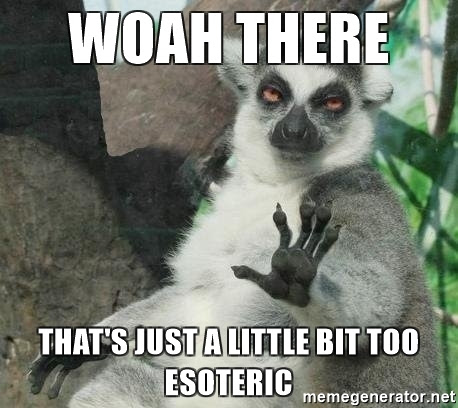
The meme is a humorous image of a monkey with a surprised expression, accompanied by the text "I can smell the desperation". The meme is likely poking fun at a situation where someone is trying too hard to impress or be liked, and the monkey's expression is meant to convey a sense of awkwardness or desperation.
detailed-analysis (gemma3-27b-vision)
Okay, let's break down this meme through the lenses you've requested.
Visual Description
The image is a close-up of a ring-tailed lemur. The lemur appears to be leaning back in a relaxed but intensely focused pose. Its eyes are wide and almost glowing red, giving it an unsettling, almost malevolent look. It's making a gesture with its hand, as if to say "Whoa there!" or to halt something. The background is blurred, suggesting a natural, forested environment. Superimposed text reads "Woah there" above the lemur and "That’s just a little bit too esoteric" below it. It is clearly a meme format adapted from the “distracted boyfriend” or similar stock photo meme.
Foucauldian Genealogical Discourse Analysis
This meme can be understood as a commentary on the discourse surrounding intellectual complexity. Foucault would focus on how the knowledge of what is considered "esoteric" is constructed and maintained.
- Power/Knowledge: The meme subtly reveals a power dynamic. The person (implied by the meme) who finds something “too esoteric” is asserting a norm of intellectual accessibility. They define what is acceptable knowledge and what is outside the acceptable boundaries. This is a form of power – defining what counts as “knowable” and “legitimate”.
- Discursive Formation: The very category of “esoteric” is not natural; it is formed through discourse – through the ways we talk about and categorize knowledge. This meme points to the anxieties surrounding specialized or complex knowledge.
- Genealogy: A genealogical approach would question how "esoteric" came to mean something undesirable or inaccessible. Tracing its historical roots might reveal how specific forms of knowledge were marginalized or controlled by institutions.
In short, the meme is not about esotericism itself, but about the ways we talk about and regulate access to knowledge.
Critical Theory
Applying a Critical Theory framework, particularly as influenced by the Frankfurt School, the meme can be seen as a commentary on the state of contemporary intellectual culture.
- Culture Industry: The meme itself is a product of the culture industry – quickly disseminated and consumed. It reflects a cultural moment where there's an impatience with, or even hostility towards, complex thought. This could be a result of the simplified, easily digestible content favored by mass media.
- Reason & Enlightenment: There’s a subtle critique of the Enlightenment project. While the Enlightenment championed reason and knowledge, this meme suggests that excessive intellectualism has become alienating or inaccessible to the majority.
- Alienation: The meme implies a sense of alienation from complex thought. The speaker (or implied audience) feels "left out" or intimidated by the "esoteric," creating a barrier to genuine understanding.
Postmodernism
This meme strongly aligns with Postmodern themes.
- Rejection of Grand Narratives: Postmodernism rejects the idea that there are universal truths or overarching explanations for everything. The meme implicitly questions the value of “esoteric” knowledge as if it is inaccessible or irrelevant to everyday life. It suggests that such knowledge doesn't necessarily hold any superior value.
- Deconstruction: The meme deconstructs the idea of intellectual authority. It playfully challenges the notion that complex thought is inherently valuable or impressive.
- Irony & Parody: The use of a lemur, an unexpected and somewhat comical image, adds a layer of irony. It’s a playful take on intellectual snobbery or the perceived pretentiousness of academic discourse.
- Simulacra and Simulation: The meme itself is a simulation of a reaction. It doesn't represent a genuine moment of intellectual discomfort, but rather a stylized and repeatable form of expression.
Queer Feminist Intersectional Analysis
While not the most obvious lens, an intersectional reading can offer some interesting insights.
- Accessibility & Exclusion: "Esoteric" knowledge is often gatekept by dominant (often white, male, Western) institutions and academic spaces. This meme can be seen as a critique of that exclusionary practice.
- Epistemic Violence: The dismissal of complex thought as "esoteric" can be a form of epistemic violence, silencing marginalized voices or knowledge systems that challenge dominant paradigms.
- Intersectional Experiences: The feeling of being excluded from "esoteric" knowledge can be particularly acute for individuals from marginalized groups who may already face barriers to accessing education and intellectual spaces.
- Challenging Elitism: The meme's playful tone can be read as a resistance to intellectual elitism, which often reinforces existing power imbalances.
In conclusion, this seemingly simple meme is quite rich in potential interpretations. It is an excellent example of how everyday cultural artifacts can reflect deeper social, political, and philosophical concerns.
simple-description (llama3.2-vision)
This meme features a picture of a lemur with a puzzled expression. The text overlay reads "WOW" and "WOW" in a bold, white font, with a lemur's face in the background. The meme is likely referencing the lemur's confused or puzzled expression, as if it's saying "WOW" in response to something unexpected or surprising.
tesseract-ocr
WORH.THERE, i Od , oe i an U PAUSTISTM MCt 4d SOUL ae