First Seen
2023-05-10T21:03:36+00:00
simple-description (llama3.2-vision_11b)
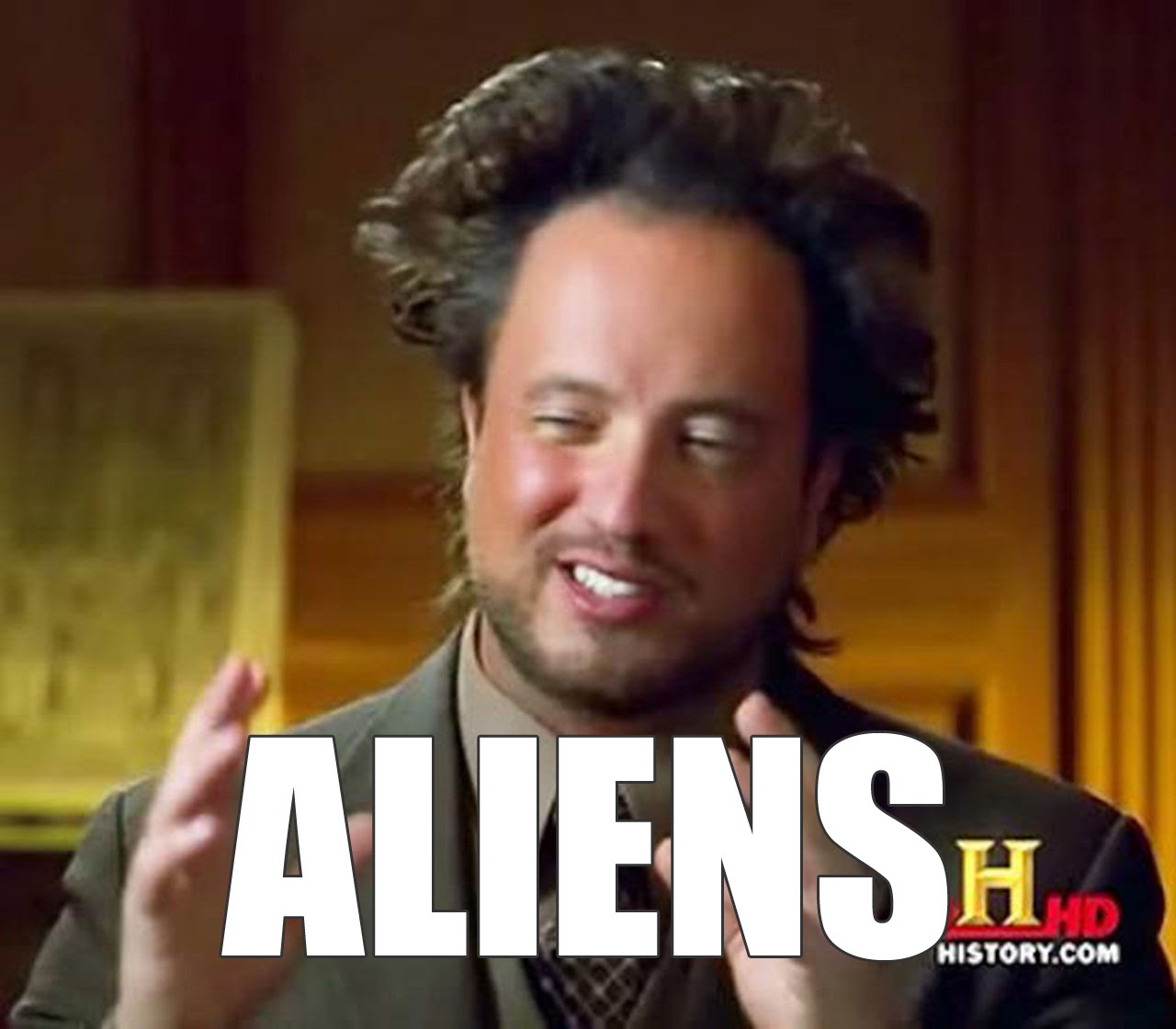
This meme is a screenshot of the TV show "Ancient Aliens" featuring a host, Giorgio Tsoukalos, with a shocked expression. The text "I find your lack of faith disturbing" is overlaid on the image, a reference to a famous Star Wars quote, but it's actually saying "I find your lack of skepticism disturbing" and is written in a font that resembles the Star Wars quote.
detailed-analysis (gemma3-27b-vision)
Okay, here's an analysis of the image, broken down into the requested sections, only including those applicable. Considering the image of Giorgio A. Tsoukalos (known for his Ancient Aliens theories) and its direct association with the word "ALIENS," the sections that apply most strongly are Postmodernism, Foucauldian Genealogical Discourse Analysis, and some elements of Critical Theory.
Visual Description
The image features Giorgio A. Tsoukalos, a prominent figure in the pseudoscientific field of ancient astronaut theory. He’s a middle-aged man with dark, curly hair and a slightly exaggerated expression of excitement, with his mouth open as if in explanation. He is dressed in a dark suit, and is mid-gesture with one hand. In front of him, superimposed over the image is the bolded word "ALIENS" in white, and the watermark “HISTORY.HD” and “HISTORY.COM”
Foucauldian Genealogical Discourse Analysis
This image is ripe for a Foucauldian analysis. Michel Foucault explored how knowledge and power are intertwined, shaping discourses that define what is considered “true” and “false.”
- Discourse of "Ancient Aliens": Tsoukalos is a key figure in the discourse of ancient astronauts, a belief system that posits extraterrestrial beings influenced early human civilizations. This discourse isn't based on empirical evidence, but it has gained traction in popular culture.
- Genealogy of the Idea: Tracing the "genealogy" of this idea would reveal a history of blending mythology, pseudoarcheology, and science fiction. It's a construction built on re-interpretations of ancient texts, archaeological finds, and a desire for “grand narratives” that explain the unknown. The idea of aliens influencing humanity taps into a long history of seeking explanations for unexplained phenomena beyond the realm of conventional religion or science.
- Power/Knowledge: Tsoukalos's platform, particularly his appearances on the History Channel, demonstrate the power of media to disseminate alternative narratives. He isn't necessarily claiming "truth" but creating a discourse that challenges dominant historical and scientific narratives. He holds power by shaping how viewers perceive history.
- The Construction of Truth: Foucault would argue this image actively participates in constructing a new “truth,” or at least a plausible counter-narrative. It’s not about proving the existence of ancient aliens, but about creating a framework where it is possible to believe in it, disrupting accepted historical and scientific knowledge.
Postmodernism
The image strongly aligns with postmodern thought:
- Rejection of Grand Narratives: Postmodernism critiques "grand narratives" (totalizing explanations of history or reality). Ancient astronaut theories, while offering a narrative, actively challenge the mainstream historical and scientific narratives.
- Simulation & Hyperreality: The image, originating from a television show, exists within a mediated reality. It's a simulation of inquiry, rather than genuine scientific investigation. The History Channel show arguably participates in a "hyperreality" – a simulation so convincing it blurs the line between the real and the constructed.
- Deconstruction: Tsoukalos's approach, constantly questioning established explanations and offering alternative interpretations, is akin to a deconstructive process, dismantling conventional understandings of history and archaeology.
- Subjectivity & Interpretation: Postmodernism emphasizes the subjectivity of knowledge. The image invites viewers to question what they "know" and to entertain alternative interpretations of the past, accepting that there is no single, objective truth.
Critical Theory
While not the central focus, elements of Critical Theory are relevant:
- Ideology Critique: One could argue that the Ancient Aliens narrative functions as an ideology, offering a seemingly radical challenge to established power structures, but ultimately distracting from real social and political issues. It provides a sense of wonder and mystery, but it does not address systemic inequalities or power imbalances.
- The Role of Media: Critical Theory examines how media shapes our perceptions and reinforces existing power structures. The History Channel, as a commercial enterprise, benefits from generating spectacle and controversy. The show is not about "truth," but about generating ratings.
- Culture Industry: The image, as part of a television show, is a product of the "culture industry"—a system that commodifies and mass-produces cultural experiences. Ancient Aliens is a "product" designed to entertain and generate profit, rather than to promote genuine understanding.
Sections Not Included:
- Marxist Conflict Theory: While the creation of media content involves economic relations, the image itself doesn't explicitly depict class struggle or exploitation.
- Queer Feminist Intersectional Analysis: This lens doesn't directly apply to the image or its content.
Let me know if you’d like me to elaborate on any of these points or explore a different angle.
simple-description (llama3.2-vision)
The meme features a still image of Giorgio "Gi" from the TV show "Ancient Aliens" with a puzzled expression. The image is captioned "ALIENS" in large, bold font, implying that Gi is responding to a question about the existence of extraterrestrial life. The tone is humorous and sarcastic, suggesting that Gi is being facetious about the topic.
tesseract-ocr
; My (SI dll em } . HISTORY.COM