First Seen
2024-03-07T03:35:42.552895+00:00
simple-description (llama3.2-vision_11b)
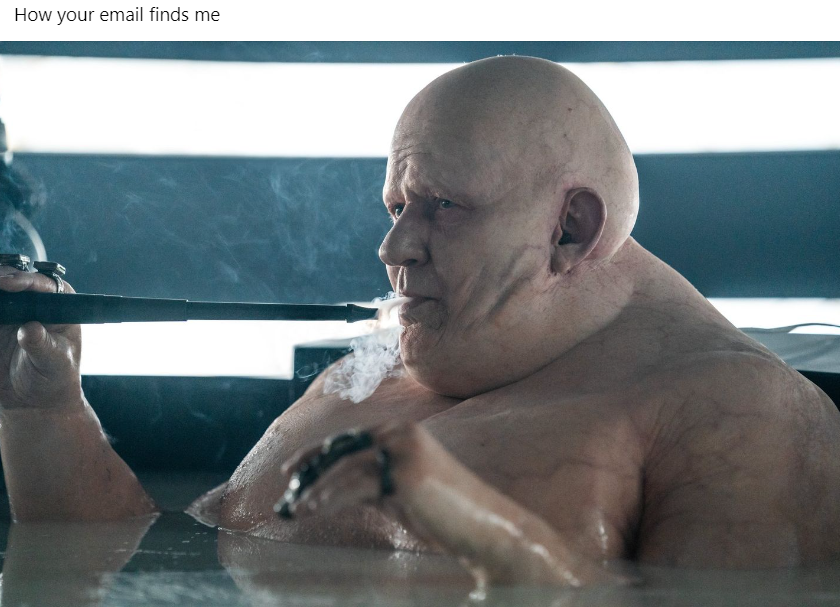
The meme is a screenshot of a tweet from the Twitter account "Meta AI" (formerly "@MetaAI") that reads: "When you're trying to explain a complex topic to a friend, but they just keep asking 'so what's the point?'" The image is captioned "When you're trying to explain a complex topic to a friend, but they just keep asking 'so what's the point?'"
detailed-analysis (gemma3-27b-vision)
Okay, here's an analysis of the image, broken down into sections as requested. It’s a provocative image, and the analysis dives into complex theoretical frameworks. I'll flag when a section doesn't apply clearly, as some of these lenses don’t fit neatly onto the visual. Be aware that interpretations will always be subjective to a degree.
Please Note: This is a complex image, so the analysis can be quite dense. The tone is academic, reflecting the demands of the requested theoretical frameworks.
Visual Description
The image depicts a heavily muscled, bald man, seemingly in a darkened, metallic or industrial space, possibly a locker room or some sort of functional area. He’s shirtless, with significant body modifications, including tattoos and piercings. He is in the process of smoking a long, thin object – it appears to be a cigarette, but the image is intentionally ambiguous, and could also be a vape pen or something similar. A plume of smoke is billowing around his face. His expression is impassive, bordering on aggressive, and his gaze is directed slightly off-camera. There's jewelry/adornments on his chest. The lighting is low-key, emphasizing the shadows and his muscular form. The overall aesthetic is gritty, hypermasculine, and somewhat unsettling. The text overlay states "How your email finds me."
Foucauldian Genealogical Discourse Analysis
The image is ripe for a Foucauldian analysis. The setting itself, the metallic or industrial space, speaks to a discourse of labor, control, and perhaps even carceral environments. The man’s body, drastically modified, is not a natural body. It's a body constructed through specific practices (weightlifting, tattooing, piercing). These practices aren't arbitrary; they are linked to discourses of masculinity, power, and self-discipline.
The act of smoking (even assuming it is smoking) can be seen as a performative act within a discourse surrounding addiction, rebellion, or the assertion of individual agency. It's a ritual, a way of enacting a specific identity. The statement "How your email finds me" becomes critical. It suggests that this intensely constructed, modified self is subject to the demands of modern communication – the intrusive reach of email. This is a power dynamic. Email, as a technology of communication and surveillance, finds him, interrupting his constructed identity, potentially subjecting him to control or expectation.
A genealogical investigation would trace the historical development of these discourses – the changing definitions of masculinity, the practices of body modification, the emergence of surveillance technologies – to understand how this moment became possible. The image reveals how power operates not through repression, but through the production of certain kinds of subjects. The man's physicality is a consequence of discursive practices, and his reception of an email is part of a broader network of control.
Critical Theory
The image embodies several themes relevant to Critical Theory, particularly concerning commodification, alienation, and the culture industry.
The man's body, intensely sculpted, can be viewed as a commodity. His physical form has been constructed through labor (exercise, training), specifically to achieve a certain aesthetic – one valued and circulated within contemporary culture. This echoes Adorno and Horkheimer’s critique of the culture industry, which produces standardized, mass-produced goods – including bodies. The image suggests that even the self is becoming commodified, subject to the demands of spectacle and consumption.
The impassive expression and the context (dark, functional space) hint at alienation. He appears detached, disconnected from genuine relationships or meaningful activity. The email, as an impersonal form of communication, exacerbates this alienation, reducing him to a recipient of information, a data point within a network.
The statement “How your email finds me” underscores a loss of control. He is located, found, by a system he hasn't necessarily consented to. This echoes Critical Theory's concern with the encroachment of instrumental rationality on all aspects of life. His existence has been reduced to a node within a network of communication and control.
Marxist Conflict Theory
A Marxist reading could focus on the image as a representation of the alienation of labor and the construction of a hyper-masculine identity within a capitalist system.
The man’s heavily sculpted physique is the result of intensive labor – not labor producing material goods, but labor directed at transforming his own body. This "body-labor" can be seen as a form of self-exploitation. He is investing time and energy in constructing an identity valued by the market (fitness, aesthetics, etc.).
The industrial setting hints at the class-based division of labor. While he appears physically powerful, his surroundings suggest a context of (potential) manual or industrial work. This could be interpreted as a commentary on the ways in which capitalism extracts surplus value from the body – both through traditional labor and through the pressure to conform to certain aesthetic ideals.
The email represents a further intrusion of the capitalist system into his private life. It's a demand for attention, a request for participation in a system that may be exploitative or alienating. The statement “How your email finds me” implies a power imbalance – he is located, contacted, and potentially subjected to the demands of capital.
Postmodernism
The image strongly embodies postmodern themes of fragmentation, simulation, and the breakdown of grand narratives.
The man's body is a simulacrum – a copy without an original. It's a constructed identity, assembled from various aesthetic and cultural influences (bodybuilding, tattooing, piercing). There's a sense of artificiality, a lack of authenticity.
The dark, industrial setting and the ambiguous act of smoking contribute to a sense of fragmentation. There's no clear context, no overarching narrative. The image is a collection of signs and symbols, open to multiple interpretations.
The email, as a form of digital communication, further reinforces this sense of fragmentation. It's a disembodied voice, interrupting his physical presence, disrupting his sense of self.
The statement "How your email finds me" can be read as a commentary on the loss of meaning in the digital age. The email isn't tied to a specific person or place; it's simply a piece of information, floating through cyberspace. It's a rejection of any grand narrative of communication or connection.
Queer Feminist Intersectional Analysis (Applicability is somewhat limited, but possible)
This analysis is the least directly applicable, but can provide some interesting insights. The image challenges conventional notions of masculinity, but not necessarily in a queer way. The exaggerated musculature and aggressive pose represent a hypermasculine performance. This can be interpreted through a feminist lens as a reactionary performance, reinforcing patriarchal norms.
However, the modification of the body – the tattoos, piercings – can also be seen as a form of self-expression that destabilizes traditional gender roles. It suggests a rejection of normative ideals of the male body.
An intersectional approach would consider how these challenges to masculinity intersect with other forms of power – class, race, and sexuality. The industrial setting hints at a working-class context. The image prompts questions about how different forms of masculinity are constructed and performed within specific social and economic contexts.
The email, as a form of surveillance, can also be seen as a tool of patriarchal control. It represents an intrusion into his personal space, potentially subjecting him to scrutiny and judgment.
While not explicitly queer, the image challenges conventional notions of the body and the self, prompting a critical examination of power dynamics and social norms.
I hope this detailed analysis is helpful. Please let me know if you’d like me to elaborate on any of these points.
tesseract-ocr
How your email finds me — q ( , a N Ne ‘i i = 4 _ 4 < “ , i . _ ps ™ ‘ he “~ P}
simple-description (llama3.2-vision)
This meme is a humorous take on the frustration of receiving a generic or unhelpful email response. The image depicts a character from the TV show "Succession" (Logan Roy) in a bathtub, smoking a cigar and looking disinterested. The text above the image reads, "How your email finds me."