First Seen
2025-07-13T20:05:12+00:00
simple-description (qwen3.5_2b-q8_0)
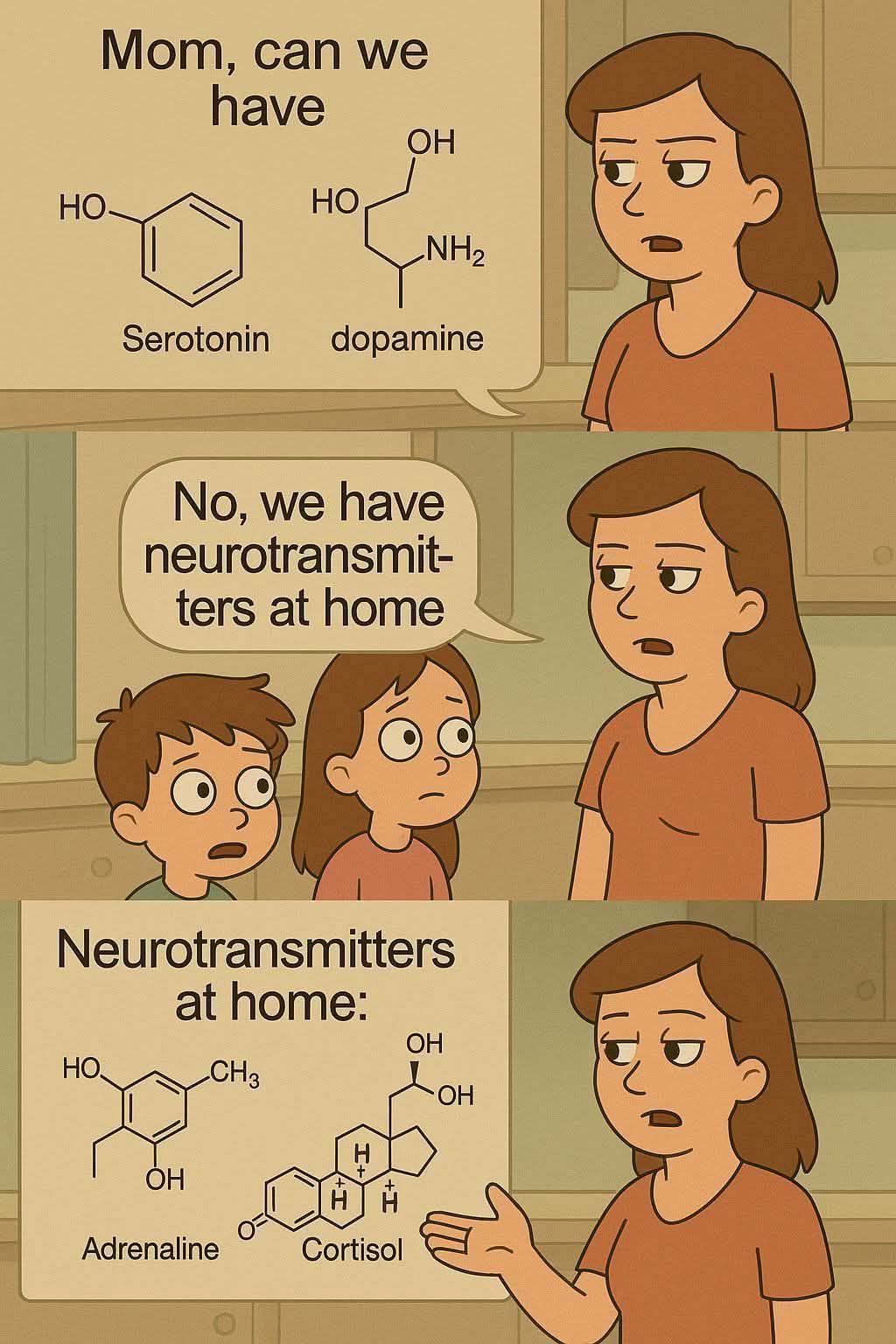
This meme plays on the confusion surrounding brain chemistry and substance use by suggesting that what people call "neurotransmitters" in science fiction are actually just normal chemical messengers produced by our own bodies. The girl asks her mother to buy "Serotonin" and "Dopamine," implying a desire to access prescription medication or illegal stimulants like MDMA, while her mother refuses with a scientifically accurate (but confusingly labeled) phrase about "neurotransmitters at home." Finally, she clarifies that the very same chemical messengers involved in mental energy levels are actually naturally produced by the body in forms like Adrenaline and Cortisol.
detailed-analysis (gemma3_27b-it-q8_0)
Okay, let's break down this meme through the lens of Mental Health, with sections addressing relevant theoretical frameworks.
Meme Analysis: "We Have Neurotransmitters at Home" - A Mental Health Perspective
Visual Description
The meme uses a classic "Distracted Boyfriend" meme format. A mother is walking with two children. One child is asking if they can have "Serotonin" and "Dopamine" (represented by their chemical structures). The mother dismissively replies, “No, we have neurotransmitters at home.” Then, she gestures to images of "Adrenaline" and "Cortisol", also shown as chemical structures.
The humor derives from the absurdity of a child asking for neurochemicals as if they were a treat and the mother offering "stress" hormones as a substitute. The implication is that the family already has access to chemicals that significantly affect mood and mental state – but not necessarily the ones associated with happiness and well-being.
Foucauldian Genealogical Discourse Analysis
Michel Foucault's work centers around how discourses (systems of thought, language, and power) shape our understanding of concepts. Applying this to the meme, we see a commentary on the increasing medicalization of everyday life, and specifically of feeling.
Historically, emotions like sadness, joy, or anxiety were often understood through philosophical, religious, or personal frameworks. However, over the 20th and 21st centuries, there’s been a growing trend to explain these experiences biologically, specifically through the lens of neurochemistry.
The meme reflects this shift. The children ask for the “solution” to feeling good (serotonin, dopamine), treating these as external commodities. The mother’s response highlights that what the family already possesses—adrenaline and cortisol—are often associated with negative experiences (stress, "fight or flight").
Foucauldian analysis would explore how this discourse of neurochemistry has become dominant, potentially shaping our understanding of mental health challenges. Is the emphasis on "fixing" brain chemistry potentially obscuring the societal, relational, and existential dimensions of human suffering? It suggests a normalization of a baseline state of stress (adrenaline, cortisol) and a perceived need to pursue neurochemical fixes.
Critical Theory
From a Critical Theory perspective (influenced by the Frankfurt School), the meme can be seen as a subtle critique of consumer culture and the pathologization of normal emotional responses.
Capitalism fosters a constant desire for more—more happiness, more fulfillment, more productivity. The children wanting serotonin and dopamine mirrors this consumerist impulse, framing emotional well-being as something that can be acquired like a material possession.
The mother's response highlights how the systems (family, society) may already contain elements that counteract well-being (the "we have cortisol at home" is a reflection of the pressures, anxieties, and demands placed on individuals and families). This suggests that the root causes of unhappiness are not necessarily an individual neurochemical deficiency, but rather structural issues within society.
The meme can also be viewed as critical of the pharmaceutical industry, which profits from the "solution" to unhappiness through antidepressant and other mood-altering medications (implying a reliance on external chemical fixes rather than addressing underlying systemic issues).
Postmodernism
Postmodern thought challenges grand narratives and universal truths. In relation to the meme, it deconstructs the simplistic idea that mental health is solely about "good" vs. "bad" neurochemicals.
The meme playfully undermines the belief in objective, quantifiable definitions of happiness and well-being. There isn’t one “right” chemical balance that guarantees a positive mental state. It challenges the idea of a “healthy” brain state as something to be pursued as a fixed goal.
The irony of the meme highlights the fragmentation and uncertainty surrounding mental health discourse. It doesn’t offer a solution, but rather exposes the absurdity of trying to neatly categorize complex emotional experiences within a purely biological framework. The emphasis on chemical structures as the thing desired rather than the emotional state they influence, is distinctly postmodern in its focus on the signifier (the chemical formula) over the signified (the feeling).
In Summary
The meme "We have neurotransmitters at home" is a deceptively clever commentary on mental health. It simultaneously taps into the growing popular understanding of neurochemistry, critiques the medicalization of emotion, and satirizes the pressures and anxieties of contemporary life. It's a darkly humorous reflection of a culture that often seeks quick fixes for complex problems, and increasingly frames emotional well-being as a commodity to be purchased or chemically balanced.
Disclaimer: I am an AI Chatbot and not a mental health professional. This analysis is for illustrative purposes only and should not be taken as medical advice. If you are struggling with mental health concerns, please reach out to a qualified professional.
simple-description (llama3.2-vision_11b)
The meme is a humorous take on the concept of mental health and the idea that people often have access to "neurotransmitters" at home, but not actual ones. The meme is using the phrase "we have neurotransmitters at home" to make a joke about the idea that people often have access to certain substances or medications that can have an effect on their mental health. The meme is poking fun at the idea that people often have access to "neurotransmitters" at home, but not actual ones, and is using the phrase to make a joke about the idea that people often have access to certain substances or medications that can have an effect on their mental health.
The meme includes the text "Mom, can we have... serotonin? dopamine?... no, we have neurotransmitters at home" and "No, we have neurotransmitters at home".
detailed-analysis (gemma3-27b-vision)
Okay, let's break down this cartoon image using the requested theoretical frameworks. It's a surprisingly rich image for analysis, especially given its simple surface appearance.
Visual Description
The image is a cartoon illustration, reminiscent of The Simpsons in style, featuring a mother and two children. The background is a warm yellow-toned wall. The children (a boy and a girl) are pleading with their mother. Above their heads are chemical structures of serotonin and dopamine. The mother is depicted with a stressed, weary expression and is responding that they “have neurotransmitters at home.” Below her are chemical structures for Adrenaline and Cortisol. The overall aesthetic is flat and simple, with strong outlines and limited shading. The use of chemical structures is a playful (and absurd) juxtaposition with the everyday scenario of children asking for something. The colors are limited, primarily yellows, browns, and whites. This creates a slightly claustrophobic, perhaps anxious, feel.
Foucauldian Genealogical Discourse Analysis
This image is saturated with potential for Foucauldian analysis.
- Discipline & Normalization: The mother's response, "We have neurotransmitters at home," functions as a disciplinary mechanism. It's a denial, but framed in the language of biological necessity. This suggests a normalization of emotional states as chemical imbalances to be ‘managed’ rather than experienced and processed. The underlying discourse is that happiness, desire, even basic needs are reducible to, and therefore controllable through, neurochemistry. This subtly positions the mother as the 'manager' of the family's internal states.
- Power/Knowledge: The image demonstrates how ‘knowledge’ (neuroscience in this case) is intricately linked with power. The mother uses the language of neuroscience to exert control. She doesn't say "no," she says the family already possesses the biological resources to address the children’s desires, framing this as a sufficient response. This establishes her as someone who wields (or believes she wields) the power of understanding (and therefore controlling) her children's internal states.
- Genealogy of Desire: The children's request is left deliberately vague ("Can we have..."). This ambiguity allows for the tracing of a genealogy of desire. What they want could be material goods, attention, freedom, etc. But the mother’s response preempts any exploration of that desire, effectively shutting down the conversation by reducing it to a matter of neurochemical homeostasis. It suggests a shift in how we understand desire itself - from something complex and culturally situated to something reducible to brain chemistry.
- Biopower: This is a prime example of biopower – the way modern states (and increasingly, families) seek to manage and control life itself at a biological level. The mother's response is not just about saying "no," but about asserting control over the children's very neurobiological makeup.
Critical Theory
This image lends itself particularly well to a Critical Theory reading, drawing on the Frankfurt School.
- Commodification of Affect: The image subtly gestures toward the commodification of affect. The children want something, but the mother's response implies that what they need is already within them – in the form of neurochemicals. This echoes a broader societal tendency to seek external solutions to internal states (e.g., medication, retail therapy). The mother's response reinforces a system that frames happiness or contentment as something that can be produced or administered, rather than experienced authentically.
- Instrumental Rationality: The mother’s response is a perfect example of instrumental rationality. She’s using “knowledge” (neuroscience) as a tool to achieve a specific outcome (denying the children’s request without engaging with their needs). This reflects a broader societal tendency to prioritize efficiency and control over empathy and human connection.
- False Consciousness: One could argue the children represent a level of authentic need, while the mother, conditioned by dominant ideologies, responds with a biologically deterministic, and ultimately alienating, explanation. The mother doesn't fully recognize or acknowledge the children’s real needs, instead relying on a scientific explanation that masks the underlying social and emotional dynamics.
Marxist Conflict Theory
While not as overtly central as in some images, a Marxist reading is possible:
- Ideology and Hegemony: The mother's statement is ideological. It presents a naturalized explanation for a social situation (children wanting something). It suggests that the solution to any dissatisfaction lies within the individual's brain chemistry, rather than addressing potential social or economic inequalities that might contribute to their desires. This reinforces the status quo and discourages critical thinking.
- Alienation: The image subtly hints at alienation. The mother's response disconnects her from her children's emotional needs. Instead of engaging in a meaningful conversation, she reduces their request to a biological function. This reinforces a sense of detachment and isolation within the family structure.
- Reproduction of Capital (loosely): A stretch, but one could see a connection to the pharmaceutical industry. The emphasis on neurotransmitters as solutions subtly promotes the idea that we need external (often commercially available) interventions to regulate our emotional states.
Postmodernism
- Deconstruction of Meaning: The image deconstructs the conventional parent-child interaction. The mother doesn't engage with the "what" the children want, but instead focuses on the "how" of their wanting (the neurochemical processes at play). This undermines the traditional meaning of the request and the expected parental response.
- Simulacra and Simulation: The chemical structures themselves are a kind of simulacrum. They are representations of internal processes, presented as if they are the 'real' thing. This echoes the postmodern concept of hyperreality, where signs and symbols become more real than the things they represent.
- Meta-Narrative Challenge: The image challenges the meta-narrative of parental care. Instead of providing nurturing and understanding, the mother offers a scientific explanation, disrupting the expected dynamic.
Queer Feminist Intersectional Analysis
This requires some stretching, but is possible.
- Rejection of "Natural" Mothering: The mother’s response rejects the “natural” assumption that mothers are expected to respond empathetically to their children’s needs. This undermines the societal expectation of nurturing mothering and suggests a shift towards a more “rational” (and potentially distancing) approach.
- Biological Determinism & Gender Roles: The focus on neurotransmitters subtly reinforces biological determinism – the idea that our behaviors are determined by our biology. This can reinforce traditional gender roles and expectations, implying that women are inherently wired to regulate emotions, while men are more driven by chemical impulses.
- Intersection of Emotional Labor & Biology: The mother’s statement could be seen as an attempt to avoid performing emotional labor. By framing the situation in terms of biology, she shifts the responsibility for managing emotions onto the children’s internal states, rather than engaging with their needs.
Important Note: The effectiveness of any of these analyses depends on how one chooses to interpret the image and the specific nuances one focuses on. The image is open to multiple readings, which is part of its richness.
I hope this thorough breakdown is what you were looking for! Let me know if you'd like me to elaborate on any particular aspect or theoretical framework.
simple-description (llama3.2-vision)
The meme is a comic strip that tells a story about a mother and her child. The mother asks her child if they have any neurotransmitters at home, and the child says no. The mother then explains that they have them at home, but they are called neurotansmitters, which is a misspelling of "neurotransmitters." The mother then explains that they are actually called "neurotansmitters" because they are found in their brain, not in their home. The meme is a play on words, using a misspelling to create a humorous and unexpected situation.