First Seen
2025-07-13T20:07:12+00:00
simple-description (qwen3.5_2b-q8_0)
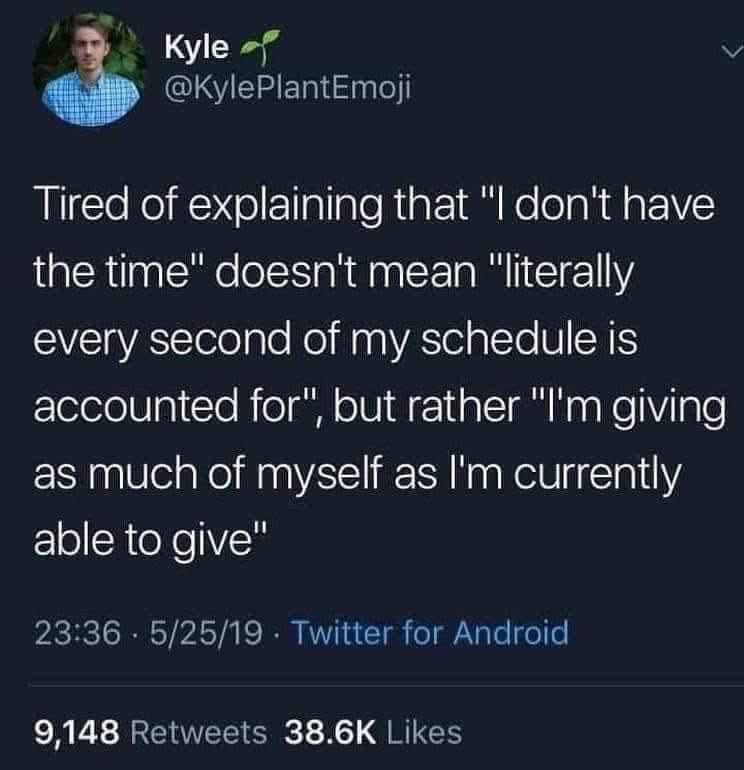
This mental health meme reframes exhaustion and burnout as a form of self-preserving behavior rather than failure. The tweet argues that when someone feels they cannot give attention or time ("I don't have the time"), it is not an excuse for laziness, but rather a testament to their current emotional state and limited capacity to contribute. This perspective normalizes feelings of overwhelm by validating exhaustion as a valid, albeit frustrating, reason for inaction.
detailed-analysis (gemma3_27b-it-q8_0)
Okay, let's break down this seemingly simple tweet through a mental health lens, applying relevant theoretical frameworks where appropriate.
Visual Description
The image is a screenshot of a tweet from a Twitter user named "Kyle" (@KylePlantEmoj). The profile picture is of a young man. The tweet itself is the central focus. The background is a dark blue. There's information at the bottom indicating the time of posting, the platform ("Twitter for Android") and the engagement metrics (retweets and likes). The tweet is composed of text.
Mental Health Context: Core Issue
At its heart, this tweet speaks to boundary setting, emotional labor, and burnout. It’s a common struggle for individuals, particularly those prone to people-pleasing or who feel a sense of obligation to be consistently available. The user expresses exhaustion from constantly having to explain the limits of their capacity. The problem isn't just needing to say "no," it's the expectation that "no" requires a detailed justification, as if one's time and energy are owed to others and need to be precisely accounted for. This can be deeply draining and contribute to chronic stress.
Foucauldian Genealogical Discourse Analysis
Michel Foucault's work on power and discourse is highly relevant here.
- Discipline and Normalization: The expectation to justify why one "doesn't have time" is a manifestation of a disciplinary power dynamic. Modern society often normalizes a constant state of productivity and availability. Saying "I don't have time" without a detailed explanation can be perceived as rude, lazy, or uncaring – because it deviates from the norm of being readily available.
- Power/Knowledge: The demand for justification isn’t just about time; it’s about demonstrating control over one’s life. The person asking for justification is attempting to gain knowledge of the other person’s schedule, effectively attempting to exert a subtle form of control. The tweet challenges this power dynamic.
- Genealogy of Time: Foucault would be interested in how the very concept of time has been constructed and how it operates as a regulatory force. The idea of "optimizing" time, maximizing efficiency, and fitting everything into a schedule is a relatively recent historical development linked to the rise of industrial capitalism. This pressure on time contributes to the mental health struggles highlighted in the tweet.
Critical Theory
- Alienation: The tweet points to a form of alienation— alienation from one’s own time and energy. The individual feels pressured to account for every moment as if it were not their own to freely dispose of. This aligns with critical theory’s concerns about how social structures can disconnect individuals from their authentic selves and experiences.
- Ideology: The belief that one should have a fully scheduled life, and that declining requests requires explanation, is an ideological construct. It's a belief system that serves to maintain existing power structures (those who benefit from a constantly available workforce, for example).
- Commodification of Self: The tweet implicitly critiques the tendency in modern society to treat individuals as resources to be optimized and utilized. The expectation to justify one's time implies that one’s time is a commodity, and one is obligated to "spend" it wisely (according to others’ demands).
Postmodernism
- Deconstruction of Meaning: The tweet subtly deconstructs the "common sense" understanding of "I don't have time." It challenges the idea that this phrase has a single, objective meaning. It highlights how meaning is contingent on context, power dynamics, and individual experiences.
- Rejection of Grand Narratives: Postmodernism often questions overarching narratives. The tweet pushes back against the "grand narrative" of relentless productivity and availability. It asserts the individual’s right to define their own limits and prioritize their own well-being, rejecting the expectation to conform to a pre-defined notion of success or efficiency.
In summary: This tweet, while brief, is a powerful statement about the pressures of modern life and the importance of establishing healthy boundaries. It resonates deeply because it captures a common experience of emotional labor and the struggle to prioritize one’s own mental health in a society that often demands constant availability. Through theoretical frameworks like Foucauldian discourse analysis and Critical Theory, we can see how the tweet’s simple message touches upon larger issues of power, control, and the commodification of self.
simple-description (llama3.2-vision_11b)
The meme is a humorous take on the struggle to balance work and personal life. It's a relatable sentiment that many people can identify with, especially in today's fast-paced and demanding society. The text in the image reads: "Tired of explaining that 'I don't have the time' doesn't mean 'I'm not interested in your request'".
detailed-analysis (gemma3-27b-vision)
Okay, let's break down this Twitter post through the lens of several critical theories.
Visual Description
The image is a screenshot of a Twitter post. At the top, a circular profile picture shows a young man (Kyle) smiling and looking at the camera. Below is the Twitter handle "@KylePlantEmoji" followed by the text of the tweet. Below the tweet is the date and time of the tweet, and a line showing that it was posted via "Twitter for Android." At the bottom, statistics show the post has 9,148 retweets and 38.6k likes. The background is a dark navy blue. The overall impression is a simple, common social media post.
Foucauldian Genealogical Discourse Analysis
This tweet is strongly amenable to Foucauldian analysis. The post is about the discourse surrounding time and the pressures it exerts. Foucault’s work on power and knowledge explains how seemingly neutral concepts (like “time,” “productivity,” "busyness") are actually embedded with power dynamics.
- Power/Knowledge: The tweet is responding to a demand – an unspoken (or spoken) expectation – that time must be fully accounted for. This expectation isn’t natural; it's a product of a historical discourse that equates worth with constant productivity, particularly within neoliberal economies. Saying "I don't have time" is perceived as a transgression, implying a lack of commitment or efficiency.
- Genealogy: A genealogical approach would trace how this pressure to maximize time emerged. It’s not a timeless concept. It’s linked to the rise of industrial capitalism, Taylorism (scientific management), and the modern focus on efficiency. It’s also connected to the anxieties of precarity – the feeling that you must always be "doing" to prove your worth and secure your position.
- Discipline & Subjectivation: The tweet implicitly pushes back against the disciplinary power of this discourse. By clarifying the meaning of "I don't have time," the poster is refusing to be subjected to the expectation that their every moment must be quantifiable and productive. They are asserting their right to limit their own self-expenditure and acknowledge their own capacity. They are challenging the norm that their value is based on being fully utilized.
Critical Theory
This post aligns well with the core tenets of Critical Theory, particularly in its challenge to seemingly neutral concepts and its focus on power structures.
- Ideology: The expectation that time must always be accounted for is an ideological construct. It functions to obscure the real social relationships and power imbalances at play. The ideology of “busyness” serves to normalize and even valorize overwork, distracting from issues like wage stagnation, lack of worker protections, and the erosion of work-life balance.
- Rationalization & Instrumental Reason: Max Weber’s concept of rationalization fits here. Modern society is increasingly characterized by an emphasis on efficiency, calculation, and the means-end rationality. The expectation that time must be quantifiable is a manifestation of this rationalizing impulse. “Time” is being treated as a mere instrument to maximize output.
- Alienation: This post suggests a feeling of alienation from one's own time and energy. When individuals feel they must constantly "give" of themselves to meet external demands, they become alienated from their own intrinsic motivations and desires.
Marxist Conflict Theory
While not directly about class conflict, the tweet touches upon themes relevant to Marxist analysis.
- Exploitation of Labor Power: The demand for constant productivity is fundamentally linked to the exploitation of labor power. Capitalism requires the extraction of surplus value from workers, and maximizing the utilization of their time is a key aspect of this process.
- Commodification of Self: The tweet indirectly suggests the commodification of the self. The expectation that you must "give" of your time and energy implies that your time is a resource to be traded and consumed. You are being treated as a means to an end, rather than an end in itself.
- False Consciousness: The widespread acceptance of the "busyness" culture can be seen as a form of false consciousness. Individuals internalize the expectation that they must always be productive, obscuring the exploitative nature of the system.
Postmodernism
The tweet's challenge to a fixed definition of "I don't have time" resonates with postmodern thought.
- Deconstruction: The post is implicitly deconstructing the seemingly straightforward meaning of a common phrase. It's exposing the layers of assumptions and power dynamics embedded within it.
- Rejection of Grand Narratives: The tweet challenges the "grand narrative" of endless productivity and economic growth. It questions the assumption that maximizing output is inherently good or desirable.
- Subjectivity & Situated Knowledge: The post acknowledges that “time” is not an objective reality, but a subjective experience shaped by individual circumstances and limitations.
Queer Feminist Intersectional Analysis
While not immediately obvious, this tweet can be examined through a queer feminist intersectional lens.
- Emotional Labor & Care Work: Often, the pressure to "give" time and energy disproportionately falls on marginalized groups, particularly women and queer individuals, who are often expected to perform a disproportionate amount of emotional labor and care work. The expectation to be constantly "giving" could be reinforcing gendered and queer-gendered expectations.
- Boundary Setting & Self-Preservation: Challenging the expectation to constantly "give" is an act of boundary setting and self-preservation. This is particularly important for marginalized groups, who may face additional pressures to conform to societal expectations and prioritize the needs of others over their own.
- Disrupting Normative Time: The tweet subtly challenges the normative concept of "productive time." This can be understood as part of a broader queer feminist project to challenge dominant norms and create space for alternative ways of being and relating.
In conclusion, this seemingly simple Twitter post is surprisingly rich in theoretical possibilities. It provides a window into the complex interplay of power, ideology, and subjectivity in modern society. It is a subtle act of resistance against the pressures of late capitalism and a reclaiming of personal time and energy.
simple-description (llama3.2-vision)
The meme is a tweet from Kyle, who is expressing his frustration with the common phrase "I don't have the time." He says that this phrase is often used to avoid giving someone or something, but he's now using it to say he's giving as much of himself as he can. The tweet is a humorous and relatable way to poke fun at the way people use this phrase to avoid giving. The text in the tweet is: "Tired of explaining that 'I don't have the time' doesn't mean 'literally every second of my schedule is accounted for,' but rather 'I'm giving as much of myself as I'm currently able to give.'"