First Seen
2023-11-30T22:49:13+00:00
simple-description (llama3.2-vision_11b)
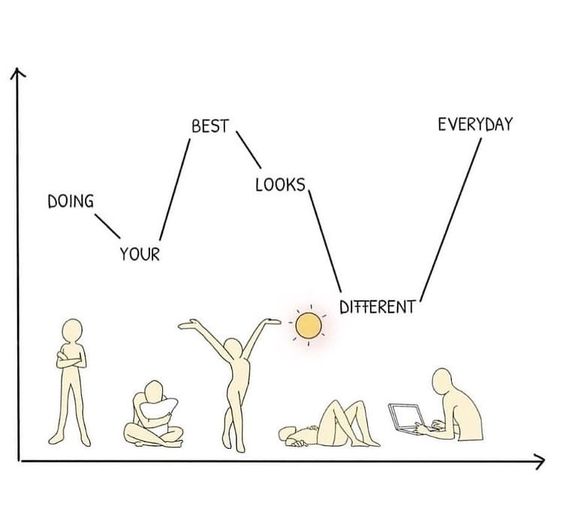
The meme depicts a person struggling to find a comfortable position while doing yoga, with the caption "When you're trying to adult but your brain is still in elementary school." The image shows a person in various yoga poses, with each one representing a different aspect of adulting, such as "doing your taxes," "making your bed," and "cooking dinner." The meme is relatable to the category of mental health, as it pokes fun at the challenges of transitioning from childhood to adulthood, and the struggles that come with it.
detailed-analysis (gemma3-27b-vision)
Here's an analysis of the image, broken down into sections as requested. Note that not every theoretical framework is a perfect fit, but I'll provide the most relevant interpretations within each.
Visual Description
The image is a simple line drawing on a plain background. It depicts a series of five stick figures arranged along a horizontal axis, resembling a graph. There is also a sun placed between the figures. Each figure is engaged in a different pose:
- Standing Figure: A basic upright stick figure, implying normalcy or a baseline state. This is labelled "DOING"
- Seated Figure: Sitting on the ground, appearing relaxed. This is labelled "YOUR"
- Backbending Figure: In a yoga-like or contorted pose, creating an arch in their body. This is labelled "BEST"
- Lying/Reclined Figure: Flat on the ground, in what appears to be a prone position. This is labelled "LOOKS"
- Lounging Figure: Reclined, perhaps on a couch, in a relaxed but less obviously "prone" position. This is labelled "DIFFERENT"
The image has a stark, almost instructional quality, and the use of labels suggests the creation of a taxonomy or comparison. The sun is placed in between the two middle figures.
Foucauldian Genealogical Discourse Analysis
This image can be interpreted through a Foucauldian lens as illustrating a historical discourse surrounding "wellness" or "self-improvement." The progression of figures can be seen as a genealogy of normalizing practices.
- Power/Knowledge: The labeling ("DOING," "BEST," "LOOKS," "DIFFERENT") creates meaning and defines what is considered “good” or desirable. This isn't an objective truth, but a construction of power that establishes norms. The “backbending” figure is positioned as the “BEST” (most desirable), implying a form of disciplinary power that rewards certain postures or levels of physical prowess.
- Discipline & Normalization: The image can be seen as subtly encouraging a disciplinary regime. The progression implies that the "standing" figure is somehow lacking and needs to become the "backbending" figure to achieve the "BEST." This implies that there is an ideal body to achieve.
- Archaeology of Knowledge: The figure in the middle is the sun. The sun represents a golden standard for the other figures to become.
Critical Theory
This image resonates with the core themes of Critical Theory.
- Ideology: The progression of figures naturalizes a certain ideology of self-optimization. It presents a seemingly neutral trajectory, but in fact, it implies that "doing" (and eventually achieving the "BEST") is a desirable state. This masks the power dynamics and social pressures that contribute to these expectations.
- Domination & Emancipation: The "BEST" figure, while seemingly celebratory, can also be read as an example of the pressures to conform to dominant ideals of physical fitness and self-presentation. The image doesn't ask who benefits from this ideal, or who is marginalized by it.
- Reason as Instrument of Domination: The attempt to categorize and rank the figures represents a "rational" approach to the body and self, but this rationality is used to reinforce existing power structures and expectations.
Postmodernism
Postmodern interpretations might focus on the image's deconstruction of meaning.
- Deconstruction of Norms: The image subtly challenges the idea of a single "normal" body or state of being. While it presents a trajectory, the presence of the "DIFFERENT" figure hints at the multiplicity of possibilities.
- Simulacra & Simulation: The labels themselves are detached from any inherent meaning. They are “simulacra,” copies that have no original. The image creates a simulacrum of progress without offering any genuine basis for evaluation.
- Fragmentation: The image presents a fragmented set of poses, implying the body is something to be manipulated and performed, rather than experienced as a whole.
Queer Feminist Intersectional Analysis
This image is ripe for a Queer Feminist reading, particularly when considering the pressures placed on bodies:
- Gendered & Racialized Bodies: The stick figures are gender neutral but the desire for "improvement" can be seen as deeply linked to gendered and racialized beauty standards. The "BEST" figure might implicitly evoke idealized (and often unattainable) bodies promoted by media and society.
- Disciplinary Power & the Body: The pressure to conform to the "BEST" pose is a form of disciplinary power that disproportionately affects marginalized bodies. Queer and trans bodies, for example, are often subjected to heightened scrutiny and pressure to conform.
- Intersectionality: The pressure to “improve” isn’t universal. Class, ability, and other factors shape experiences of body image and self-worth. The image ignores these complexities.
In conclusion, this seemingly simple image is a surprisingly rich site for critical analysis. It reflects broader social power dynamics and the ways in which bodies are disciplined, categorized, and evaluated.
tesseract-ocr
BEST \ EVERYDAY / LOOKS, DOING M \ / YOUR > 4 DIFFERENT J SSS?
simple-description (llama3.2-vision)
The meme is a humorous comparison of two people's daily activities. The left person is "Doing your thing" and is shown doing a mundane task, while the right person is "Being on your best" and is shown doing something more exciting and energetic, such as dancing in the sun. The text "Doing your thing" vs "Being on your best" is written above the two people.