First Seen
2023-05-10T21:03:36+00:00
simple-description (llama3.2-vision_11b)
This meme is a humorous take on the challenges of managing mental health during the holiday season. The image is likely a photo of a person surrounded by festive decorations, but with a caption that reads: "I love that it's finally December and I can officially isolate myself from all social events and focus on my anxiety and depression". The meme pokes fun at the idea that the holiday season is supposed to be a time of joy and celebration, but for many people, it can be a source of stress and anxiety.
detailed-analysis (gemma3-27b-vision)
Okay, let's break down this social media post (a tweet) through various theoretical lenses.
Visual Description
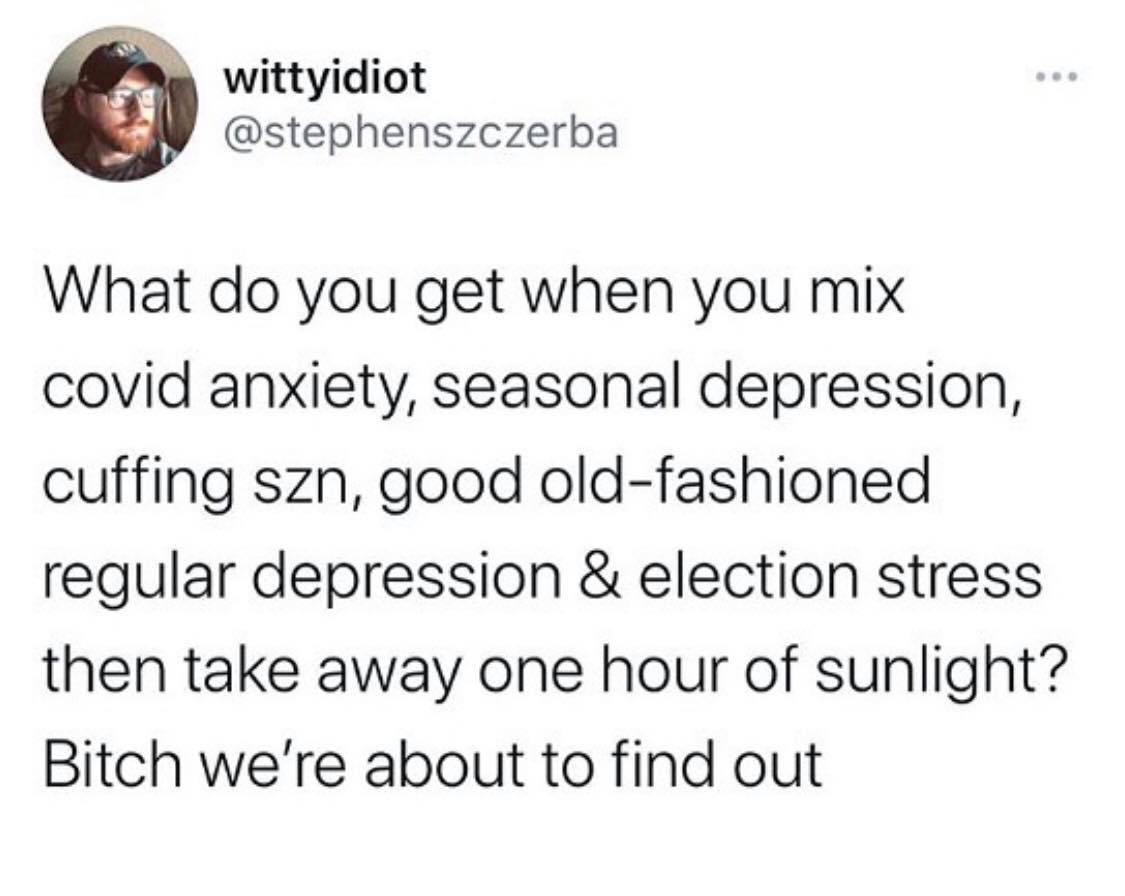
The image is a screenshot of a Twitter post from the account "@wittydiot" (presumably belonging to Stephens Czerba). The profile picture is a person wearing a hat. The text is a rhetorical question that builds a list of anxieties and depressive states ("covid anxiety, seasonal depression, cuffing szn, good old-fashioned regular depression & election stress") and then adds a reduction in sunlight. The post concludes with a provocative and slightly aggressive statement: "Bitch we're about to find out." It's a raw, confessional, and meme-like expression of collective anxiety.
Foucauldian Genealogical Discourse Analysis
This post is deeply amenable to a Foucauldian reading.
- Discourse of Mental Health: The post explicitly engages with the discourse of mental health – the way we talk about, categorize, and understand depression, anxiety, and related states. It doesn’t treat these as solely individual pathologies but as conditions produced by specific historical and social contexts.
- Power/Knowledge: Foucault argued that power and knowledge are inextricably linked. This tweet implies that these "conditions" are not simply natural occurrences, but are constructed and shaped by power dynamics. COVID-19 (and the ensuing anxieties) isn't just a biological event; it's a social and political one with profound mental health consequences imposed by circumstances. Similarly, election stress is a product of a specific political system and the anxieties it generates. The reduction of sunlight is a literal "imposition" on the body.
- Genealogy: A Foucauldian "genealogy" would trace the historical emergence of these categories and anxieties. How did "seasonal depression" become a recognized diagnosis? How have understandings of anxiety shifted? What are the power relations embedded within those shifts? The post hints at this by juxtaposing established diagnoses (seasonal depression) with more modern social phenomena (cuffing season – the urge to find a partner during the fall/winter).
- "Bitch we're about to find out": This phrase is a direct challenge to the presumed neutrality of these categorizations and a performative acknowledgement of the subjective reality of experiencing these pressures.
Critical Theory
This tweet resonates with key tenets of Critical Theory, particularly the Frankfurt School.
- Culture Industry: The mention of "cuffing szn" is significant. This is a manufactured social phenomenon, fueled by media, advertising, and consumer culture. It's a commodification of intimacy and a pressure to participate in a specific social script. Critical Theory would analyze how this contributes to alienation and unhappiness.
- Reason & Enlightenment Critique: The sheer accumulation of anxieties suggests a breakdown of the Enlightenment promise of reason and progress. Instead of achieving a better world, modern life seems to generate ever-increasing sources of stress and existential dread.
- Alienation: The list of anxieties points to a sense of alienation from self, community, and the natural world. The reduction of sunlight is a literal separation from a vital force.
- Pathologies of Late Capitalism: The anxieties are produced by the conditions of late capitalism—the relentless pressure to achieve, the precarity of labor, the alienation of consumer culture, and the anxieties surrounding political instability.
Postmodernism
The tweet exhibits several postmodern characteristics.
- Fragmentation: The list of anxieties is fragmented and disjointed, mirroring the fragmented experience of modern life.
- Hyperreality & Simulacra: "Cuffing szn" is an example of a simulacrum – a copy without an original. It’s a social construct that feels "real" but is entirely manufactured.
- Rejection of Grand Narratives: There is a rejection of any singular, overarching explanation for these anxieties. Instead, it's a complex web of intersecting factors.
- Self-Reflexivity and Irony: The provocative language ("Bitch we're about to find out") acknowledges the constructed nature of the anxieties and injects a dose of ironic self-awareness.
- Subjectivity: It highlights the individual experience of these anxieties. The feeling of what is happening to them instead of an external “thing” happening to them.
Queer Feminist Intersectional Analysis
While not explicitly "queer" or "feminist," an intersectional lens can illuminate the post’s implications.
- Interlocking Systems of Oppression: The list of anxieties can be seen as reflecting how different forms of oppression intersect. COVID-19, political instability, and societal pressures (like the expectation to couple up during "cuffing szn") disproportionately affect marginalized groups. The post highlights the cumulative effect of these stressors.
- Gendered Expectations: The pressure to participate in “cuffing szn” can be particularly acute for women, who often face societal expectations to find a partner.
- Emotional Labor: The anxieties are often internalised and the pressure to deal with these are not equal across all gender identities or sexual orientations.
- Mental Health Stigma: Stigma around mental health is also disproportionately impacting the LGBTQIA+ community. The tweet directly addresses the collective experience as an alternative to the “individual” categorization of these feelings.
In conclusion: This seemingly simple tweet is a surprisingly rich text that can be analyzed through multiple theoretical lenses. It speaks to the anxieties of our time and offers a glimpse into the ways in which social and political forces shape our mental and emotional well-being.
simple-description (llama3.2-vision)
The meme is a humorous response to a question about what to do when multiple negative emotions or situations are combined. The text reads: "What do you get when you mix...". The rest of the text is a humorous and sarcastic list of various negative emotions or situations, followed by a question about what happens when these are combined.
tesseract-ocr
©) wittyidiot @stephenszczerba What do you get when you mix covid anxiety, seasonal depression, cuffing szn, good old-fashioned regular depression & election stress then take away one hour of sunlight? Bitch we're about to find out