First Seen
2023-05-10T21:03:36+00:00
simple-description (llama3.2-vision_11b)
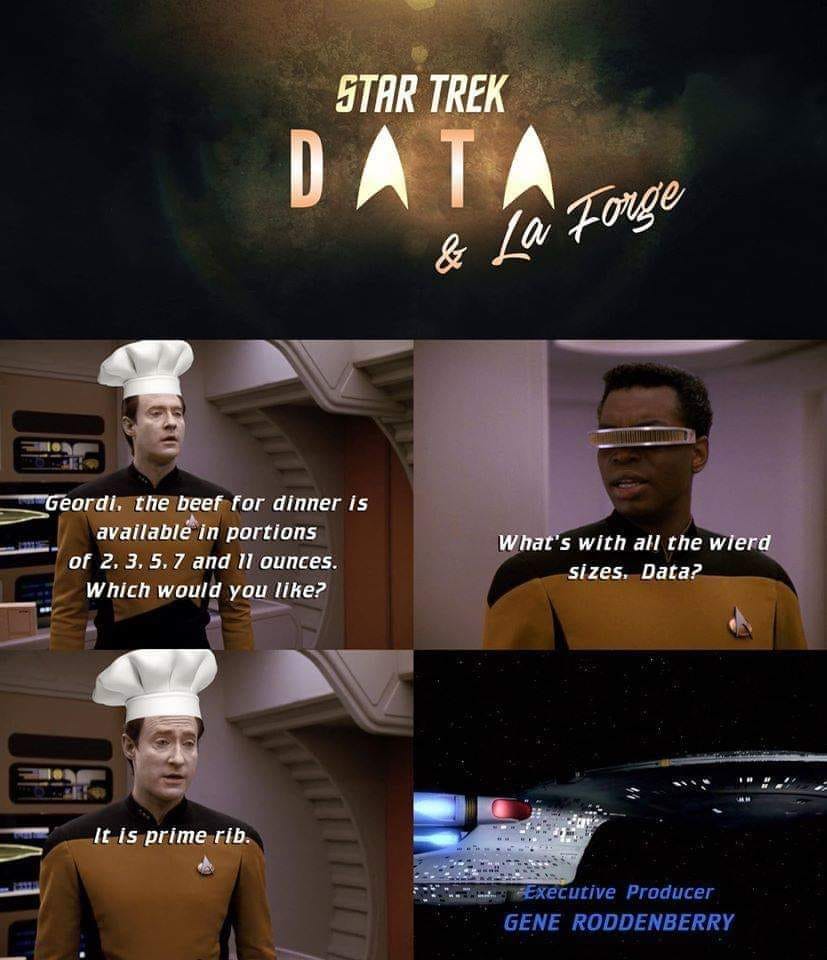
The meme is a humorous take on the Star Trek: The Next Generation episode "The Big Goodbye" where the character Geordi La Forge is blind but uses a device to "see" his surroundings. The meme juxtaposes this concept with a math problem, implying that Geordi's device can also "see" complex mathematical equations, with the text "2+2=4" appearing on screen. The meme is a play on words, using the concept of Geordi's device to make a joke about the simplicity of basic math.
detailed-analysis (gemma3-27b-vision)
Okay, here's an analysis of the Star Trek: The Next Generation still you provided, broken down into the sections you requested. I will indicate if a section doesn't apply. I'll attempt to be thorough, but remember these are complex theoretical frameworks, and application to a single image is necessarily partial.
Visual Description
The image is a four-panel collage of stills from the television series Star Trek: The Next Generation.
- Panel 1: Commander Data, the android, is wearing a chef's hat and a yellow Starfleet uniform. He's standing in a brightly lit, somewhat sterile corridor. He’s stating, "Geordi, the beef for dinner is available in portions of 2, 3, 5, 7 and 11 ounces. Which would you like?"
- Panel 2: Geordi La Forge, wearing his VISOR, looks at Data with a questioning expression. He asks, "What's with all the weird sizes, Data?"
- Panel 3: A close-up of Data, still in his chef's hat and uniform. He states with absolute conviction, "It is prime rib."
- Panel 4: A dark space scene with text reading "Executive Producer Gene Roddenberry" appears.
The overall aesthetic is clean and brightly lit, typical of the Star Trek series. The contrast between Data’s logical, precise approach to cooking and Geordi’s confusion is visually emphasized.
Foucauldian Genealogical Discourse Analysis
This image offers a fertile ground for Foucauldian analysis, particularly regarding the discourse of “expertise” and “rationality.”
- Power/Knowledge: Data, as an android, embodies a perceived “pure” rationality. He isn’t bound by human culinary tradition or subjective preferences. He defines the “correct” size and type of meal (prime rib) through a process of logical deduction. This demonstrates how knowledge (in this case, "culinary knowledge") is intrinsically linked to power. Data's power stems from his perceived objectivity, allowing him to define culinary standards.
- Discursive Formation: The conversation reveals a "discursive formation" around the concept of a "meal." Human conceptions of meals are often tied to cultural norms, emotional satisfaction, and aesthetic presentation. Data disrupts this discourse by reducing it to quantifiable units of measurement. He is constructing a new, purely rational form of "meal."
- Genealogy: Examining the "genealogy" of this discourse (tracing its historical roots) reveals the shift from food as sustenance/culture to food as data/optimization. Data's approach is reminiscent of early modern scientific thought, seeking to categorize and quantify the natural world. This can be seen as a continuation of a historical project of categorizing and controlling the environment.
- Discipline: Data's insistence on precise portions can be seen as a micro-level act of discipline. It attempts to impose order and control on the otherwise chaotic act of eating.
Critical Theory (Frankfurt School)
This image can be examined through a critical theoretical lens, focusing on themes of instrumental rationality and alienation.
- Instrumental Rationality: Data's approach to providing dinner epitomizes Max Horkheimer and Theodor Adorno’s concept of "instrumental rationality." He focuses solely on the means to the end (providing food) without considering the purpose or the subjective experience of eating. The enjoyment of the meal, the social context, or even the nutritional value are all secondary to the precision of the portions.
- Commodification of Experience: The reduction of a meal to measurable units can be seen as a form of commodification. The experience of eating is stripped of its cultural and social significance and reduced to a quantifiable transaction.
- Alienation: This process contributes to alienation. Geordi's question suggests a disconnect between Data's logic and human experience. The scene hints at the potential for technology to create a world where even basic human activities become dehumanized and driven by purely rational calculations.
Marxist Conflict Theory
While not overtly central, a Marxist reading can be applied, focusing on the relationship between labor and the control of resources.
- Division of Labor: Data’s acting as chef is a representation of the division of labor within the Starfleet society. This division, while seeming egalitarian, highlights the distribution of skills and access to resources. Data's ability to perfectly prepare a meal represents a technological mastery that may not be available to all.
- Control of Production: Data’s precise control over the “production” of the meal, determining portions and type, reflects a larger issue of control over resources and the means of production. In a future where resources are presumably abundant, the question shifts from scarcity to how those resources are allocated.
- Ideology: The seemingly benign presentation of Data’s efficiency can be seen as ideological. It promotes the idea that rational, technological solutions are the most effective way to address even the simplest of human needs, potentially masking underlying power structures and inequalities.
Postmodernism
The image plays with postmodern themes of simulation and the breakdown of grand narratives.
- Hyperreality/Simulation: Data's performance of a chef is a simulation. He isn’t motivated by a passion for cooking or a desire to nourish others; he is simply executing a program. This blurs the line between authenticity and imitation, characteristic of postmodern thought.
- Deconstruction of Tradition: The bizarre portion sizes are a deliberate disruption of culinary norms. They undermine the expectation of standardized serving sizes, challenging the “grand narrative” of culinary tradition.
- Playfulness & Irony: There’s a level of playful irony in the scene. The juxtaposition of a highly advanced android attempting to fulfill a traditionally human role is inherently humorous, highlighting the absurdity of attempting to impose rigid rationality on subjective experiences.
Queer Feminist Intersectional Analysis
This is the least directly applicable theoretical framework, but some interesting points can be made.
- Challenging Gendered Labor: Traditionally, cooking is often relegated to a feminine sphere. Data, as a non-gendered android, disrupts this association, questioning the social construction of culinary labor.
- De-centering Human Experience: Data's approach can be seen as a de-centering of human experience. His logic prioritizes technical precision over emotional or cultural considerations, potentially marginalizing perspectives based on embodied experience.
- Non-Normative Existence: Data, as an android, occupies a non-normative existence. His perspective offers a challenge to anthropocentric assumptions about what constitutes "good" or "proper" behavior, including the preparation and consumption of food.
Hopefully, this detailed analysis provides a thorough exploration of the image through various theoretical lenses. It demonstrates how a seemingly simple still from a science fiction television show can be a rich source of intellectual inquiry.
simple-description (llama3.2-vision)
The meme is a humorous exchange between two characters, Geordi and a chef, from the TV show Star Trek: The Next Generation. The chef is serving Geordi a beef dish, but Geordi is confused about the size of the beef. The chef responds with a joke about the size of the beef, which is a play on words referencing the show's title, "Star Trek: The Next Generation."
tesseract-ocr
AS ee yy] dy Co TAR IKCK ” Belk ae ‘oy po GU 7 I \ — — | = ess a1 [ Tat a ~ i Scie ee a CUCU OAM 's with all the w: of 2, 3. 5,7 and Il ounces. rca Te? i ' j E ae eee AN se Which an eo / % 4 i “FE ] Le 4 a s = , Pe nata a - = 3 aiatica 7 ee eS ra ae ar y Caries op eee ae h GENE RODDENBERRY . A i _