First Seen
2024-02-29T18:46:16.969577+00:00
simple-description (llama3.2-vision_11b)
The meme appears to be a humorous illustration of a LoRa (Long Range) wireless communication device, which is a type of low-power wireless communication technology. The image shows a LoRa device with a battery and a tiny microcontroller, and the text "I can hear you now" is written above it, implying that the device is capable of long-range wireless communication. The meme is likely poking fun at the idea that the device can hear and respond to distant voices, much like a wireless radio device.
detailed-analysis (gemma3-27b-vision)
Okay, here's an analysis of the image, broken down into the requested theoretical sections where applicable. Some sections will be sparse, as not every theory neatly applies to a single image of a partially assembled electronics project.
Visual Description
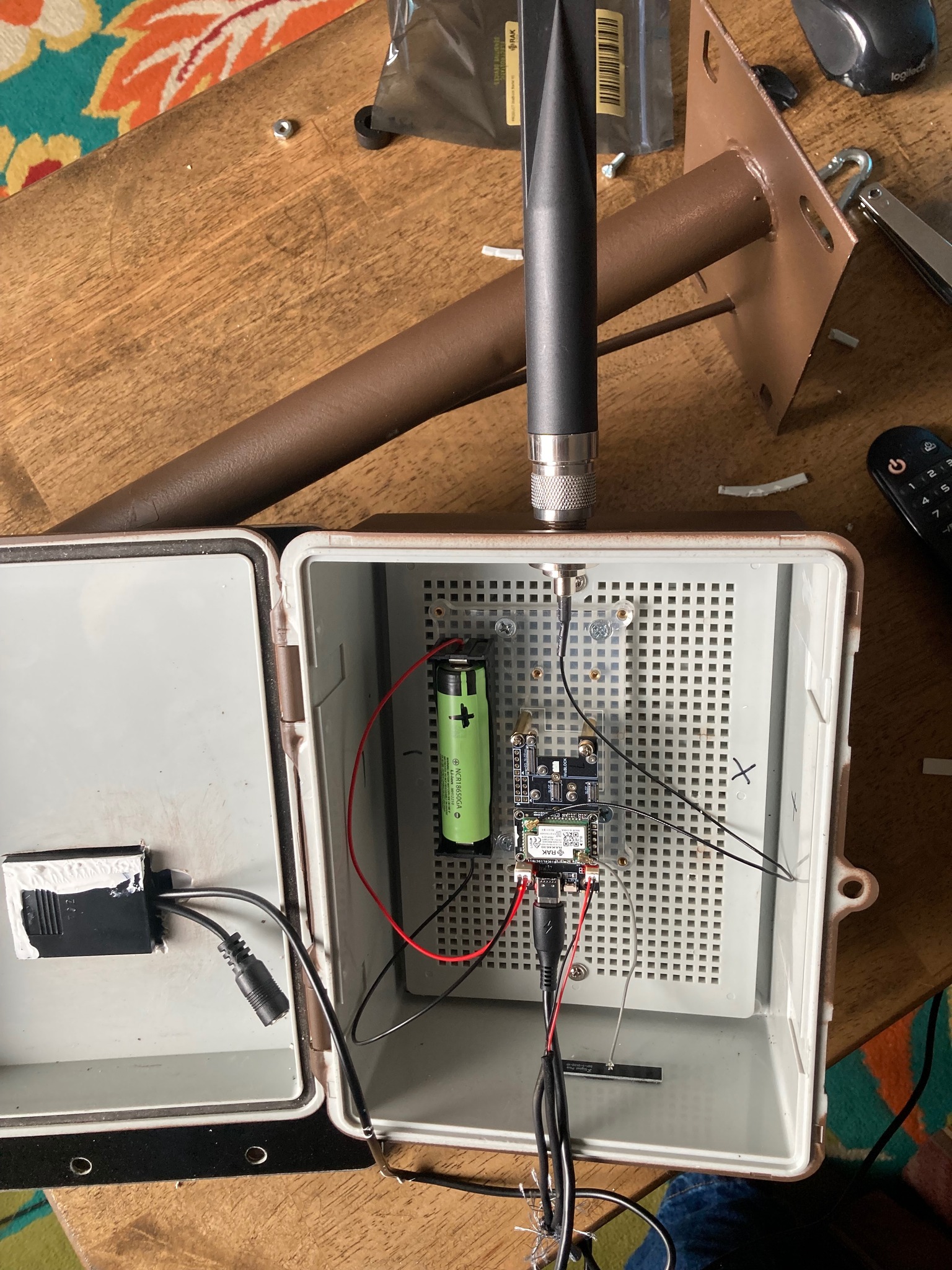
The image depicts the interior of a light grey plastic project box. Inside, various electronic components are visible. A green 18650 lithium-ion battery is secured to the side with clear tape. A small printed circuit board (PCB) with surface-mounted components occupies the center. Wiring is visible connecting the battery to the PCB and extending to connectors on the side. A black cable with a circular connector is also present. The interior of the box has a grid-like perforated surface. The box rests on a textured brown wooden surface; there is a vibrant and colorful rug in the background and some other electronics partially visible around the box. A soldering iron is partially in frame.
Foucauldian Genealogical Discourse Analysis
This image offers a potent entry point for a Foucauldian analysis focused on the discourse of maker culture and the shift towards individual empowerment through technological fabrication.
The project box, the battery, the PCB, and wiring represent a technological apparatus that isn't simply about functionality. It’s about a discourse of self-sufficiency in the digital age. The act of building something oneself, of “hacking” or “making,” is imbued with a specific history of ideas – a move away from reliance on pre-packaged consumer goods and towards active participation in technological creation.
The tools visible – the soldering iron, the wires, the components – are not neutral instruments. They embody a power/knowledge dynamic. The knowledge required to manipulate these tools (soldering, electronics, coding) confers a particular form of power. The DIY ethos, while seemingly liberatory, can also create new exclusions: those without access to resources, knowledge, or time are further marginalized.
A genealogical approach would trace the historical development of this “maker” discourse – its roots in counter-cultural movements, the rise of the personal computer, the open-source software movement, and the contemporary anxieties about technological control. The image, therefore, isn't just a snapshot of a project; it's a manifestation of a complex historical and discursive formation.
Critical Theory
From a Critical Theory perspective, this image can be examined through the lens of instrumental rationality. The focus on building and assembling suggests a prioritization of means over ends. While the purpose of this project isn't visible, the emphasis on how something is made can eclipse questions about why it is being made or what its societal implications might be.
The project box, in this context, could be seen as a manifestation of a desire for control in a world perceived as increasingly complex and alienating. By building something oneself, the maker attempts to regain a sense of agency and mastery over technology. However, this pursuit of control can also be viewed as a form of reification – treating technology as an end in itself, rather than a tool for human flourishing.
Furthermore, the image embodies the logic of capitalism. The purchase of components, the investment of time and effort, and the potential for creating a product that can be commodified or used to generate value all point to the pervasive influence of economic forces. Even the DIY ethos can be co-opted by capitalist logic, becoming another form of consumption and self-optimization.
Marxist Conflict Theory
While subtle, a Marxist reading of the image can focus on the means of production. The maker is taking control of the process of creating a technological object, potentially challenging the traditional power dynamics between producers and consumers. This, however, is a limited form of resistance.
The components themselves (battery, PCB, wiring) are products of labor extracted from various sources, likely in a globalized supply chain with exploitative labor practices. The maker's “autonomy” is therefore built upon the backs of workers elsewhere.
The image could also be interpreted as a micro-level expression of class struggle. The maker, through self-reliance and technological skills, attempts to circumvent the need for expensive, pre-made products. This can be seen as a rejection of the capitalist system and an assertion of independence. However, this is ultimately a limited form of resistance, as it does not address the systemic inequalities that underpin the capitalist mode of production.
Postmodernism
From a postmodern perspective, the image challenges the notion of a singular, coherent meaning. The project is incomplete, a work-in-progress. This reflects the postmodern emphasis on fragmentation, uncertainty, and the rejection of grand narratives.
The act of “hacking” or “making” can be seen as a playful deconstruction of existing technologies. The maker is not simply replicating a pre-existing design but rather remixing and reconfiguring components to create something new. This embodies the postmodern emphasis on pastiche and intertextuality.
The image also highlights the fluidity of identity. The maker is not a passive consumer but an active creator, constantly shaping and reshaping their own technological landscape. This reflects the postmodern emphasis on subjectivity and the rejection of essentialist notions of self.
Queer Feminist Intersectional Analysis
This analysis is the most challenging to apply directly to the image, as it doesn't inherently address issues of gender, sexuality, or intersectionality. However, we can consider the following:
- Access and Privilege: The ability to engage in DIY electronics requires a degree of privilege – access to resources (money, tools, knowledge) that are not equally distributed. This intersects with gender, race, and class. Historically, STEM fields have been dominated by white men, creating barriers to entry for women and people of color.
- Deconstruction of Binary Logic: Electronics operates on binary code, a fundamental binary logic. “Hacking” and remixing this logic can be seen as a metaphorical disruption of binary systems of thought that underpin oppressive social structures.
- Subverting Normative Technical Spaces: DIY electronics can be seen as a space for creating alternative technologies that challenge the dominant narratives and power structures. For example, creating accessible technologies for disabled people or developing open-source tools that promote social justice.
- The Body and Technology: The image highlights the materiality of technology and its connection to the human body. The act of building and manipulating these components can be seen as a way of reclaiming control over our relationship with technology and challenging the notion of technology as a neutral force.
I hope this provides a comprehensive analysis of the image from the requested theoretical perspectives. It’s important to remember that these are interpretations and other readings are possible. Let me know if you'd like me to elaborate on any of these points or explore additional theoretical frameworks.
tesseract-ocr
a “(Vale ag "le | De . A. saan’ xe ae ; Fn A * Sah )) | | FF \ f a Se age es Das! cf py tme 2 Cee ' : ie shit ; ‘ Le ol - ‘ > es befor ee ——e—E—e—E — 2 a , | a \ 4 i 1 “ah » BEB B PERE | \ Bestest: ff i Ser ys@.grrtii: : a SiUseene Oe Roe ' Seer Acco: decsss:: 1 | RSEBGE EEE Pm EE Pao | ¥ LR Scrsci::: pS le al a | BMicciscissss: | | \ Bee cisicissis: | . N | 3° semen ee a \ (3 _ — 7 i \ he fl Ss —= = *?7—-.,. VW ~ 5 ll OSE G es G #12
simple-description (llama3.2-vision)
The meme is a photo of a small, DIY-style computer or device with a label that says "Raspberry Pi" on it. The device is surrounded by various electronic components and wires, suggesting that it's a homemade project. The text "I'm not a computer, I'm a Raspberry Pi" appears on a sign in the background.