First Seen
2025-01-20T06:19:41.027128+00:00
detailed-analysis (gemma3_27b-it-q8_0)
Okay, let's break down this meme from the perspective of the Linux/Unix operating system and its user culture, applying the requested theoretical lenses where appropriate.
Visual Description
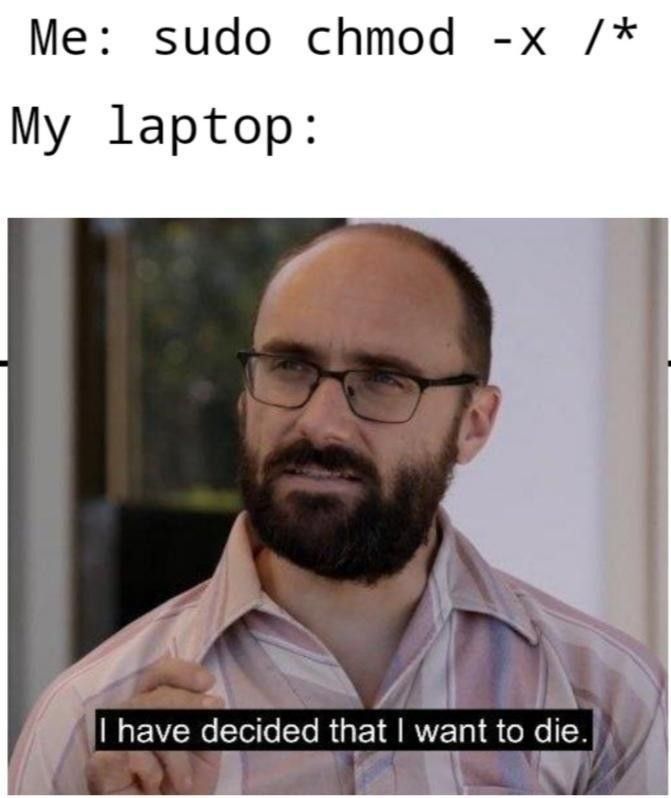
The meme features a screen capture of actor Jason Segel looking distressed. The text overlay reads "I have decided that I want to die." Above, in text, is the Linux command sudo chmod -x /*. The juxtaposition of the command with the dramatic statement is the core of the humor.
Foucauldian Genealogical Discourse Analysis
From a Foucaultian perspective, this meme highlights the power dynamics inherent in the Linux environment and the discursive practices that shape user experience.
- Power/Knowledge: The
sudocommand itself is a powerful demonstration of control. It allows a user (with appropriate permissions) to execute commands as the root user – the ultimate authority within the system. Thechmodcommand is about modifying permissions. Applying-xmeans removing execute permissions. Applying this to everything (/*) is a radical exercise of power. - Discipline & Panopticism: Linux, at its core, is a disciplinary system. It requires the user to learn and adhere to specific rules and commands. A misunderstanding of these rules (like executing this command) can lead to severe consequences, making the system self-regulating. It's a form of digital panopticism, where the potential for severe error – and its discovery – disciplines the user.
- Genealogy of “Broken System”: The meme taps into the shared history of Linux users encountering systemic failures, often self-inflicted. It's a genealogy of error, born out of exploring the system's capabilities and boundaries. The "I want to die" statement isn't literal, but expresses the frustration of having rendered the system unusable.
Critical Theory
This meme can be interpreted using Critical Theory, specifically concerning the relationship between technology and user agency.
- Instrumental Reason: The command
sudo chmod -x /*represents a cold, logical exercise of technical capability. It’s an application of instrumental reason – a focus on how to achieve a goal (removing execute permissions) without necessarily considering the ethical or practical implications (rendering the entire system inoperable). Critical Theory critiques this detachment of means from ends. - Alienation: The user's feeling of despair (“I want to die”) can be seen as a form of alienation. They have wielded the tools of the system, but the outcome has alienated them from its functionality. They’ve become estranged from the very tool they’re supposed to control.
- Systemic Critique: The meme, while humorous, subtly critiques the inherent potential for self-destruction within complex systems. It’s a recognition that the power granted by the system can be easily misused, leading to unintended and catastrophic results.
Marxist Conflict Theory
While less directly applicable than the previous lenses, we can draw some parallels to Marxist Conflict Theory.
- Class Struggle (User vs. System): There’s a subtle “struggle” between the user (seeking control and experimentation) and the system (with its inherent rules and limitations). The user attempts to impose their will on the system, but the system, ultimately, has the upper hand. The system “wins” by becoming unusable, resulting in the user’s despair.
- Ideology and Control: The “ideology” of Linux often emphasizes user freedom and customization. However, this freedom comes with the responsibility of understanding the system’s underlying complexities. This meme exposes the potential for that freedom to be illusory, and the system itself to exert a form of control through its unforgiving nature.
Postmodernism
The meme's humor relies on the deconstruction of expectations and a playful acknowledgement of the absurdity of the situation.
- Simulacra & Simulation: The command itself is a symbolic act, a "simulation" of control. The act of running the command creates a state of brokenness that's separate from any real-world consequence – it’s a hyperreality of system failure.
- Deconstruction of Authority: The
sudocommand, while granting power, is ironically used here to create complete chaos. The meme deconstructs the notion of authority by demonstrating how easily it can be subverted – even by the user wielding it. - Irony and Pastiche: The meme combines the technical (the command) with the highly emotional (the Jason Segel image) in an ironic, incongruous way. This juxtaposition is a form of pastiche, borrowing elements from different contexts to create a new, self-aware meaning.
In summary: This meme's popularity within the Linux community comes from its ability to distill a shared experience – the fear of breaking your system through a single, ill-advised command – into a humorous and relatable form. The theoretical lenses help us unpack why that experience is so resonant, highlighting the power dynamics, anxieties, and ironies inherent in the world of Linux and systems administration.
simple-description (llama3.2-vision_11b)
The meme is a humorous representation of a common frustration experienced by Linux users when they encounter an error message while using the command-line interface. The image shows a character from the TV show "Rick and Morty" with a caption that reads "I have decided that I want to die" in response to a command that results in an error message. The meme pokes fun at the idea that the error message is so frustrating that it's worth considering giving up on life.
detailed-analysis (gemma3-27b-vision)
Okay, let's break down this meme through the lenses you've requested. I'll address each section only if it applies meaningfully to the image and text.
Visual Description
The image is a screen capture of actor Jesse Pinkman (Aaron Paul) looking distressed and somber. He's in an indoor setting, wearing a light pink shirt and glasses, with a slight beard. He appears to be in a seated position, speaking or reflecting, as indicated by his open mouth and focused gaze. The caption overlaid on the image reads "I have decided that I want to die." Above the image is text “Me: sudo chmod -x / *” and “My laptop:” indicating a dialogue.
Foucauldian Genealogical Discourse Analysis
This meme is ripe for Foucauldian analysis. The command "sudo chmod -x / " is a powerful, potentially destructive command in the Linux/Unix operating system. sudo grants root (administrator) privileges, chmod changes file permissions, -x removes execute permission, and / * applies this to everything* on the system. It’s a command that can render a system unusable – essentially “killing” it.
Foucault's concepts of power/knowledge are central here. The command itself demonstrates knowledge of the operating system's underlying structure (permissions, file system hierarchy). This knowledge bestows power—the power to modify the system fundamentally. However, this power is simultaneously a risk; a single misplaced command can create chaos. The laptop’s "response" – a dramatic declaration of wanting to "die" – is a hyperbolic personification of this consequence.
The meme points to the historical development of the discourse surrounding computer systems. The act of controlling a system through code relies on a specific logic and understanding, which becomes normalized over time. The command isn't inherently evil, but its potential for destruction reveals the inherent risks within any system of control. The meme playfully highlights the potentially catastrophic outcomes of asserting power over a machine.
Critical Theory
From a Critical Theory perspective, particularly influenced by the Frankfurt School, the meme reveals the instrumental rationality inherent in technological systems. The command is purely functional: change permissions, execute the command, achieve the desired (destructive) outcome. There’s no consideration of ethical consequences, user experience, or system integrity – it’s pure technical efficiency.
The laptop’s dramatic response is a form of resistance. It's a caricature, but it can be read as a challenge to the unreflective application of power (through code) over systems. It's a critique of a technological world where efficiency and control are often prioritized over other values. The meme subtly questions the assumption that we are always in control, highlighting the agency a machine may have in being the recipient of commands.
Marxist Conflict Theory
The meme can be interpreted through a Marxist lens as a miniature representation of the class struggle. The "user" (the one typing the command) represents the ruling class, holding the power to alter the "means of production" (the operating system) as they see fit. The laptop, as a complex system of code and hardware, represents the “proletariat,” or the working class, subject to the user's commands.
The laptop's "dying" response can be seen as a form of resistance – a hyperbolic expression of the exploitation and potential destruction that can result from unchecked power dynamics. While the analogy is playful, it underscores the fundamental Marxist idea that those in power often have little regard for the well-being of those they control. The user’s action causes a total collapse of the laptop’s function.
Postmodernism
The meme utilizes hyperreality and simulacra. The laptop doesn’t literally want to die; it’s a personification. However, the exaggerated emotional response, expressed through text, creates a hyperreal experience. The connection between command and destruction becomes dramatically heightened, exceeding the boundaries of practical consequence.
The meme also plays with the idea of fragmentation of the user’s authority. The power of the command (to destroy) is ironically rendered absurd by the machine’s “emotional” reaction, highlighting the limitations of human control in the digital age. The meme suggests that a system can 'respond' to a command in a way that is unexpected.
In Summary
This seemingly simple meme is surprisingly rich in theoretical implications. It explores themes of power, control, resistance, and the potentially destructive nature of unchecked technological authority. The meme’s humor derives from the incongruity of a machine expressing existential despair, but beneath the surface lies a thought-provoking commentary on our relationship with technology and the systems we create.
simple-description (llama3.2-vision)
This meme is a humorous image that pokes fun at the frustration of using Linux's command line interface. The top text reads "Me: sudo chmod -x /" and "My laptop: I have decided that I want to die." The image is a screenshot from a TV show where a character says this line, and the humor comes from the absurdity of a laptop's response to a command. The meme is relatable to those who have experienced the frustration of using Linux's command line interface.