First Seen
2023-05-10T21:03:35+00:00
simple-description (llama3.2-vision_11b)
This meme is a play on the idea that leftists often use Twitter to share their opinions and engage in online debates. The meme is referencing a tweet from a user named @leftistguy, who has a profile picture of a cartoonish, exaggeratedly angry-looking left-wing figure. The tweet says "I'm not a lefty, I'm a communist" and is accompanied by a photo of a hammer and sickle, a symbol of communism.
detailed-analysis (gemma3-27b-vision)
Okay, here's an analysis of the social media exchange (a pair of tweets) broken down into sections based on the frameworks you requested, only including those that are relevant and applicable.
Visual Description
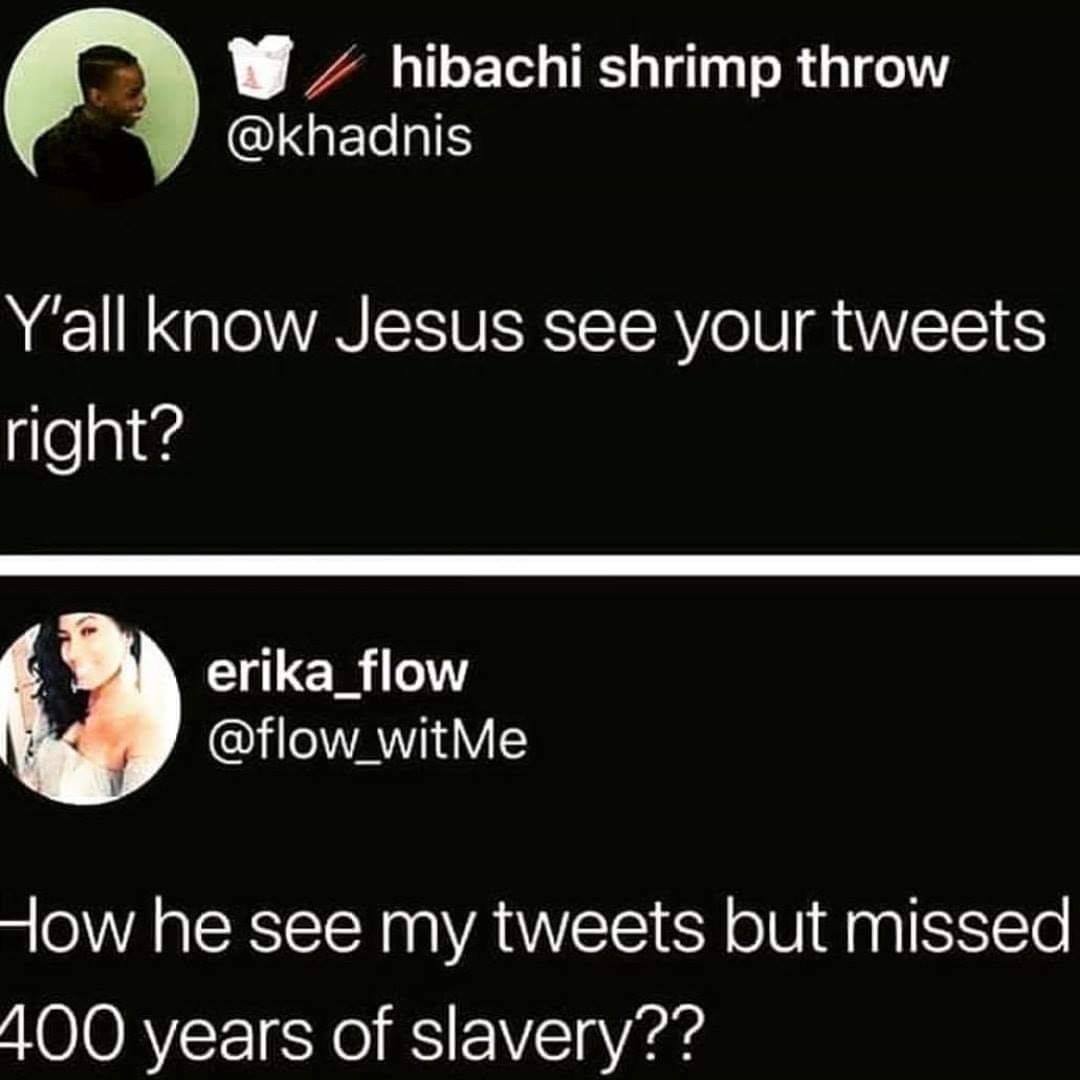
The image displays two Twitter screenshots. Each screenshot features a user profile picture (one a silhouette, one a headshot) and a Twitter handle. Both screenshots contain text in a white font against a black background. The first tweet from @khadnis asks the rhetorical question, "Y'all know Jesus see your tweets right?". The second tweet from @flow_witMe is a response, questioning "How he see my tweets but missed 400 years of slavery??". The overall visual is minimal and the focus is entirely on the textual content.
Critical Theory
This exchange powerfully utilizes the core tenets of Critical Theory. The primary issue here is power—specifically, the power dynamics surrounding religion, visibility, and historical injustices. @flow_witMe’s response is a sharp critique of the prioritization of online surveillance by a divine figure over the acknowledgement of centuries of systemic oppression. This challenges the established order of things: it questions why a purportedly all-knowing being would seemingly overlook a deeply traumatic historical reality while paying attention to trivial social media posts.
The tweet reveals an indictment of the ways in which systems of power (in this case, religious authority) can selectively recognize and ignore suffering. The question is not necessarily about whether Jesus literally sees tweets, but about the symbolism of that assertion and the implication that modern online activity is seen as more important or visible than enduring historical trauma. It also points to how these systems often operate to maintain existing power structures by obscuring or minimizing the suffering of marginalized groups. The critique is aimed at a perceived hypocrisy inherent in the claim of divine awareness.
Postmodernism
This exchange exhibits elements of postmodern thought. The juxtaposition of the sacred (Jesus) with the profane (tweets) and the hyperreal (social media) is inherently postmodern. It deconstructs traditional notions of divinity and authority by placing them within the context of contemporary digital culture.
The very act of questioning a traditional belief (Jesus’ awareness) through the lens of a modern technology (Twitter) is an example of postmodern playfulness and a rejection of grand narratives. It challenges the established idea of how divine beings interact with humanity, proposing a satirical view that mocks the notion of a heavenly power focusing on trivialities while ignoring real-world systemic issues. It is a disruption of the expected and a destabilization of meaning.
Queer Feminist Intersectional Analysis
While not the primary focus, a queer feminist intersectional lens adds depth to the analysis. The user @flow_witMe positions herself as a Black woman questioning a historically patriarchal religious figure. The 400 years of slavery and its legacy deeply impacts Black women in unique ways. The question implicates a power dynamic where those historically marginalized (Black women, in this context) have had their suffering overlooked by institutions that claim to offer protection or salvation.
The question subtly highlights the ways in which these systems are often built to serve the interests of those in power, reinforcing hierarchies of race, gender, and class. The intersectional lens acknowledges that oppression isn’t singular—it is a complex web of interconnected systems, and the critique is directed at the ways these systems work together to deny visibility and justice to those on the margins.
Let me know if you’d like a more detailed exploration of any specific aspect of this analysis, or if you have other frameworks you'd like me to apply!
simple-description (llama3.2-vision)
This meme is a conversation between two Twitter users. The first user, "hibachi shrimp throw", asks if everyone knows Jesus is seeing their tweets. The second user, "erika_flow", responds with a humorous and unexpected answer, asking how Jesus would know their tweets but miss 400 years of slavery.
tesseract-ocr
we WZ hibachi shrimp throw @khadnis Y'all know Jesus see your tweets right? , erika_flow : @flow_witMe tow he see my tweets but missed 400 years of slavery??