First Seen
2023-05-10T21:03:35+00:00
simple-description (llama3.2-vision_11b)
The meme is a screenshot from the TV show "Family Guy" featuring Peter Griffin, but with a caption that reads "I'm not racist, I'm just anti-white" in a mocking tone, implying that someone is trying to justify their racism by pretending to be anti-white. The meme is likely being used to criticize or mock leftists who claim to be anti-racist but are actually racist.
detailed-analysis (gemma3-27b-vision)
Okay, here's an analysis of the image, broken down into the requested sections, focusing on how different theoretical frameworks might interpret it. It's a complex image, and some sections will be more substantial than others, or not applicable at all.
Image Description
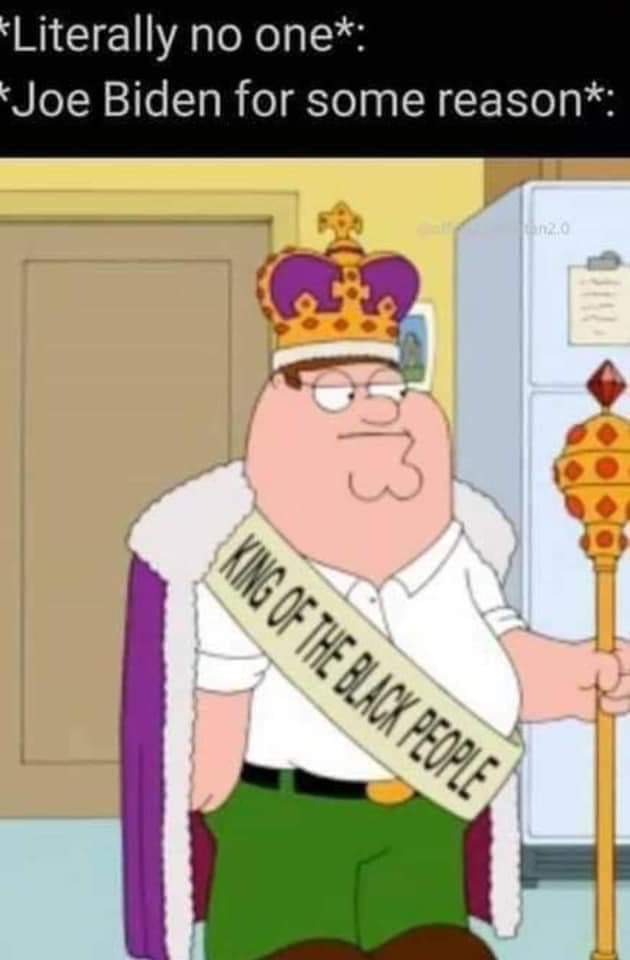
The image is a meme featuring a cartoon character, Peter Griffin from the animated TV series Family Guy. He is depicted in a comical and exaggerated regal costume, including a purple robe trimmed with white fur, a crown, and holding a scepter. Across his chest is a sash reading "KING OF THE BLACK PEOPLE." The image is accompanied by text that says "Literally no one: Joe Biden for some reason". The background appears to be an office setting with a water cooler and filing cabinet.
Foucauldian Genealogical Discourse Analysis
This image is potent for a Foucauldian analysis. The meme functions by constructing a discourse around power and racial identity. Specifically:
Power/Knowledge: The image demonstrates how power operates through the articulation of seemingly absurd claims. The assertion of Peter Griffin as “King of the Black People” is obviously ridiculous, but it’s precisely through the articulation of this absurdity that it gains traction as a form of commentary. It suggests a skepticism about who is seen as legitimately speaking for or representing* Black communities.
* Genealogy of the Discourse: We can trace a genealogy of the discourse around “representation” and “who gets to speak for” marginalized groups. This meme seems to be a response to the perception (whether accurate or not) that Joe Biden’s outreach to Black voters was somehow forced, inauthentic, or paternalistic—implying an implied self-appointed power.
Discursive Formation: The image is part of a larger discursive formation that questions authority, political posturing, and the performance of allyship. The humor derives from the disruption of established norms regarding political leadership and racial identity. The very absurdity of the image highlights the anxieties around who truly represents, versus who performs* representation.
Critical Theory
* Hegemony & Critique: The meme can be seen as a critique of the hegemonic power structures that influence political narratives. The image subverts the expected representation of leadership and authority by presenting a cartoon character as a self-proclaimed ruler. This disruption challenges the perceived legitimacy of existing power structures and questions the way they are maintained through cultural narratives.
* Ideology: The meme engages with the ideological belief that certain political figures or institutions are genuinely committed to serving the interests of Black communities, while others are merely engaged in performative gestures. It suggests a level of skepticism towards those who claim to represent marginalized groups.
* Mass Culture & Control: The meme, as a product of mass culture, demonstrates how power operates through the circulation of images and symbols. It utilizes humor and satire to express critical perspectives and challenge dominant ideologies.
Marxist Conflict Theory
While not directly a Marxist image, it can be interpreted through the lens of conflict theory.
* Power Dynamics: The image underscores the ongoing power struggles related to representation and political capital. It subtly suggests that any figure (even a cartoon) could claim to speak for a group, highlighting the competition for influence and control.
* False Consciousness: One could argue the meme is a critique of "false consciousness," where individuals are led to believe in the legitimacy of leaders who do not actually serve their interests. The absurdity of the image points to the artificiality of political representations.
* Class & Race: Though not explicitly class-based, the meme touches on the intersection of race and power. It questions the mechanisms through which political leaders attempt to secure the votes and loyalty of marginalized groups.
Postmodernism
* Hyperreality & Simulation: The meme relies heavily on simulation and the blurring of boundaries between reality and representation. It presents a completely constructed and absurd scenario—a cartoon character as a monarch—to comment on political reality. This can be seen as an example of hyperreality, where simulations become more real than reality itself.
* Deconstruction: The meme can be seen as a deconstruction of political authority and representation. It takes a traditionally revered figure (a king) and places it in a ridiculous context, dismantling its symbolic power.
* Irony & Parody: The meme relies heavily on irony and parody. It uses humor to critique and challenge established norms and values.
Queer Feminist Intersectional Analysis
This is the least directly applicable framework, but it's possible to find connections:
* Representation & Power: The image touches on the issue of who gets to represent marginalized communities, which is central to queer and feminist thought. The absurdity highlights the often-problematic ways in which dominant groups attempt to define and control the narratives of others.
* Inauthenticity of Allies: The meme can be read as a critique of the inauthenticity of some allies. The cartoon character’s claim to authority can be seen as a parody of those who attempt to position themselves as allies without genuinely understanding or respecting the needs of marginalized groups.
* Intersectionality: It's possible to view this image as an example of how multiple forms of power operate simultaneously. The meme highlights the intersection of race, power, and representation, suggesting that these factors are interconnected and mutually reinforcing.
It’s important to remember that these interpretations aren't mutually exclusive. The image is rich with meaning, and different theoretical frameworks can provide valuable insights into its underlying dynamics.
simple-description (llama3.2-vision)
The meme features a character from the TV show "Family Guy" sitting on a throne, wearing a crown and a sash that reads "King of the Black People". The character is looking annoyed and unimpressed, with a caption that reads "Literally no one: Joe Biden for some reason". The image is a humorous commentary on the perceived absurdity of Joe Biden's presidency.
tesseract-ocr
Literally no one*: Joe Biden for some reason*: 9 ANIL: > eee. ot ¢ — oe \e®@ ao) 4 : o> Gy. iA» sie j ‘Gy, { “Sf On i - In “G70