First Seen
2023-05-10T21:03:35+00:00
simple-description (llama3.2-vision_11b)
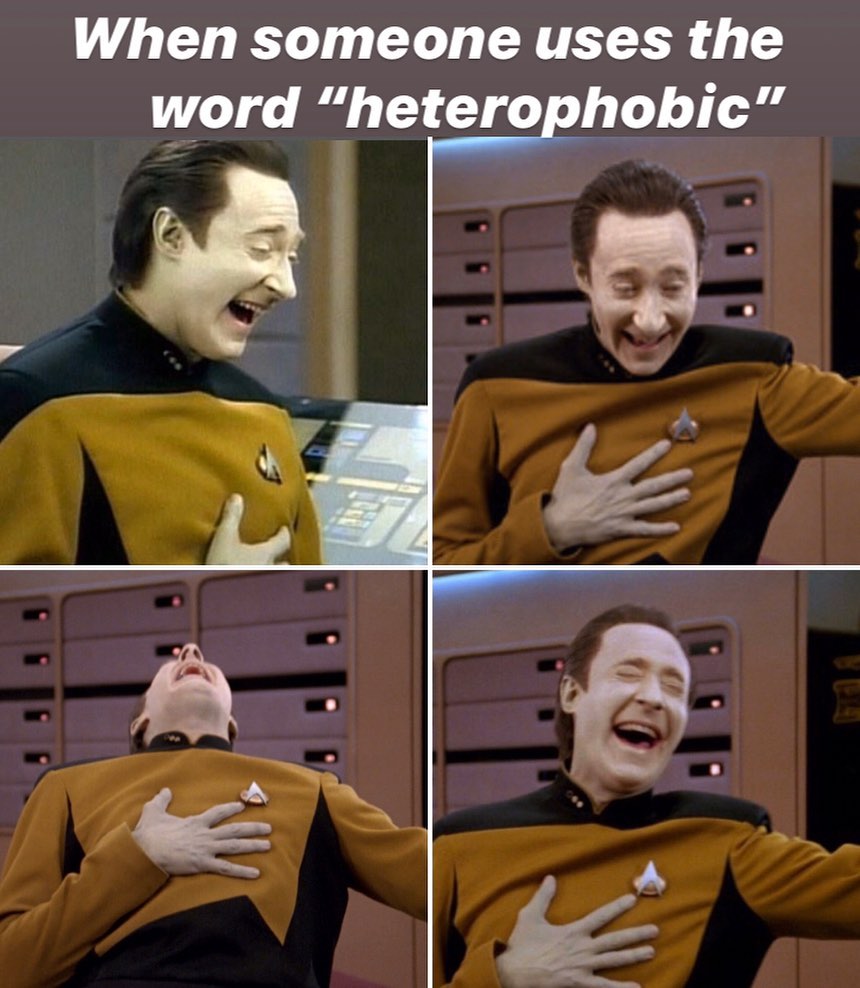
The meme is a play on the term "leftist" and the concept of being a "leftist" in a derogatory way. The image is of a character from the Star Trek franchise, Data, who is known for his literal interpretations of human behavior and language. The text overlay says "When you're a leftist but you don't know what a leftist is" and Data's expression is one of confusion and embarrassment.
detailed-analysis (gemma3-27b-vision)
Okay, let's break down this meme through a series of theoretical lenses. It's a rich image, ripe for analysis.
## Visual Description
The image is a four-panel meme featuring Patrick Stewart as Captain Jean-Luc Picard from Star Trek: The Next Generation. In each panel, Picard reacts with increasing theatrical distress. He clutches at his chest, his face contorting into an expression of shock and pain. The background is a standard interior setting from the Star Trek series – a corridor with a futuristic, slightly purple-toned metallic finish, with control panels visible. The text overlay reads “When someone uses the word ‘heterophobic’”. The meme leverages a well-known character and a heightened emotional response to convey a specific reaction to the word "heterophobic." It presents a hyperbolic and potentially satirical critique of the term.
## Foucauldian Genealogical Discourse Analysis
This meme is a potent example of how discourse shapes our understanding of power. The term "heterophobic" is being presented as something that causes a dramatic, even physical, reaction. Foucault’s work emphasizes that power isn't simply repressive, but productive—it creates the categories and knowledge systems we use to understand the world.
The meme highlights a particular discursive struggle around the language used to discuss prejudice and discrimination. Some may see the term “heterophobic” as a legitimate parallel to homophobia (fear or dislike of gay people) and an attempt to recognize discrimination against heterosexuals. Others (as this meme suggests) may see it as a misnomer, a hyperbolic attempt to equate legitimate forms of oppression with potential discomfort or social awkwardness experienced by heterosexuals. The meme aims to delegitimize the term by portraying it as absurd or even offensive.
Foucauldian analysis would explore the history of these terms. How did “homophobia” itself come to be understood? How is “heterophobia” framed in relation to that historical development? What power dynamics are at play in the struggle over these terms and their meanings? The meme doesn’t resolve these questions, but it draws attention to the fact that they exist.
## Queer Feminist Intersectional Analysis
This meme can be deeply analyzed through a Queer Feminist Intersectional framework. It touches on several crucial points.
Firstly, the implied criticism of the term “heterophobic” often stems from a resistance to acknowledging that heterosexuals can experience prejudice or discrimination, even if it isn’t systemic in the same way as homophobia or other forms of oppression. However, an intersectional approach recognizes that all individuals, including those belonging to dominant groups, can be subject to prejudice based on various intersecting identities.
Secondly, the meme taps into debates about the equivalence of different forms of prejudice. Queer theory questions universalizing assumptions about oppression and emphasizes the specificity of different experiences. The meme implicitly critiques the use of the "phobia" suffix for a discomfort that doesn't align with clinically defined phobias or systemic oppression.
Furthermore, it can be read as a critique of the appropriation of the language of marginalized groups. Using the "phobia" suffix—historically associated with experiences of marginalized communities—to describe discomfort experienced by heterosexuals can be seen as diminishing the weight of that terminology and erasing the experiences of those who truly suffer from systemic discrimination.
Finally, a feminist lens highlights how power dynamics are at play, with the meme potentially functioning as a form of backlash against attempts to challenge heteronormativity.
Important Note: I have provided an analysis based on the potential implications of the meme and the theoretical frameworks applied. The interpretation is subjective and open to debate. The meme is, after all, designed to provoke a reaction and spark conversation, and its meaning can vary depending on the viewer's own perspective and experiences.
simple-description (llama3.2-vision)
This meme features a character from the TV show "Star Trek: The Next Generation" named Jean-Luc Picard, played by actor Patrick Stewart. The meme shows Picard in a series of comedic, exaggerated expressions of embarrassment or discomfort, with the text "When someone uses the word 'heterophobic'" above the images. The meme is poking fun at the idea that someone might be offended or embarrassed by the word "heterophobic", which refers to a person who is prejudiced against or dislikes people who are not of the same sex or sexual orientation.
tesseract-ocr
When someone uses the word “heterophobic” pir | Veer : Pr Fi ‘ , uy S / GAA - si eI y Fi ~ yw te 7 7% —* r Ac ~ ; . My Cunt Z if _ ai On Ae a 7 | (“A be >