First Seen
2023-05-10T21:03:35+00:00
simple-description (llama3.2-vision_11b)
This meme is a screenshot of a Twitter post from a user named @Ludovico, who is criticizing the platform's algorithm for promoting a tweet about a left-wing news article that is getting a lot of engagement. The tweet reads "I just read the most accurate thing I've ever read on the internet" and is followed by a screenshot of a news article about a left-wing politician's speech. The meme is a commentary on the way social media platforms can manipulate users into engaging with certain types of content, and how this can be used to promote a particular ideology or agenda.
detailed-analysis (gemma3-27b-vision)
Okay, here's an analysis of the Twitter post, broken down into sections based on the theoretical frameworks you requested. Note that some frameworks are more directly applicable than others, and I'll indicate when a section is less strongly connected.
## Visual Description
The tweet originates from a user with the handle "@lyrratc" and username "lucy @ ECLIPSE". Their profile picture is a stylized digital illustration of a person with vibrant blue hair, pale skin, and a dramatic, somewhat gothic-inspired outfit, including a dark-colored coat or cape with white trim. They are adorned with multiple earrings, and the overall aesthetic suggests a subcultural, potentially alternative, sensibility. This visual identity potentially establishes the poster as someone with a critical or unconventional perspective.
## Foucauldian Genealogical Discourse Analysis
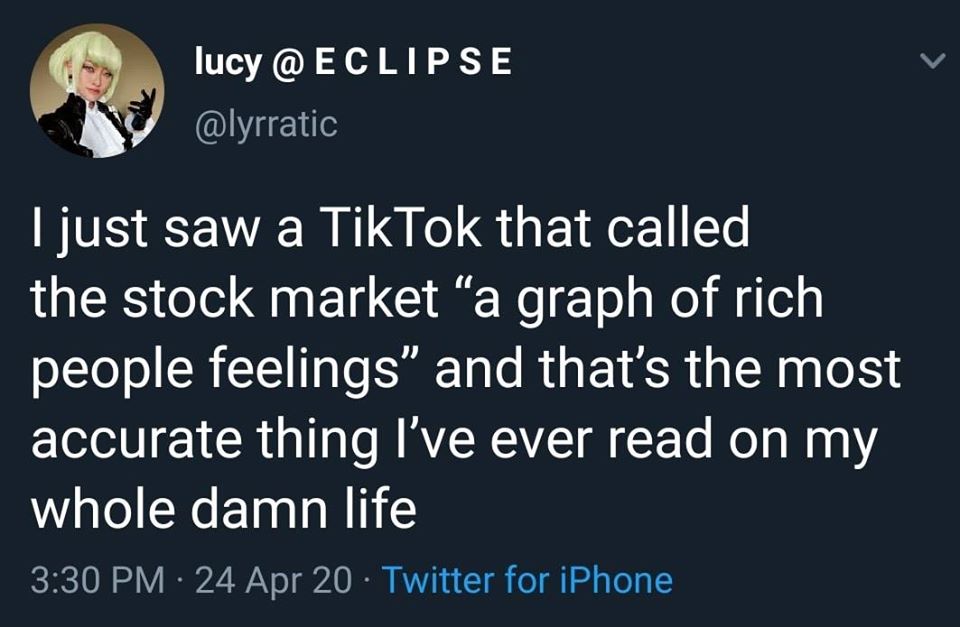
This tweet provides a strong starting point for a Foucauldian analysis. The post focuses on the discourse surrounding the stock market. Typically, the stock market is discussed in terms of economic indicators, rational investment, and objective data. Lucy @ ECLIPSE's reaction to the TikTok reframes this discourse entirely, proposing that the stock market is not about objective value, but is instead a representation of the subjective "feelings" of a very specific group – the wealthy.
A genealogical approach asks us to investigate how this dominant discourse about the stock market came to be established, and what power relations it serves. The traditional discourse obscures the emotional, often irrational, forces at play. It masks the role of fear, greed, and speculation in market movements. By highlighting the "feelings" of the rich, the TikTok and Lucy's affirmation challenge the notion that the market is governed by logic and reason, exposing it as a socially constructed phenomenon deeply rooted in power.
The post also suggests that language itself constitutes reality. By labeling the stock market a "graph of rich people's feelings", it actively creates a new understanding of it.
## Critical Theory
The tweet aligns with many principles of Critical Theory, especially the Frankfurt School’s emphasis on critique of dominant ideology. The traditional framing of the stock market as a neutral, objective system serves to legitimize wealth inequality. This framing obscures the ways in which the stock market actively contributes to the accumulation of capital by a select few, and ignores the social consequences of this accumulation.
The tweet implicitly critiques this legitimization. By reframing the market in terms of “feelings,” it demystifies the economic logic, implying that it’s driven by the whims and anxieties of the wealthy—a force divorced from genuine societal need or ethical consideration. It is a questioning of the cultural hegemony of capitalism.
## Marxist Conflict Theory
This tweet can be seen through a Marxist lens as a statement on class conflict. The stock market is inherently tied to the means of production and the extraction of surplus value. The assertion that it reflects the "feelings" of the rich highlights the disconnect between the economic interests of the wealthy and the material conditions of the working class.
The "feelings" being represented are not those of need, fairness, or social responsibility, but rather those of greed, fear of loss, and a drive for ever-increasing wealth. This reinforces the idea that the capitalist system operates on a fundamentally exploitative basis, benefiting a small minority at the expense of the majority. The market, therefore, isn’t a reflection of economic health, but a barometer of the emotional state of the ruling class.
## Postmodernism
The statement itself carries a postmodern flavor. It rejects the notion of a singular, objective truth about the stock market. Instead, it proposes a subjective interpretation—a "feeling"—as being just as valid (if not more so) than traditional economic analyses. The re-labeling of the stock market as “a graph of rich people’s feelings” is a deconstruction of established meaning.
It also reflects the postmodern emphasis on the instability of language and the constructed nature of reality. By challenging the dominant discourse, the tweet suggests that meaning is not inherent in the stock market itself, but is rather created through social interpretation.
## Queer Feminist Intersectional Analysis
This lens is the least directly applicable, but can still be teased out. While the tweet doesn’t explicitly address gender, sexuality, or other forms of social identity, the act of disrupting a traditionally masculine, economically-focused discourse can be read as a queer act. It challenges the normative assumptions and power structures that underpin capitalism.
The focus on "feelings" itself can be seen as a move toward valuing emotional experience—something historically marginalized in both economic and patriarchal systems. And, implicitly, the extreme wealth represented in the stock market is almost certainly maintained through systems that disproportionately benefit white, cisgender men. The tweet could be seen as a rejection of this power dynamic.
Let me know if you’d like me to expand on any of these points or explore other theoretical frameworks!
simple-description (llama3.2-vision)
The meme is a screenshot of a tweet from a user named "lucy" who is sharing their reaction to a TikTok video that compares the stock market to a "graph of rich people's feelings". The user is expressing their surprise and amusement at the idea that a video on the stock market could be compared to a video of people's emotions.
tesseract-ocr
lucy @ECLIPSE Vv a @lyrratic | just saw a TikTok that called the stock market “a graph of rich people feelings” and that’s the most accurate thing I’ve ever read on my whole damn life 3:30 PM - 24 Apr 20 - Twitter for iPhone