First Seen
2023-05-10T21:03:35+00:00
simple-description (llama3.2-vision_11b)
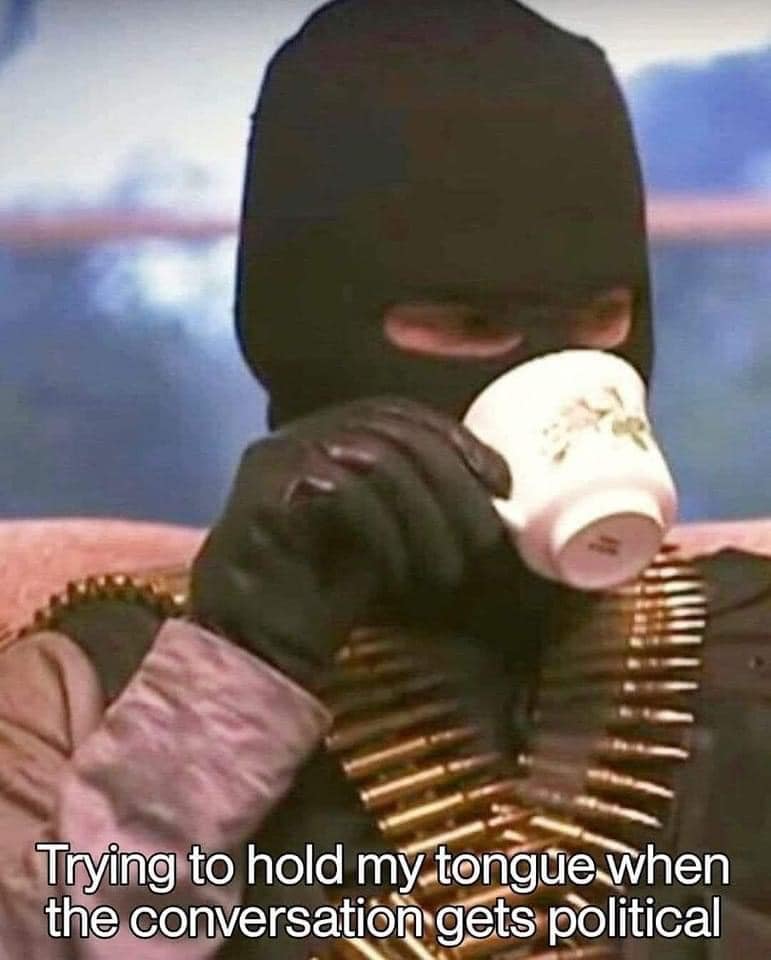
This meme is a satirical commentary on the challenges of engaging in left-wing discussions. The image depicts a person holding a cup of coffee while being shot by a machine gun, with the text "Trying to hold my tongue when the conversation gets political" overlaid. The joke is that the person is literally being shot by a gun, but is still trying to keep their mouth shut, much like how someone might try to avoid getting into a heated argument in a conversation about politics.
detailed-analysis (gemma3-27b-vision)
Okay, here's an analysis of the image, broken down into the requested sections, focusing on relevant theoretical lenses. I'll note where sections don't strongly apply.
Visual Description
The image is a still from a film, possibly a vintage action movie, depicting a figure entirely covered in black clothing. The figure wears a tight-fitting balaclava/mask covering the entire head and neck, obscuring all features except for the eyes. They are also wearing dark gloves and are clutching a large, metallic bandolier loaded with ammunition. The most striking feature is a white gag over the mouth, seemingly tying it shut. The background is an out-of-focus reddish/pinkish desert landscape with a hazy sky. The image is presented with text overlay: "Trying to hold my tongue when the conversation gets political." The lighting is slightly grainy, suggesting a low-budget or older film production.
---
Foucauldian Genealogical Discourse Analysis
This image is highly amenable to Foucauldian analysis. The central visual metaphor – the gag – represents a power dynamic and disciplinary practice.
Discipline & Panopticism: The gag is a literal manifestation of silencing. It's a mechanism of control. It is not necessarily about physical suppression of speech but about the regulation of speech. The figure is disciplined* into silence. This ties into the idea of the Panopticon, where the threat of observation and control (even if not actively enforced) is enough to shape behavior. In this case, the "conversation" itself functions as the potential surveilling power, and the desire to avoid conflict motivates the self-imposed silence.
Discourse & Power/Knowledge: The act of “holding one’s tongue” is not just about controlling words, but about controlling what counts as acceptable speech. "Political conversations" are, themselves, discourses laden with power relations. Certain viewpoints are privileged, others marginalized. By gagging the figure, the image highlights the ways in which dominant discourses can suppress dissenting or challenging voices. What’s not* being said is as important as what is.
Genealogy: We can trace a genealogy of silencing: from overt censorship and oppression to more subtle forms of social pressure, self-censorship, and the fear of judgment. The image evokes a history of political repression and control, manifesting in a contemporary (digital/meme) form. The image does not necessarily suggest an outside force suppressing speech, but an internal* act of self-discipline motivated by potential ramifications.
---
Critical Theory
The image lends itself to a Critical Theory analysis, particularly focusing on the critique of ideology and the role of communication.
Ideology & False Consciousness: The image suggests that even the attempt* to engage in political discourse can be fraught with power imbalances. The gag represents a silencing of potential critique – a suppression of counter-narratives. This can be interpreted as a symptom of dominant ideologies that perpetuate existing power structures. The figure's self-silencing can be seen as a form of internalizing dominant ideology.
* Communication & Domination: The image challenges the notion of "free speech." Whose speech is truly "free?" The figure's inability to speak suggests that genuine, uninhibited dialogue is often impossible within a highly structured and unequal social environment. The image calls into question the idea of a “rational” political debate.
* Critique of Reason: The image highlights the potential for reason and discourse to be used as tools of oppression, as opposed to liberation.
---
Marxist Conflict Theory
The image can be viewed through a Marxist lens as a manifestation of class conflict and the suppression of dissent.
* Power & Oppression: The gag symbolizes the suppression of the voices of the oppressed or marginalized. The figure's silence can be seen as a consequence of the fear of retribution from those in power.
* False Consciousness: The act of self-silencing can be interpreted as a manifestation of “false consciousness,” where the individual internalizes the ideology of the ruling class and fails to recognize their own exploitation.
* Class Struggle: The image implies that engaging in political discourse, particularly challenging the status quo, can be dangerous or unwelcome, reinforcing existing power imbalances.
---
Postmodernism
While not the strongest fit, postmodern elements are present.
* Deconstruction of Meaning: The image disrupts the simple notion of "free speech" and challenges the idea that communication is always transparent and unproblematic. It deconstructs the assumed neutrality of political discourse.
Simulacra & Simulation: The gag itself can be seen as a simulacrum* – a copy without an original. It’s a visual metaphor for the way in which political language can be detached from reality.
* Rejection of Grand Narratives: The image suggests a skepticism toward grand narratives of progress, reason, or justice, highlighting the complexities and contradictions inherent in political engagement.
---
Queer Feminist Intersectional Analysis
This lens has potential relevance, especially if we consider the marginalized identities of the silenced figure.
* Silencing of Marginalized Voices: Queer and feminist theories emphasize the ways in which marginalized groups (women, LGBTQ+ individuals, people of color, etc.) are often silenced in political discourse. The gag can be seen as a metaphor for the systemic silencing of these voices.
* Intersectional Oppression: The gag represents a metaphor for the layered and intersecting forms of oppression that many individuals face.
* Power & Control: The image reinforces the idea that power and control are often exercised through the regulation of speech and the suppression of dissent, disproportionately affecting marginalized communities.
Let me know if you’d like me to expand on any of these analyses or explore a different theoretical perspective!
simple-description (llama3.2-vision)
This meme features a person wearing a black balaclava, holding a white cup, and holding their tongue. The text reads, "Trying to hold my tongue when the conversation gets political." The person is likely trying to avoid discussing politics, but their facial expression suggests they are struggling to do so. The image is meant to be humorous and relatable, as many people can relate to feeling uncomfortable or wanting to avoid discussing politics. The person's facial expression and the text suggest that they are trying to maintain a neutral or non- confrontational attitude, but it's clear that they are finding it challenging to do so. The image is likely meant to be humorous and relatable, as many people can relate to feeling uncomfortable or wanting to avoid discussing politics.
tesseract-ocr
a a ee aS ining to hold aN Acclale Walia - thle,conVersatiomgets: political