First Seen
2023-05-10T21:03:35+00:00
simple-description (llama3.2-vision_11b)
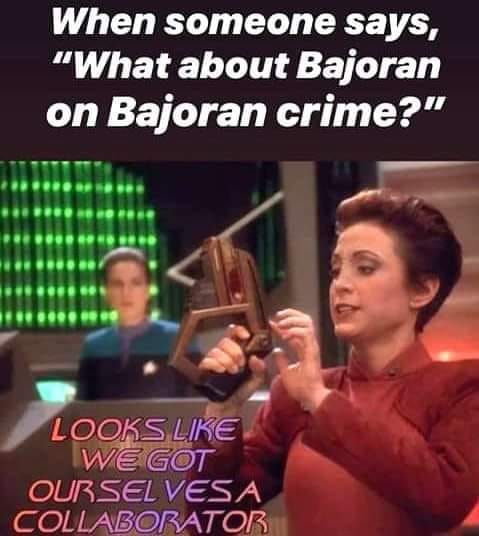
This meme is a humorous commentary on left-wing politics, specifically the concept of "Bajorn" (a fictional term) being a crime. The image features a Star Trek: The Next Generation character, Deanna Troon, holding a device, with the text "When someone says, 'What about Bajorn on Bajorn crime?'" above her. The text "Looks like we got ourselves a Bajorn" is written in a humorous, playful font.
detailed-analysis (gemma3-27b-vision)
Okay, let's break down this meme using the requested theoretical lenses. It's important to note that applying these frameworks can often be interpretive, and multiple readings are possible.
Visual Description
The image is a screencap from Star Trek: Deep Space Nine. It features Major Kira Nerys, a Bajoran officer, holding a disruptor rifle in a threatening manner. Her facial expression is fiercely accusatory, and she is looking directly at the viewer. Behind her, and slightly blurred, is Captain Sisko. The background is a dimly lit, technological setting, presumably the bridge of Deep Space Nine. Overlaid text reads: "When someone says, 'What about Bajoran crime?'" and "Looks like we got ourselves a collaborator." The text is in a bold, somewhat rough font.
Foucauldian Genealogical Discourse Analysis
This meme provides an interesting entry point for a Foucauldian analysis. It demonstrates how discourse shapes our understanding of crime, justice, and even identity. The question “What about Bajoran crime?” is not simply a request for information. Instead, it's a move that implicitly frames Bajorans as potential criminals – invoking a power/knowledge dynamic.
The meme interrupts this discourse. It doesn’t engage with the question of "Bajoran crime". It immediately labels the questioner as a "collaborator." This labeling is a form of disciplining. It's an attempt to shut down the conversation by associating the question with betrayal and negative connotations.
A genealogical approach would ask how the concept of "Bajoran crime" came to be articulated in this context. It might trace the history of Bajoran occupation by the Cardassians, the struggles for liberation, and the subsequent challenges of building a new society. The meme implicitly suggests that asking about "Bajoran crime" ignores the historical context of oppression and implicitly blames the victims of that oppression. The meme highlights how discussions of crime are not neutral but are always embedded in power relations and historical circumstances.
Critical Theory
From a critical theory perspective, the meme reveals the ways in which power structures shape perception and understanding. The question “What about Bajoran crime?” functions as a subtle mechanism of control. It diverts attention from the history of Cardassian occupation and the resulting socio-political problems on Bajor. By focusing on “Bajoran crime”, the questioner shifts blame onto the oppressed, rather than questioning the actions of the oppressor.
The meme's response – labeling the questioner a “collaborator” – is a challenge to this power dynamic. It accuses the questioner of aligning with the oppressive forces, implicitly suggesting a need to disrupt the normal order of things. The meme functions as a critique of those who perpetuate harmful narratives.
Marxist Conflict Theory
A Marxist reading would emphasize the underlying class and power struggles that frame the meme. Bajor, in the Star Trek universe, is a society recovering from a prolonged and brutal Cardassian occupation. This occupation created significant economic and social inequalities. The question “What about Bajoran crime?” can be seen as an attempt to deflect attention from the systemic causes of crime—poverty, lack of opportunity, and social injustice—and instead focus on individual culpability.
The meme's response ("Looks like we got ourselves a collaborator") reflects a revolutionary sensibility. The label "collaborator" is a charge of siding with the oppressor, implying a betrayal of the Bajoran people’s struggle for liberation. It’s a call to defend the interests of the oppressed against those who seek to maintain the existing power structures.
Postmodernism
A postmodern reading would focus on the deconstruction of grand narratives and the questioning of objective truth. The meme challenges the idea that crime is a neutral concept with a universally agreed-upon definition. It highlights how discussions of crime are always shaped by subjective perspectives and cultural contexts.
The meme disrupts the expectation that a question will be answered directly. It offers an emotional response instead of a factual one, signaling a rejection of rational discourse. It is an act of disrupting the established order. This disruption can be interpreted as a rejection of the notion of a stable, coherent truth.
Queer Feminist Intersectional Analysis
While less directly applicable than some of the other frameworks, an intersectional approach can still offer insights. The meme implicitly touches on the ways in which marginalized communities are often subjected to heightened scrutiny and blame. The question about "Bajoran crime" can be seen as a form of othering and the perpetuation of negative stereotypes about a specific group.
The meme’s assertive response (“Looks like we got ourselves a collaborator”) is a refusal to tolerate such scrutiny. It is a form of resistance against power structures that attempt to control and marginalize certain groups. The meme also acknowledges that trauma caused by systemic issues impacts community behavior.
***
Disclaimer: These analyses are interpretations, and others are possible. The richness of memes lies in their ambiguity and the multiple layers of meaning they can evoke.
simple-description (llama3.2-vision)
This meme is a screenshot from the TV show Star Trek: The Next Generation, featuring the character Deanna Troi. The image shows Troi holding a PADD (Personal Access Device) with a puzzled expression. The text above the image reads "When someone says 'What about Bajoran on Bajoran crime?'" and below it, the character responds "In the Bajoran system, we have a saying: 'The Bajorans are a peaceful people.'"
tesseract-ocr
When someone says, Teele tle) oY Pet) (oleae 11 val me —— Tite ral (il 7“ i ae . - " HH wee aa y- ey ‘ . a an —, a LOOKS LIKE VWisGom OURSELVESA COLLAB@RAT OF