First Seen
2023-05-10T21:03:35+00:00
simple-description (llama3.2-vision_11b)
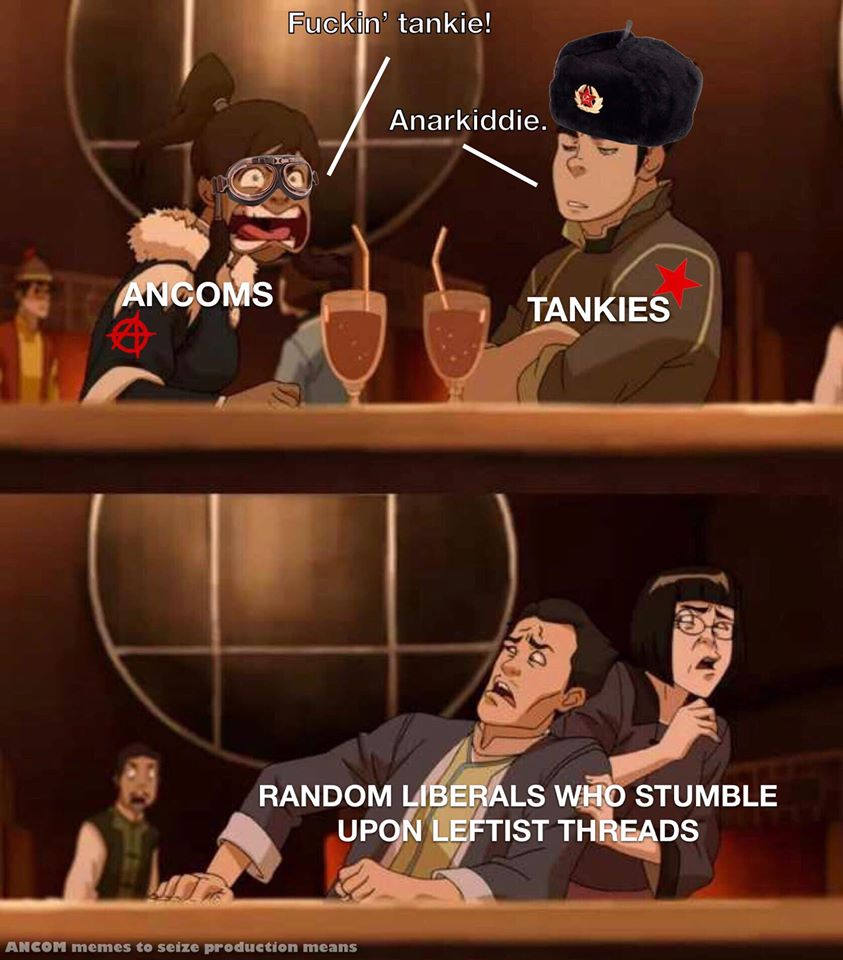
The meme is a humorous critique of the left-wing online community, specifically the "Tankies" (a subgroup of leftists) and "Ancoms" (anarchists), who are often at odds with each other. The meme is a satirical commentary on the left's internal conflict, with the characters in the image representing the different factions and their interactions. The text "ANCOMS" and "TANKIES" are written on the characters' arms, with the latter being a reference to the infamous "Tankies" online community.
detailed-analysis (gemma3-27b-vision)
Okay, here’s an analysis of the image, structured into the requested sections, only including those applicable. Given the content and visual style, several of these frameworks are highly relevant.
## Visual Description
The image is a screenshot from the animated TV show BoJack Horseman, digitally altered to create a meme. The scene depicts a group of animated anthropomorphic characters (horse, cat, human, etc.) in a dimly lit, upscale bar setting, sipping cocktails. Labels have been added to the characters, categorizing them into different leftist political factions: “ANCOMS”, “TANKIES”, and “RANDOM LIBERALS WHO STUMBLE UPON LEFTIST THREADS”. There's an exchange of pointed dialogue. The character identified as "ANKOM" is yelling "F***in' tankie!" while pointing at the character labeled "TANKIE". "TANKIE" is wearing a ushanka and has a visible red star on their uniform. Another character in the background is labeled "Anarkiddie". The characters are visibly engaged in political tension. Beneath the scene is a text, “ANCOM memes to seize production means.” The overall aesthetic is darkly comedic, drawing on the show's established tone.
## Marxist Conflict Theory
This image directly engages with Marxist conflict theory. The depiction of different leftist groups—Anarcho-Communists (ANCOMs), Tankies (pro-Soviet/authoritarian left), and "random liberals"—highlights internal class conflict within the broader leftist movement.
* Class Struggle within the Left: The yelling and labeling demonstrate ideological conflict. ANCOMs, who traditionally advocate for a stateless, decentralized society, are shown in open antagonism with “Tankies,” who, in this context, typically represent a nostalgic or supportive stance towards the Soviet Union and centralized, state-led socialist projects.
* False Consciousness (in a meta way): The "random liberals" represent those who may engage superficially with leftist ideas without fully understanding the underlying theory or historical context. They could be seen as a manifestation of "false consciousness"—accepting the dominant ideology without critical reflection.
* Power Dynamics: The visual positioning and the act of labeling emphasize a hierarchical power dynamic. By categorizing and defining these groups, the image maker asserts a particular viewpoint and attempts to police the boundaries of acceptable political discourse.
Seizing Production Means: The text at the bottom “ANCOM memes to seize production means” is a clear reference to the core tenet of Marxist thought - the revolutionary struggle against capitalist ownership and control of the means of production. This meme itself can be seen as a form of "seizing" the means of cultural* production - using social media and internet meme culture as a site for political messaging and mobilization.
## Foucauldian Genealogical Discourse Analysis
The image lends itself well to a Foucauldian reading.
Discourse and Power: The labeling of the characters represents a specific discourse around leftist politics. These labels are not neutral descriptors but constitutive*—they create the categories themselves, defining what it means to be an “ANCOM” or a “Tankie.” This act of labeling exercises power by attempting to fix meaning and control the terms of debate.
* Genealogy of "Tankie": The term “Tankie” itself has a history (a “genealogy”) that is relevant. Originally used as a derogatory term in the British left to describe socialists who uncritically supported Soviet intervention in Hungary in 1956, it has evolved to become a catch-all term for those perceived as uncritical of authoritarian regimes or lacking nuance in their analysis of historical socialist states. The meme engages with this history.
* Disciplinary Power: The scene resembles a kind of political tribunal or observation of internal ideological battles. The labeling and the exchange of insults function as a form of disciplinary power—attempting to police the boundaries of acceptable political thought and punish deviance from perceived norms.
* Construction of Subjects: By categorizing the characters, the image constructs "subjects" within the leftist discourse. Each label defines a specific position and set of expectations, shaping the individuals within those categories.
## Postmodernism
The image can be viewed through a postmodern lens in a few ways:
* Deconstruction of Political Identity: The meme implicitly deconstructs the idea of stable political identities. The characters aren't simply "ANCOMs" or "Tankies"—they are individuals who exist within complex and often contradictory ideological frameworks.
* Irony and Parody: The image's dark humor and use of a cartoon context suggest a degree of irony and self-awareness. It's not taking itself entirely seriously, and may be critiquing the performative aspects of leftist political discourse.
* Fragmentation of Meaning: The scene reflects the fragmentation and complexity of contemporary political thought. There’s no single, coherent ideology at play—only a series of competing perspectives and internal conflicts.
* Simulacra and Simulation: The image itself is a "simulacra" (a copy without an original) of a real-world political conflict. It's a representation of a representation, divorced from the original context.
In conclusion: The image is a layered and complex meme that engages with key themes in Marxist thought, Foucauldian discourse analysis, and postmodern theory. It’s a satirical commentary on the internal divisions and ideological conflicts within the leftist movement, using visual and textual cues to create a darkly humorous and thought-provoking critique. It’s a highly charged meme that’s likely to provoke strong reactions from those familiar with the relevant political subcultures.
simple-description (llama3.2-vision)
The meme features a scene from the animated series "Avatar: The Last Airbender" where a character is trying to intimidate someone by making a threatening face. The meme replaces the character's face with a image of a "tankie" (a supporter of authoritarian leftism) with a comically exaggerated, cartoonish expression. The text "I'm a tankie" is overlaid on the image, and the caption reads "I'm a tankie" in a mocking, sarcastic tone.
tesseract-ocr
i — eWekin’ tankie! Fy : ' si _—— er } & a J Anarkiddie. ad f 4 # @ et i es s m3 { A te r cy / A) ie ara Miao eS 7 | : | a ee 7S 4 WN BS ‘ y Tr ie RANDOM LABERALS ya0)5]85 , A Wage am ~ xX Ay ce i : \ PUT Ree ety