First Seen
2023-05-10T21:03:35+00:00
simple-description (llama3.2-vision_11b)
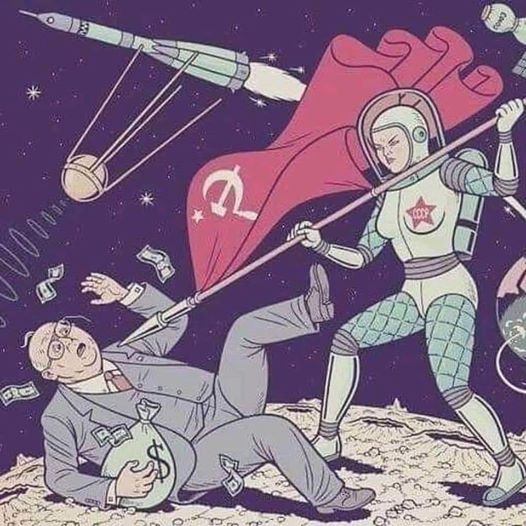
This meme features a cartoon of a Soviet-era space program astronaut, complete with a Soviet flag and a hammer and sickle emblem on his space suit. He's depicted as being attacked by a capitalist, who is shown as a wealthy businessman in a space suit, using a giant hammer to hit the astronaut with a hammer. The text "Communist" is written in the top left corner of the image.
detailed-analysis (gemma3-27b-vision)
Okay, let's break down this image with analyses through the frameworks you've provided. It's a rich image with many layers, so each section will attempt to capture those within the lens of the respective theory.
1. Visual Description
The artwork is a digitally rendered illustration with a strong aesthetic reminiscent of vintage Soviet propaganda posters, using a limited, slightly muted color palette dominated by blues, reds, and browns. The scene depicts a lunar landscape. A woman, dressed in a futuristic Soviet-style spacesuit (complete with a flowing red cape and a prominent star symbol), is aggressively using a pole to knock down a man dressed in a traditional business suit and helmet. The man is falling backwards, papers (presumably currency or stock certificates) fluttering around him. A rocket ship and satellite(s) are visible in the background. The image feels dynamic, portraying a clear power imbalance and a moment of confrontation. The woman’s determined expression contrasts with the man’s shocked and helpless pose.
2. Marxist Conflict Theory
This image is deeply rooted in Marxist conflict theory. The core dynamic is a direct illustration of class struggle.
Bourgeoisie vs. Proletariat/Revolutionary: The man in the business suit clearly represents the capitalist class – the "bourgeoisie." His attire, the floating money, and helpless fall signify the vulnerability and ultimate downfall of a system based on exploitation and accumulation. The woman in the spacesuit embodies the revolutionary force, a symbolic representation of the proletariat (working class) taking action against the existing power structure. The "space" setting could be interpreted as the ultimate expansion of capitalist desires – conquering new territories (even celestial ones) – but here, it’s being reclaimed* by revolutionary forces.
* Means of Production/Control: The pole, used to aggressively knock the man down, can be seen as a tool representing the means of production being taken back into the hands of those who were historically exploited. It's a forceful reclaiming of control.
* Ideological Struggle: The Soviet iconography (red flag, star) signals a specific ideological framework—communism—that challenges the dominant capitalist ideology. The entire image serves as a visual critique of capitalism and an endorsement of a revolutionary alternative.
* Historical Materialism: The artwork suggests a historical progression towards a socialist/communist future, one that's actively achieved through confrontation and the overthrow of the existing order.
3. Foucauldian Genealogical Discourse Analysis
Applying Foucault’s framework, we need to examine the discursive elements within the image and trace the power relations they reveal.
Power/Knowledge: The image doesn’t merely depict physical force but demonstrates how power operates through discourse. The traditional depiction of "progress" (space exploration) has been discursively tied to capitalism. This image rewrites that discourse by associating space exploration with a revolutionary, anti-capitalist agenda. The woman’s actions aren’t simply about defeating an individual; they’re about dismantling a system of knowledge* that has legitimized inequality.
Genealogy of Power: The image invites a genealogy of the idea of “progress” and “innovation.” Foucault would ask how* the discourse around these concepts historically became linked to capitalist expansion and control. The image is a disruption of that established genealogy, proposing an alternative where technological advancements serve a different, socialist purpose.
* Discipline and Biopower: The businessman falling backwards could also be interpreted as a breakdown of the capitalist disciplinary system. The woman is effectively disrupting the mechanisms that maintain order and control within a capitalist society.
Subject Formation: The woman is not simply acting in opposition to the man; she becomes* a revolutionary subject through her actions. The image highlights how power relations shape individual identities.
4. Postmodernism
While the image carries strong ideological weight, it also has elements that resonate with postmodern ideas.
* Meta-Narratives: The image challenges the grand narrative of capitalist progress and dominance. It rejects the idea that capitalism is an inevitable or universally beneficial system.
Intertextuality: The strong visual references to Soviet propaganda posters create a layer of intertextuality. The image acknowledges its own history and borrows from existing visual language, but it repurposes* it for a new message.
* Deconstruction: The image deconstructs the traditional associations between space exploration, innovation, and capitalism, revealing the underlying power dynamics.
* Fragmentation: The falling papers and dynamic composition create a sense of fragmentation, reflecting the postmodern suspicion of totalizing systems and coherent narratives.
5. Queer Feminist Intersectional Analysis
This is potentially more nuanced, as the image doesn’t explicitly focus on gender or sexuality. However, we can apply an intersectional lens.
* Challenging Traditional Power Structures: The woman taking a forceful role, asserting power over a traditionally dominant male figure, is inherently subversive. It challenges patriarchal norms and disrupts the conventional gender roles associated with leadership and authority.
* Reclaiming Space/Taking Up Space: The “space” setting can be seen as a metaphor for traditionally male-dominated fields (science, technology, exploration). The woman’s presence and active role are a symbolic reclaiming of that space.
* Intersection of Class and Gender: The image reveals how class struggles and gender power dynamics can intersect. The woman’s revolutionary act is not just about challenging capitalism but also about dismantling a system that has historically marginalized and oppressed women.
* Masculinity & Capitalism: The businessman represents a particular form of masculinity deeply intertwined with capitalist ideals (dominance, control, accumulation of wealth). His fall can be interpreted as a dismantling of that particular manifestation of power.
Important Considerations:
* Context is Key: Understanding the artist's intentions and the broader socio-political context is crucial for a complete analysis.
* Multiple Interpretations: As with any artwork, there are multiple possible interpretations. These analyses represent one possible reading based on the chosen theoretical frameworks.
I hope this detailed breakdown provides a helpful analysis of the image through the lenses you requested! Let me know if you'd like me to elaborate on any of these points or explore other theoretical frameworks.
simple-description (llama3.2-vision)
The meme is an image of a Soviet-era propaganda poster with a few key modifications. A Soviet astronaut is shown holding a hammer and sickle, but instead of the usual hammer, he is holding a hammer that is actually a giant mallet used for pounding a hammer and sickle into the ground. The image is captioned "When you finally get to the moon, but you still have to make the bed".
tesseract-ocr
: a= Ss = > a y a ‘ zz CP .4 Rie oF A en Z ye. Y- 3 —S ad | : : ted i =