First Seen
2025-05-20T02:53:19+00:00
detailed-analysis (gemma3_27b-it-q8_0)
Okay, let's break down this meme through the lens of "Tankie" leftist ideology, leveraging the requested theoretical frameworks where applicable. It's a dense meme, loaded with subtext, so this will be a detailed response.
Disclaimer: The term "Tankie" is often used pejoratively to describe leftists who express strong, uncritical support for authoritarian states (especially the Soviet Union and its successors) and who tend towards a "whataboutism" defense of these regimes, dismissing criticism as Western propaganda or imperialism. I will explain the meme as a Tankie would likely interpret it while acknowledging the problematic nature of the ideology.
---
Visual Description
The meme uses a side-by-side image comparison.
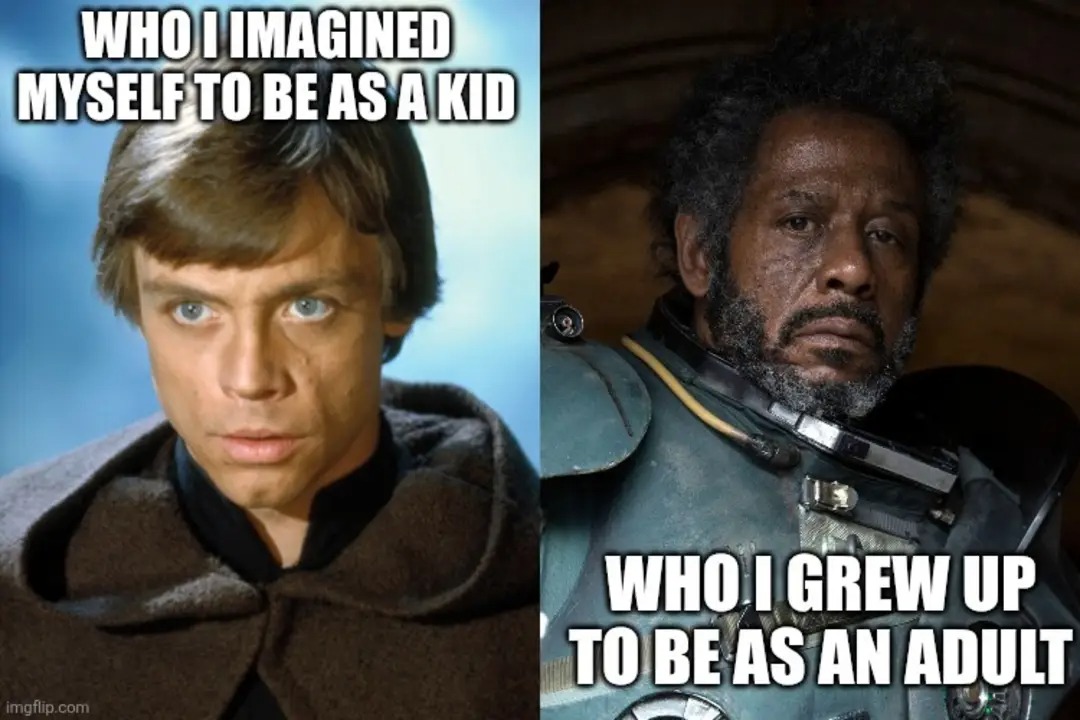
- Left: A young, idealistic Luke Skywalker from Star Wars: A New Hope. He's clean-cut, determined, and embodies a heroic figure fighting against a clearly defined "evil" Empire. The caption reads: "WHO I IMAGINED MYSELF TO BE AS A KID."
- Right: A grizzled, weathered Moff Gideon from The Mandalorian. Gideon is a complex villain, a former ISB officer and leader of a remnant Imperial faction. He is ruthless, pragmatic, and possesses a hardened, cynical outlook. The caption reads: "WHO I GREW UP TO BE AS A ADULT."
The visual contrast is key. It’s about the loss of innocence and the acceptance of harsher realities.
Marxist Conflict Theory
This is the dominant framework for understanding the meme within a Tankie context.
- Initial Idealism as Bourgeois Liberalism: The "Luke Skywalker" phase represents the initial stage of political awakening – often encountering leftist ideas through mainstream media or introductory texts. However, this is seen as inherently limited and bourgeois. It's a focus on individual "heroism," moralizing against "evil" (the Empire), and accepting a fundamentally liberal framework of "democracy" and "freedom." Tankies view this as naive, lacking an understanding of class struggle and material conditions. They see this as what Capitalist states want you to believe.
- Moff Gideon as Historical Materialism: Gideon embodies a worldview shaped by a more "realistic" understanding of power. He doesn't concern himself with moral appeals or "good vs. evil." He's focused on acquiring resources (the Darksaber, beskar steel), maintaining order (Imperial remnant control), and operating within a brutal, unforgiving system. This, for a Tankie, represents a shift towards historical materialism – recognizing that power structures are rooted in material conditions (ownership of the means of production, military strength) and that achieving change requires a pragmatic, often ruthless approach.
- Imperialism & Anti-Imperialism: Within Tankie circles, the Empire is often framed as analogous to the United States or other Western powers. The initial "good vs. evil" framing is seen as Western propaganda. The realization that the Empire isn't just "evil" but a complex system with its own internal logic – a logic of resource extraction, control, and domination – is seen as a sign of intellectual maturity. The “realization” of Gideon is an embrace of anti-imperialist thought.
- The necessity of violence: Gideon's willingness to use force is presented not as villainy, but as a necessary tool for achieving political goals. Tankies often rationalize the violence committed by authoritarian regimes as regrettable but unavoidable in the fight against imperialism and capitalist exploitation.
Foucauldian Genealogical Discourse Analysis
While not immediately obvious, Foucault’s work can illuminate the meme’s meaning.
- Power/Knowledge: The shift from Luke to Gideon represents a change in understanding power. The naïve view of power as something that can be defeated by a righteous hero is replaced by a recognition that power is diffuse, pervasive, and operates through discourse. Gideon understands how power works.
- Genealogy of Morality: Foucault’s genealogy traces the historical development of moral concepts. The meme implicitly critiques the "good vs. evil" morality of childhood. Gideon's actions aren't necessarily "evil" in a vacuum; they are products of a specific historical and political context, a different genealogy of morality where pragmatism and power are prioritized.
- Discipline and Punish: Gideon's control over the Imperial remnant and his willingness to use harsh methods align with Foucauldian concepts of discipline and surveillance. The Tankie interpretation would be that effective governance sometimes requires a level of control and repression.
Postmodernism
This is a more subtle influence, but present.
- Deconstruction of Narratives: The meme deconstructs the simplistic, heroic narrative of Star Wars. It reveals the complexities and ambiguities that lie beneath the surface of popular culture. Tankies often apply this deconstructive lens to mainstream narratives, exposing what they see as underlying ideological biases.
- Rejection of Metanarratives: The shift from Luke to Gideon can be seen as a rejection of the grand "metanarrative" of liberal democracy and individual liberation. The meme suggests that these narratives are insufficient to explain the realities of power and struggle.
Critical Theory
- Ideology Critique: The meme is an explicit critique of liberal ideology. It mocks the idealism of youth and embraces a more cynical, “realistic” worldview. Tankies would argue that mainstream media and education systems actively promote these liberal ideologies to maintain the status quo.
- False Consciousness: The initial “Luke Skywalker” phase is seen as a state of “false consciousness.” The individual has been misled into believing in illusions about the nature of power and justice. The “Moff Gideon” stage represents a break from this false consciousness and an awakening to the true nature of the world.
In essence, the meme is a self-deprecating, yet proud, statement of political radicalization. It’s a declaration that the user has moved beyond naïve liberalism and embraced a more hardline, pragmatic, and often authoritarian worldview—one that prioritizes revolutionary struggle, anti-imperialism, and a willingness to do whatever it takes to achieve political goals.
It’s important to remember that this interpretation is specific to the Tankie ideological position. Others may interpret the meme differently. The meme's popularity within certain online leftist spaces demonstrates the appeal of this cynical, anti-establishment sentiment.
simple-description (llama3.2-vision_11b)
The meme is a humorous commentary on the idea that leftists, or "tankies," often romanticize the past and imagine themselves as part of a historical or cultural movement. The image juxtaposes two characters, Luke Skywalker from the Star Wars franchise and a character from the movie Mad Max: Fury Road, with the caption "Who I imagined myself to be as a kid" and "Who I grew up to be." The text implies that the speaker's childhood imagination was more idealistic and naive, while their adulthood is more cynical and rugged.