First Seen
2025-04-28T04:01:07+00:00
detailed-analysis (gemma3_27b-it-q8_0)
Okay, let's break down this meme from a "Tankie" (far-left, often pro-authoritarian communist/socialist) perspective, applying the requested theoretical frameworks where relevant. It's important to remember that "Tankie" is a pejorative term, but it's used here to understand the internal logic of the meme's appeal within that subculture.
Visual Description
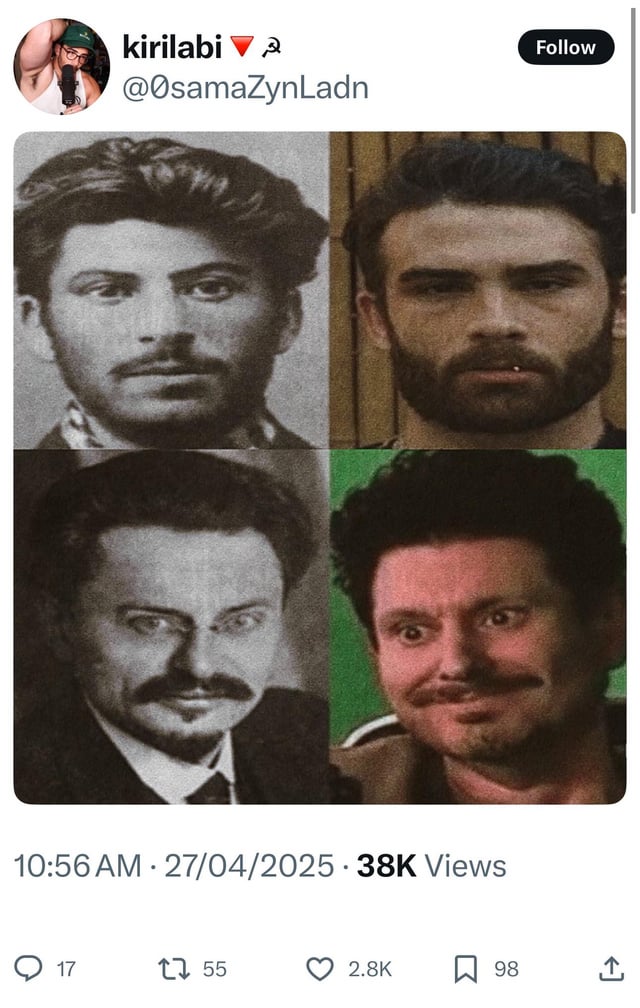
The meme presents a four-panel grid. Each panel depicts a different iteration of a man, seemingly escalating in perceived "deviation" from a perceived norm.
- Top Left: A black and white portrait of Leon Trotsky, a prominent Marxist revolutionary and theorist. His appearance is 'classic' – carefully groomed mustache, intellectual demeanor.
- Top Right: A color photo of a man with a beard, seemingly a regular individual.
- Bottom Left: A black and white photo of Nikolai Bukharin, another key Marxist theorist and initially a leading figure in the Bolshevik revolution.
- Bottom Right: A color photo of Pete Buttigieg, a former US presidential candidate and current Secretary of Transportation. This image appears to be taken in a somewhat awkward or unflattering setting (green screen background, slightly wide-eyed expression).
The framing of the images suggests a progression or evolution, specifically highlighting a decline or 'fall' from a perceived position of revolutionary purity.
Marxist Conflict Theory
This is the most crucial lens for understanding this meme. The core argument within the Tankie subculture is one of class struggle and ideological betrayal.
- Trotsky & Bukharin as Representatives of Genuine Marxism: Trotsky and Bukharin, despite their own ideological differences, represent figures who, in the Tankie perspective, were genuinely committed to the overthrow of capitalism and the establishment of a socialist/communist order. They are seen as principled revolutionaries who faced repression from capitalist forces and, crucially, from counter-revolutionary elements within the socialist movement itself.
- Buttigieg as the Embodiment of Liberal Compromise: Pete Buttigieg represents, in this meme's implicit argument, the ultimate betrayal of socialist ideals. He is perceived as a tool of the capitalist class, a figure who has assimilated into the liberal establishment and who actively works to maintain the status quo. He is not fighting for systemic change, but for tweaks within a fundamentally unjust system.
- The Progression as a "Degeneration": The meme's layout suggests a line of ideological descent. It implies that genuine Marxism (Trotsky, Bukharin) gradually degrades into the "bourgeois" politics of figures like Buttigieg. The 'normal' man in the middle is arguably the average liberal or centrist who is unaware of the larger class dynamics.
- Focus on "Revisionism": Tankies often accuse other leftist movements of "revisionism" – watering down Marxist theory and abandoning the goal of revolution. Buttigieg, in their view, is a prime example of this revisionism.
Foucauldian Genealogical Discourse Analysis
We can explore how the meme constructs "truth" around political figures using Foucault's ideas.
- Power/Knowledge: The meme creates a power/knowledge dynamic. It doesn't present objective facts, but rather a specific narrative about these individuals. The "knowledge" (that Buttigieg is a betrayer, that Trotsky and Bukharin were authentic) is constructed and circulated within the Tankie discourse. This narrative reinforces the group’s power to define "genuine" leftist ideology.
- Genealogy of 'Authenticity': The meme traces a “genealogy” of political authenticity. It asks how the idea of a "true revolutionary" has been historically constructed and then undermined. It suggests that the contemporary Left has lost this authenticity, while figures like Trotsky and Bukharin possessed it.
- Discourse and Subjectivity: The meme participates in the broader discourse of the far-left, shaping how individuals within that community understand political figures and their roles in history. It helps produce subjects who identify as 'genuine' Marxists and reject those deemed 'compromised' or 'bourgeois.'
Postmodernism
While not directly central, postmodern themes are present in the way the meme functions.
- Deconstruction of Political Representation: The meme subverts conventional political imagery. It doesn't offer a positive program, but rather a negative critique of a political figure (Buttigieg). This is a characteristic postmodern approach – focusing on dismantling existing narratives rather than building new ones.
- Rejection of Grand Narratives: Although Tankies embrace a “grand narrative” (Marxism), the meme implicitly critiques the narratives constructed around liberal politicians. It questions the sincerity and legitimacy of their claims.
Critical Theory
The meme touches on themes relevant to Critical Theory:
- Critique of Ideology: The meme critiques the ideology of liberal capitalism, portraying it as a betrayal of genuinely revolutionary ideas.
- False Consciousness: The 'normal' man in the middle could be interpreted as representing individuals suffering from false consciousness - unable to see the underlying class dynamics and systemic injustice.
- Culture Industry: The somewhat awkward image of Buttigieg might be seen as a commentary on how politicians are packaged and presented by the media (the "culture industry") as carefully curated images divorced from any real substance.
Queer Feminist Intersectional Analysis
This is where the meme completely falls apart, and even actively opposes these frameworks. Tankies are often highly critical of (and hostile toward) Queer Feminist Intersectional Analysis.
- Rejection of Identity Politics: Tankies prioritize class struggle above all else. They often view identity-based movements (feminism, LGBTQ+ rights) as "divisive" or "bourgeois distractions" from the primary goal of class revolution. Therefore, any intersectional analysis would be actively rejected. Buttigieg's identity as a gay man is irrelevant, and likely seen as exploitable by the capitalist system to deflect from larger economic issues.
- Authoritarian Tendencies: Tankies often support authoritarian regimes that actively suppress LGBTQ+ rights and feminist movements. The meme implicitly defends the idea that "revolutionary goals justify harsh methods," which directly clashes with queer feminist values of liberation and inclusivity.
In Conclusion
From a Tankie perspective, this meme is a succinct and pointed critique of liberal compromise and ideological betrayal. It reinforces a worldview centered on class struggle, historical materialism, and a firm belief in the necessity of revolutionary change. It leverages historical figures and contemporary politicians to create a narrative of decline and degeneration, and to define the boundaries of "genuine" leftist ideology. It uses a visual structure that evokes a sense of escalating disappointment and moral outrage. However, it relies on a heavily biased and often problematic interpretation of history and political reality, and stands in opposition to queer feminist intersectional analysis.
Disclaimer: This analysis is provided to explain the meme's meaning within a specific ideological framework. It does not endorse or support the views expressed by that framework. It's crucial to critically examine all perspectives and to understand the potential harms of extremist ideologies.
simple-description (llama3.2-vision_11b)
The meme is a collage of images of left-wing activists from the early 20th century, including Lenin and Trotsky, with the faces of modern-day left-wing activists, such as Tankies, photoshopped onto them. The text "Tankies" is likely added to the image to reference the online community of left-wing activists who are often referred to as "Tankies". The meme is likely meant to be humorous, poking fun at the idea that these modern-day activists are similar to the original left-wing activists from the early 20th century.