First Seen
2023-05-10T21:03:35+00:00
simple-description (llama3.2-vision_11b)
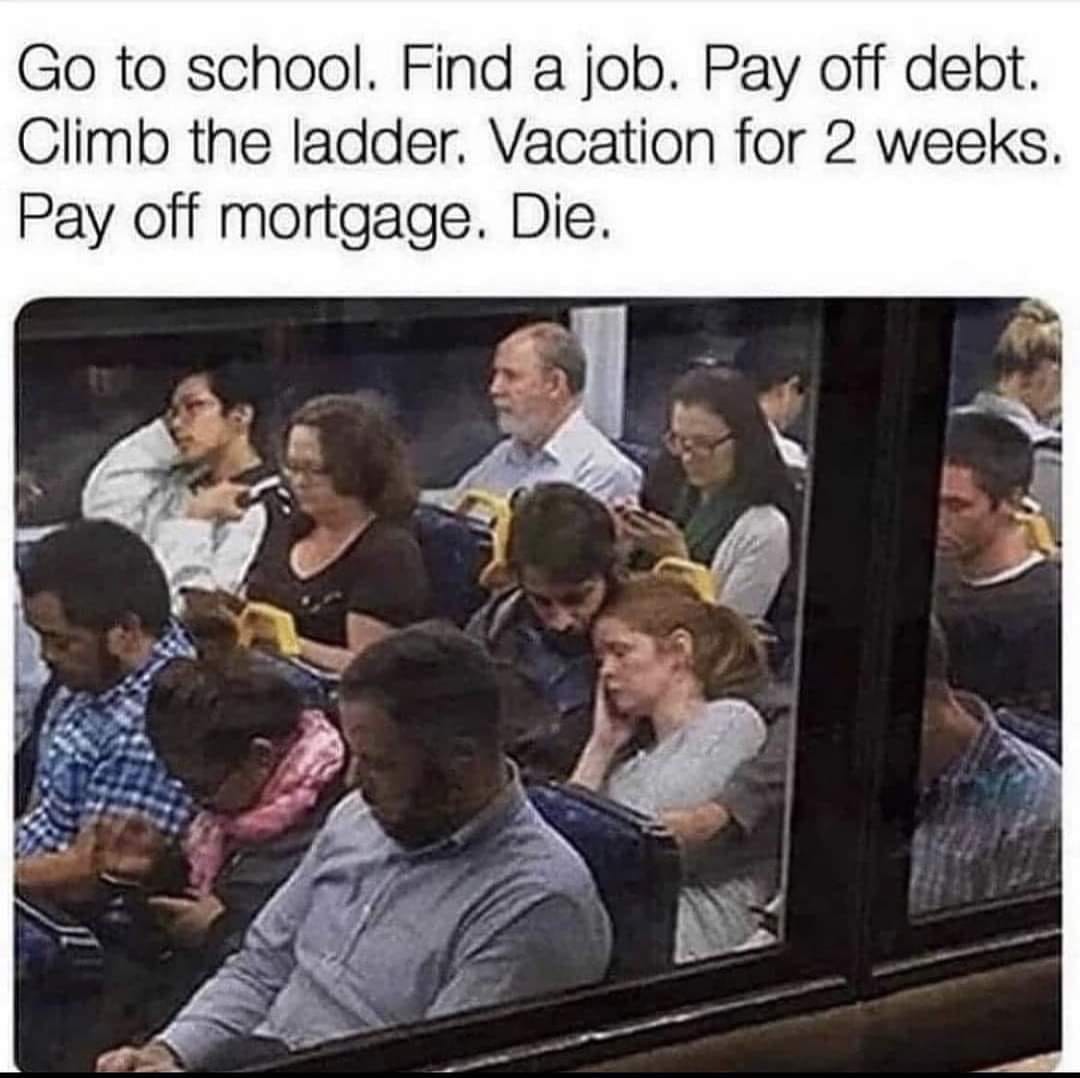
The meme is a satirical commentary on the labor theory of value, a concept in economics that suggests that the value of a product is determined by the amount of labor it takes to produce it. The image is a photo of a crowded bus, but the text above it is a humorous and ironic list of "life goals" that are actually a series of tasks that would lead to a person's death, such as "Go to school. Find a job. Pay off debt. Climb the ladder. Vacation for 2 weeks. Pay off mortgage. Die." The joke is that these "goals" are actually a series of tasks that would lead to a person's death, and the final one is a literal "die" in the context of a person's life.
detailed-analysis (gemma3-27b-vision)
Okay, let's break down this image and text pairing through several critical theory lenses. It's a darkly humorous meme that lends itself to a lot of analysis.
1. Visual Description
The image depicts a crowded, seemingly modern airport or travel lounge. A diverse group of people are seated in rows of dark blue seats. They are all in varying states of exhaustion or emotional drain—heads in hands, eyes closed, slumped shoulders, expressions of weariness. The overall aesthetic is one of being overwhelmed and physically drained. The lighting is somewhat muted and doesn't convey a sense of comfort or relaxation. The close proximity of the individuals reinforces the feeling of being packed in, and possibly contributing to the exhaustion.
2. Foucauldian Genealogical Discourse Analysis
This meme powerfully illustrates how modern discourse produces the subject. Foucault would be fascinated by the normalized sequence presented: education, employment, debt, accumulation of capital, brief respite (vacation), and death. It’s not just a description of life; it performs the expectation of a life lived within specific parameters.
- Discipline & Normalization: The sequence embodies the disciplinary power of societal institutions. We are encouraged—almost required—to move through these stages to be considered “successful” or even “normal”. Deviation is punished (through social stigma, economic hardship, etc.).
- Genealogy of the "Good Life": Foucault would ask how this sequence became the accepted model. It's not natural, but historically constructed. Tracing the genealogy might reveal how certain capitalist ideologies (e.g., the work ethic, consumerism) became dominant, shaping our expectations of what a "good life" looks like.
- Power/Knowledge: The text presents a particular "knowledge" about life which then exerts power over the individuals subject to it. The very presentation of this sequence as a standard normalizes it, making it harder to envision alternative ways of living.
3. Critical Theory
This meme exemplifies a core tenet of Critical Theory: the critique of instrumental reason and the “culture industry.”
- Instrumental Reason: The sequence is profoundly instrumental. Each stage exists solely as a means to another end (education to get a job, job to pay off debt, etc.). The pursuit of ends becomes detached from any intrinsic value or meaning. The finality of "Die" suggests the totalization of this instrumental logic, reducing life to a mere sequence of transactions.
- Culture Industry: The meme itself is a product of the culture industry. It's a form of entertainment that implicitly reinforces the very system it appears to critique. It allows us to acknowledge the absurdity of the sequence without challenging its fundamental premises. (We laugh about it, but continue to participate in it).
- Commodification of Experience: The vacation is only a 2 week respite, it is not something that is valued in itself but as a function of being able to work and pay off debt.
4. Marxist Conflict Theory
This meme is potent within a Marxist framework.
- Alienation: The sequence highlights the alienation of labor under capitalism. Individuals are alienated from the products of their labor (they don't own what they produce), from the labor process itself (it's often meaningless and repetitive), and from other people (competition rather than collaboration is emphasized).
- Class Struggle: The meme implicitly acknowledges the class struggle. The pressure to "climb the ladder" and "pay off debt" is particularly acute for those with limited economic resources. It demonstrates how the system disproportionately burdens certain groups.
- Exploitation: The entire sequence suggests a process of being exploited by capital, and the vacation is merely an attempt to recover from the exploitation. The inevitability of “die” signals the ultimate alienation from the products of one’s labor, one is only a means to an end.
5. Postmodernism
Postmodern analysis would focus on the fragmentation and the loss of grand narratives.
- Deconstruction of the "Good Life": The meme deconstructs the traditional narrative of the "good life" – education, career, financial security. It reveals this narrative as a social construct, rather than a universal truth.
- Simulacra and Simulation: The vacation could be seen as a simulacrum – a copy without an original. It is a temporary escape from a system that is inherently alienating, but it doesn't address the underlying problems.
- Loss of Meaning: The finality of "Die" underscores the postmodern sense of nihilism and the loss of inherent meaning. The pursuit of material goals is ultimately futile.
6. Queer Feminist Intersectional Analysis
This meme is powerful when considered through a queer feminist intersectional lens.
- Gendered Expectations: There is an assumed subject within this narrative. The expectations in this sequence are likely to be more intense for women, who may face pressure to achieve career and financial stability while also fulfilling traditional caregiving roles.
- Intersectionality and Debt: Debt is not experienced equally. People from marginalized communities (racial minorities, LGBTQ+ individuals, people with disabilities) often face higher levels of debt due to systemic discrimination and limited access to resources.
- Challenging Linear Narratives: This meme challenges linear narratives of life that prioritize productivity and achievement. Queer and feminist perspectives often emphasize the importance of living outside of normative expectations and embracing diverse ways of being. The bluntness of "Die" could be read as a refusal to participate in this relentless cycle.
In summary, this seemingly simple meme is a rich text for critical analysis. It reveals a lot about the pressures and anxieties of modern life, the power of social structures, and the potential for resistance. The visual of weary individuals underscores the emotional cost of participating in this cycle.
simple-description (llama3.2-vision)
The meme is a humorous take on the traditional "to-do" list. It presents a series of tasks in a straightforward, matter-of-fact way, but the final instruction is a darkly comedic and unexpected conclusion. The text reads: "Go to school. Find a job. Pay off debt. Climb the ladder. Vacation for 2 weeks. Pay off mortgage. Die."
tesseract-ocr
Go to school. Find a job. Pay off debt. Climb the ladder. Vacation for 2 weeks. Pay off mortgage. Die. i toe ae, -