First Seen
2024-02-29T21:50:52.988388+00:00
simple-description (llama3.2-vision_11b)
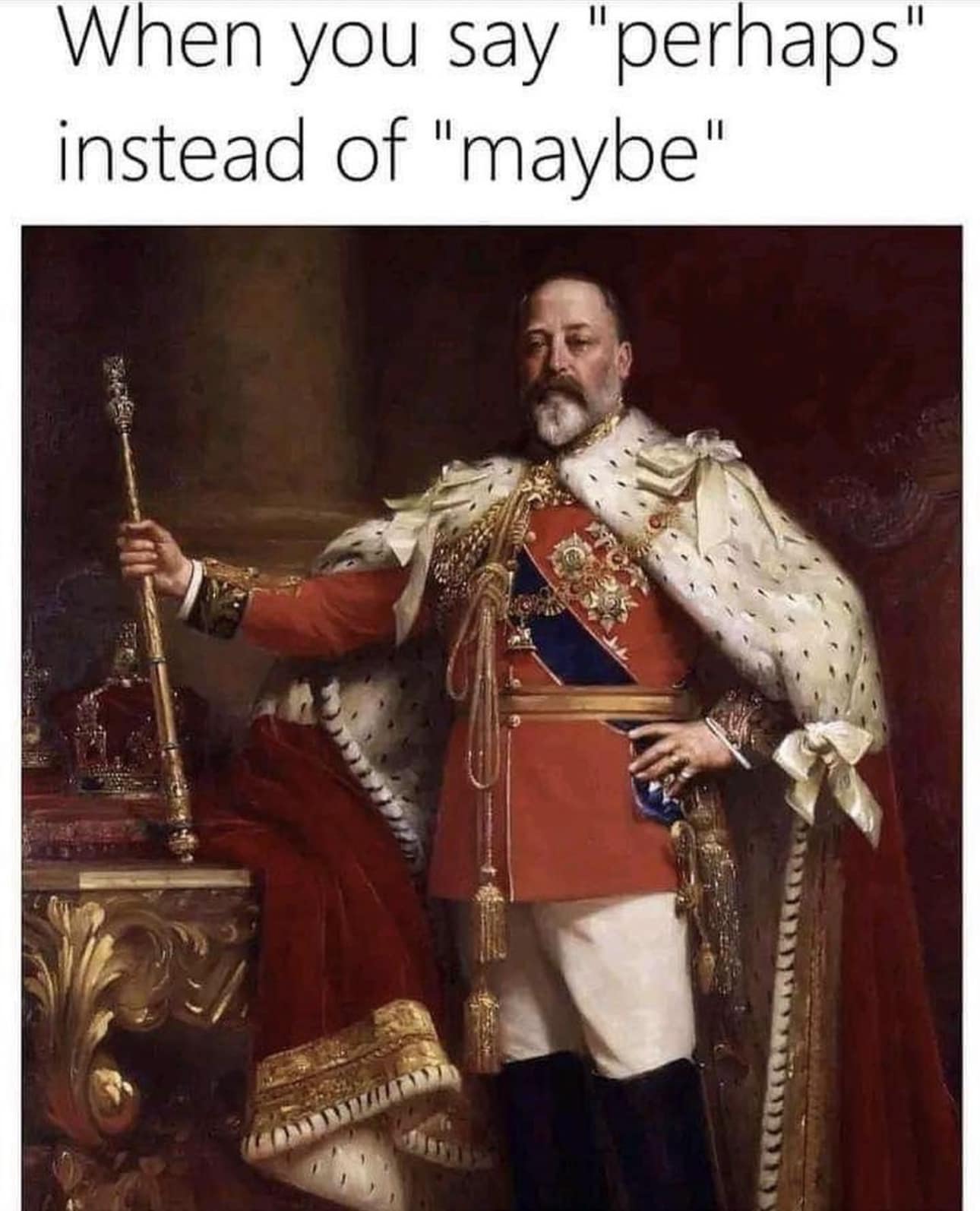
The meme is a humorous illustration of a king, likely a monarch, in a regal setting, with a caption that pokes fun at the nuances of language. The image is meant to convey the idea that even the most authoritative figures can struggle with the subtleties of language, as evidenced by the caption "When you say 'perhaps' instead of 'maybe'".
detailed-analysis (gemma3-27b-vision)
Okay, let's break down this meme through several theoretical lenses.
Visual Description
The image is a formal portrait of King Edward VII, likely a painted reproduction of a traditional royal portrait. He is depicted in full regalia, including a crimson coat adorned with gold trim, a heavily decorated sash, numerous medals, and an elaborate, ornate crown. He is seated, posed with one hand resting on a highly embellished throne or chair and the other holding a staff or scepter. The background is a dark, rich red, and the overall effect is one of extreme wealth, authority, and power. The meme text above the image reads, "When you say 'perhaps' instead of 'maybe.'" The juxtaposition of the elaborate imagery with the trivial text is central to the meme's humor.
Foucauldian Genealogical Discourse Analysis
This meme operates precisely because of the historical construction of language and social meaning. Focusing on the difference between “perhaps” and “maybe,” we can trace a genealogy of how these words have become associated with specific social positions and performative acts.
- Discourse & Power: The use of "perhaps" carries an air of aristocratic detachment and aristocratic politeness, the very qualities exhibited by the King in the image. This is in stark contrast to the more common and direct "maybe." Historically, these subtle linguistic choices served to mark class differences and reinforce social hierarchies. The choice between the two is not merely semantic, it's a performance of social power and the display of elevated social capital.
- Archaeology of Knowledge: Foucault would ask: How did the meaning of “perhaps” become associated with a more refined, upper-class speech? Tracing the historical usage of these words would reveal how they became imbued with connotations of sophistication and distance.
- Power/Knowledge: The meme implies that choosing "perhaps" is an act of asserting social status. It's not simply about being polite; it's about enacting a performance of privilege. The King, as an embodiment of inherited power, is the exemplar of this language.
Critical Theory (Frankfurt School)
The meme taps into a familiar trope of Critical Theory – the critique of culture industry and the ways in which even seemingly trivial things can be vehicles for the reproduction of dominant ideologies.
- Culture Industry: The meme can be seen as a commentary on how even everyday language choices can become associated with status and class. It’s a small instance of how culture is used to reinforce social hierarchies.
- Reification: The meme points to the reification of class distinctions. The King isn’t merely a person; he’s a symbol of an entire system of power. By associating "perhaps" with this symbol, the meme highlights how language can become fetishized and divorced from its actual communicative function.
- Commodification of Language: The meme subtly points to how even language can become a commodity, a marker of social status that can be “purchased” through education, upbringing, and performance.
Postmodernism
The meme embodies several core tenets of Postmodern thought:
- Hyperreality & Simulacra: The meme doesn’t deal with the “real” meaning of “perhaps” or “maybe.” It deals with the image of a certain way of speaking and its association with an exaggerated symbol of authority. The King is a symbol of power, and "perhaps" becomes a symbol of the symbol – a hyperreal construct.
- Deconstruction: The meme deconstructs the seemingly innocuous act of choosing one word over another. It reveals how even these seemingly small choices can be loaded with cultural and historical meaning.
- Playfulness & Irony: The meme’s humor stems from the ironic juxtaposition of high and low culture – the regal portrait and the trivial text. This playfulness is a characteristic feature of Postmodern art and thought.
Marxist Conflict Theory
While not immediately obvious, a Marxist reading can be applied:
- Class Struggle: The meme implicitly references the ongoing class struggle. The King, representing the ruling class, embodies a particular way of speaking that reinforces his position of power. Choosing "perhaps" over "maybe" is a subtle act of asserting dominance.
- Ideology: The meme exposes how ideology operates through everyday language. The seemingly harmless choice of words becomes a vehicle for the perpetuation of class distinctions and the naturalization of hierarchy.
- False Consciousness: The meme could be interpreted as a critique of how individuals might unconsciously adopt the language and mannerisms of the ruling class, thereby reinforcing their own subordination.
Important Note: These are interpretations, and a single meme can be analyzed from multiple perspectives. The richness of the meme lies in its ability to evoke these diverse theoretical frameworks.
tesseract-ocr
I I When you say "perhaps . i ll instead of "maybe me ee Se " : > _ Sy o> - = *€ s Bh, eA ‘ \S ” ' Pea ey : ‘ [ +e > ‘We Se : %, rr 4 A; . 4 a % Abs ——s ‘ Ln) £ i) ia eae: \ /é J ! 3 ee E eS a sa 3 iS er | 4 F I
simple-description (llama3.2-vision)
This meme is a humorous image of a regal-looking king, likely from a historical or fictional context, with a caption that pokes fun at the phrase "I was going to say...". The text at the top reads, "When you're about to say 'I was going to say...' but you remember you're a king and you have to say 'I was going to say... perhaps'".