First Seen
2023-05-10T21:03:35+00:00
simple-description (llama3.2-vision_11b)
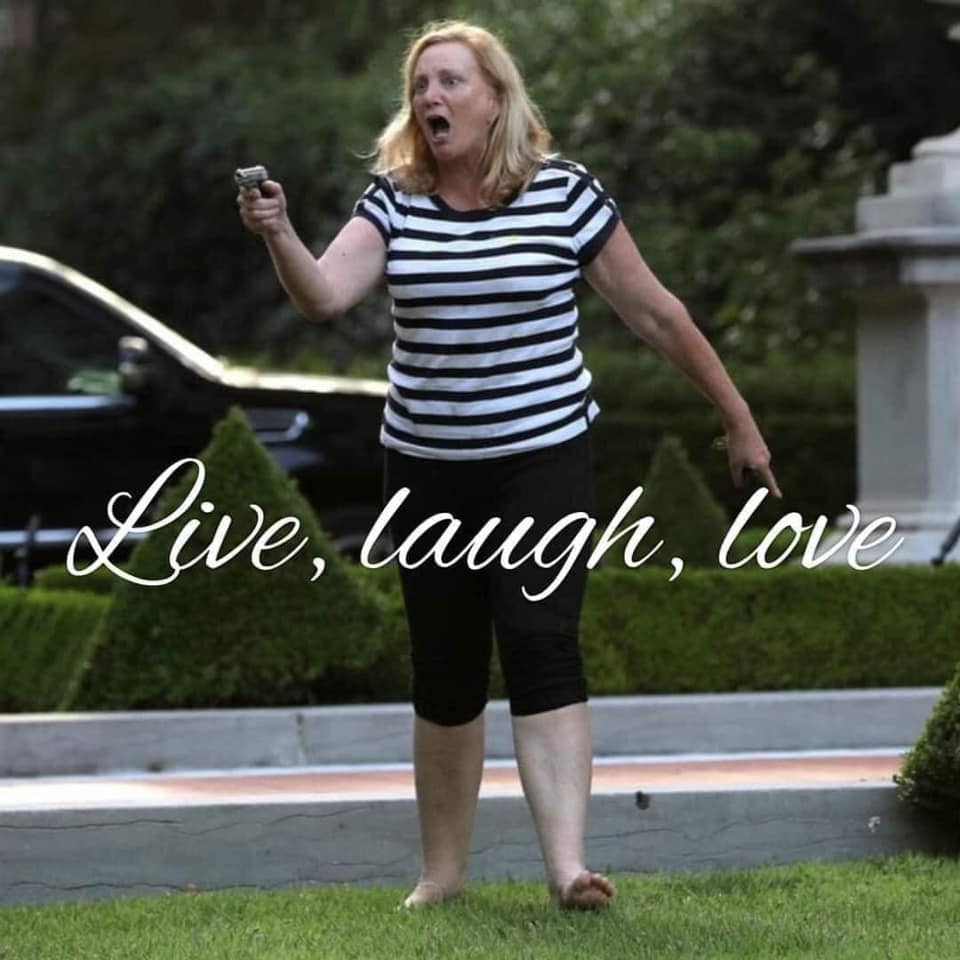
The meme is an image of Karen, a stereotypical suburban woman, yelling at someone or something. The text "Live, laugh, love" is overlaid on the image, which is ironic because Karen is known for being angry and confrontational, not living, laughing, or loving.
detailed-analysis (gemma3-27b-vision)
Okay, let's break down the image through several theoretical lenses. It's important to note that interpretations are subjective, and different perspectives will yield different insights.
Visual Description
The image depicts a middle-aged woman outdoors, seemingly in a suburban front yard. She is barefoot and wearing a striped t-shirt and cropped pants. Her arms are outstretched, and her facial expression is exaggerated – mouth open in what could be a shout or scream, eyes wide. She’s holding a mobile phone in one hand. The background features a well-manicured lawn, a paved driveway, a car, and a stone pillar or decorative element. Overlaid on the image is the text “Live, Laugh, Love” in a decorative cursive font. The overall impression is one of performative emotion, and a slightly chaotic energy.
Foucauldian Genealogical Discourse Analysis
The image, particularly when combined with the “Live, Laugh, Love” slogan, is a fertile ground for Foucauldian analysis. We can trace a discourse around self-optimization, happiness as a duty, and the construction of a specific, idealized "self."
Power/Knowledge: The phrase “Live, Laugh, Love” isn’t simply a sentiment; it’s a technology of the self. It’s part of a discourse that produces expectations about how one should feel and behave. The emphasis on positivity and happiness becomes a norm, and deviations from it (expressed by the woman's seeming distress) are framed as failures. It suggests that happiness is something to be achieved and displayed*, rather than a naturally occurring emotion.
* Genealogy: Tracing the history of this discourse reveals its connection to late capitalist self-help culture, the rise of consumerism and branding of emotions. The “Live, Laugh, Love” aesthetic gained traction in the 2000s and 2010s, becoming a visual shorthand for a specific lifestyle and set of values.
Subjectivation: The woman’s posture and expression can be read as a performance of this discourse. She is attempting to project an image of vitality, but her exaggerated, almost desperate demeanor suggests a disconnect between this ideal and her actual experience. The image suggests a feeling of being subjected* to this discourse – attempting to perform happiness as a means of self-regulation.
Critical Theory
From a Critical Theory perspective, particularly drawing on the Frankfurt School, this image is symptomatic of a culture industry that promotes conformity and suppresses genuine emotion.
Commodification of Affect: The "Live, Laugh, Love" slogan, often displayed as decorative wall art or merchandise, commodifies* positive emotions. Happiness becomes a product to be consumed, reinforcing a capitalist logic where even personal feelings are subject to market forces.
False Consciousness: The image potentially points to a state of false consciousness*. The woman might be trapped in a cycle of performing happiness for external validation, masking underlying anxieties or dissatisfactions. The slogan itself acts as a kind of ideological cover, obscuring the complexities of life.
Repressive Tolerance: The constant pressure to “Live, Laugh, Love” can create a form of repressive tolerance*. While appearing to celebrate individuality, it discourages authentic expressions of sadness, anger, or vulnerability. It privileges a narrow range of acceptable emotions.
Marxist Conflict Theory
A Marxist lens reveals how class and economic forces are implicated in the performance of happiness displayed in the image.
* Distraction from Material Conditions: The emphasis on individual positivity can serve as a distraction from systemic inequalities and material hardships. "Live, Laugh, Love" becomes a comforting mantra that obscures the struggles faced by those lacking economic security or social privilege. It encourages focusing on personal fulfillment rather than challenging oppressive systems.
* Consumerism and Idealized Lifestyle: The aesthetic surrounding "Live, Laugh, Love" is often associated with a middle-class or upper-middle-class lifestyle – a comfortable home, well-manicured lawn, and disposable income for decorative items. The image reinforces this aspirational lifestyle, potentially creating feelings of inadequacy among those who cannot afford it.
Labor and Emotional Performance: The woman's exaggerated emotional display can be viewed as a form of emotional labor*, where she performs happiness for an audience, either real or imagined. This can be exhausting and alienating, particularly in a society that demands constant positivity.
Postmodernism
From a postmodern perspective, the image is an example of the instability of meaning and the fragmentation of identity.
Simulacra and Simulation: The “Live, Laugh, Love” slogan is a simulacrum – a copy without an original. It has become detached from any genuine feeling or experience, existing as a purely symbolic representation. The woman’s performance can be seen as a simulation* of happiness, a carefully constructed facade.
* Deconstruction of Grand Narratives: The image challenges the notion of a singular, universal path to happiness. It suggests that happiness is not a fixed state, but a fluid and constructed experience.
* Irony and Parody: The exaggerated nature of the woman’s expression could be interpreted as a form of self-aware irony, a critique of the very discourse she is performing. However, this is open to interpretation.
Please note: This analysis is complex and relies on theoretical frameworks. There are many potential interpretations, and the meaning of the image is ultimately subjective.
simple-description (llama3.2-vision)
The meme features a photo of a woman screaming and holding a phone, with a caption that reads "I just found out I'm a cat in a past life". The image is meant to be humorous and exaggerated, with the woman's expression and body language conveying a sense of shock and outrage. The caption adds to the humor by implying that the woman has just discovered a shocking or surprising fact about her past life as a cat.
tesseract-ocr
~ OSE Pree PS , Z ‘ aN CLL LE