First Seen
2023-05-10T21:03:35+00:00
simple-description (llama3.2-vision_11b)
The meme is a play on the infamous 2019 mass shooting at a high school in Florida, where a student, who was later known as the "Florida School Shooting" or "Florida Mass Shooting," was known as the "Florida School Shooting" or "Florida Mass Shooting." The meme is a joke about the fact that the school's name was also a "Florida School" and that the "Florida" school was also a "Florida" school.
detailed-analysis (gemma3-27b-vision)
Okay, let's analyze this image through the requested lenses. It's a provocative image, and the interpretations can be layered. Here's a breakdown, section by section, noting where certain analytical frameworks don't fully apply.
1. Visual Description
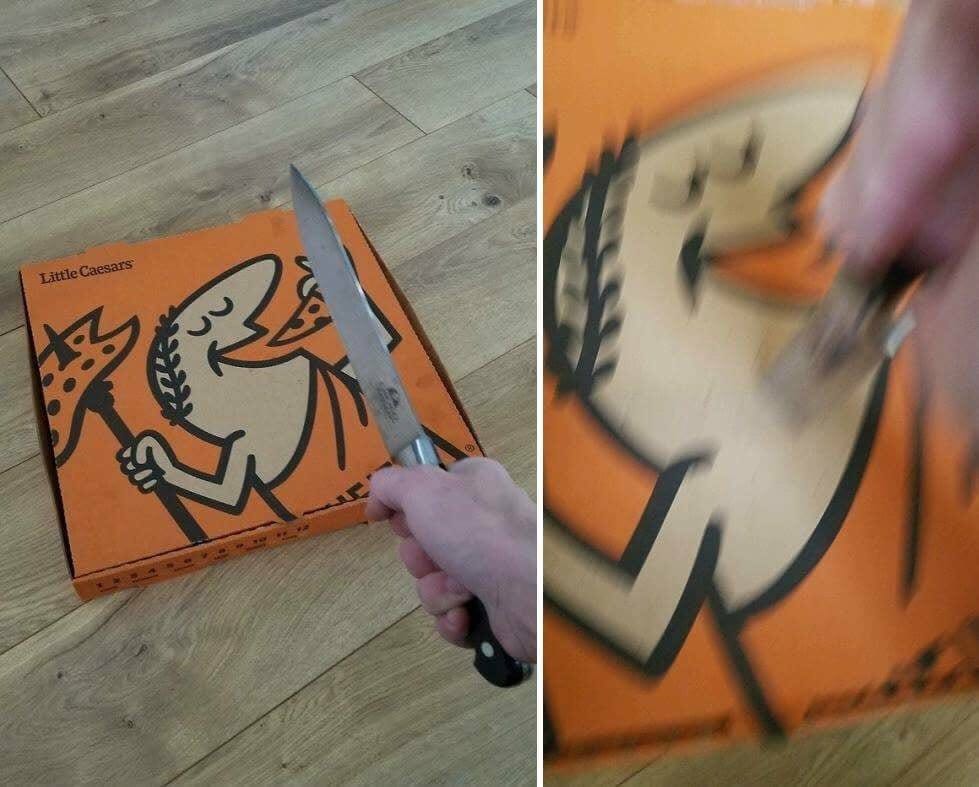
The image depicts a person, viewed from the knees down, wielding a large chef's knife and cutting through a Little Caesars pizza box. The box is visibly printed with the company's logo – a cartoon Roman/Caesar figure holding a wreath. The photograph is taken at a slightly angled, low-perspective, making the knife and the act of cutting visually prominent. The background is a wood-patterned floor. The lighting appears natural. The focus is sharp on the knife/box interaction, while the person's feet/legs are blurred suggesting movement. The image is unsettling due to the combination of a mundane object (pizza box) with a weapon.
2. Foucauldian Genealogical Discourse Analysis
This image can be approached through Foucault's concept of discourse and power. The Little Caesars logo itself is a discourse – a system of thought, language, and practice that constructs a particular meaning around pizza, convenience, and Roman/imperial imagery.
- Discipline and Normalization: Little Caesars' marketing relies on normalizing the idea of quick, affordable, mass-produced pizza as a standard for eating and entertainment.
- Power/Knowledge: The destruction of the pizza box can be read as a disruption of this normalized discourse. The act of cutting through the established brand imagery is a form of asserting power over the system. The knife represents an assertion of agency in contrast to the passive consumption encouraged by the brand.
- Genealogy: A genealogical tracing of the Little Caesars logo/brand could reveal how its visual language and associations (Roman imagery, affordability) have shifted over time and how it has contributed to a specific cultural understanding of food and leisure. The act of defacing the box could be seen as a rejection of that historical trajectory.
3. Marxist Conflict Theory
The image is particularly fertile ground for a Marxist analysis.
- Commodity Fetishism: Little Caesars, as a capitalist enterprise, relies on obscuring the labor and resources that go into making a pizza. The focus is on the image (the logo, the 'convenience'), not the conditions under which the pizza is produced. The act of cutting through the box is a direct challenge to the commodified object. It is an assertion that the image is not the same as the thing and the conditions of its creation.
- Class Conflict: The affordability of Little Caesars can be seen as a strategy to appeal to lower and working-class consumers. The act of destroying the box can be read as a symbolic rejection of a system that relies on exploiting labor to offer cheap goods. It could symbolize a revolt against the conditions that necessitate such low pricing.
- Alienation: The pizza, as a mass-produced commodity, contributes to the alienation of individuals from the process of food production. The destruction of the box could be a symbolic attempt to reclaim agency over what one consumes.
4. Postmodernism
The image lends itself to postmodern interpretations.
- Simulacra & Hyperreality: The Little Caesars logo is a simulacrum – a copy without an original. It’s a constructed image that refers to Roman history but is ultimately detached from any real historical connection. The act of cutting the box could be seen as a gesture towards the artificiality of this image and the hyperreal nature of consumer culture.
- Deconstruction: The image deconstructs the brand image by physically dismantling it. It challenges the idea of a stable, fixed meaning for the logo.
- Irony and Playfulness: There’s a degree of irony in the image – the violent act of cutting being applied to something as trivial as a pizza box. This playful subversion of expectations is a key element of postmodern aesthetics.
5. Queer Feminist Intersectional Analysis
While less immediately apparent, intersectional analysis can be applied:
- Challenging Norms: The act of violently disrupting a brand image can be viewed as a transgression of conventional behavior and consumer expectations. This disruption can be interpreted as a form of resistance against normative structures.
- Reclaiming Agency: The act of cutting the box can be seen as an assertion of agency in a world where women and marginalized groups are often subjected to objectification and control.
- Critique of Consumerism: Consumer culture often perpetuates harmful gender and racial stereotypes. The image can be seen as a critique of this system and a rejection of the pressures to conform.
- Gender and Violence: It's important to note the image contains a display of "violence," and this intersectional lens requires careful consideration. The image could be viewed as problematic if the symbolic "violence" reinforces harmful power dynamics.
Important Considerations:
- Context is key. The meaning of this image depends heavily on the context in which it is presented. Who created it? What is the intent behind it? Where is it being circulated?
- Multiple interpretations are possible. No single interpretation is definitive. The image is open to a variety of readings, depending on the perspective of the viewer.
I hope this detailed analysis is helpful. Let me know if you'd like me to elaborate on any specific aspect or theoretical framework.
simple-description (llama3.2-vision)
The meme is a humorous image of a pizza box with a cartoon character on it, but the character has been replaced with a crude drawing of a pizza with a knife stuck in it. The image is captioned "I ordered a pizza and it came with a side of anger". The joke is that the pizza box is now "armed" with a knife, implying that the pizza is "angry" or "armed" and ready to attack.
tesseract-ocr
> : ne # j gies C 2 aaah 4 pe : < SS < sie » % ¢ oe eT i | | saeco A) a) <d. ‘ a 4 Z = a ss a Hig q Ms e \ a 3 ” fF 4 x Zs : eS y 7 el 2 ig | ” es — ie er be a BOG! Fe oF, a PM Poa tr. » . me fe IE, aa wa Wee ee e/g rg KE > Se, ES ae, go” ; Gig 72 CREE: Ag eee bj ae Bees fe fare 5 Fa ges uaa eo ct Sts ete AG f Vg Sa Ye