First Seen
2023-11-02T23:02:07+00:00
simple-description (llama3.2-vision_11b)
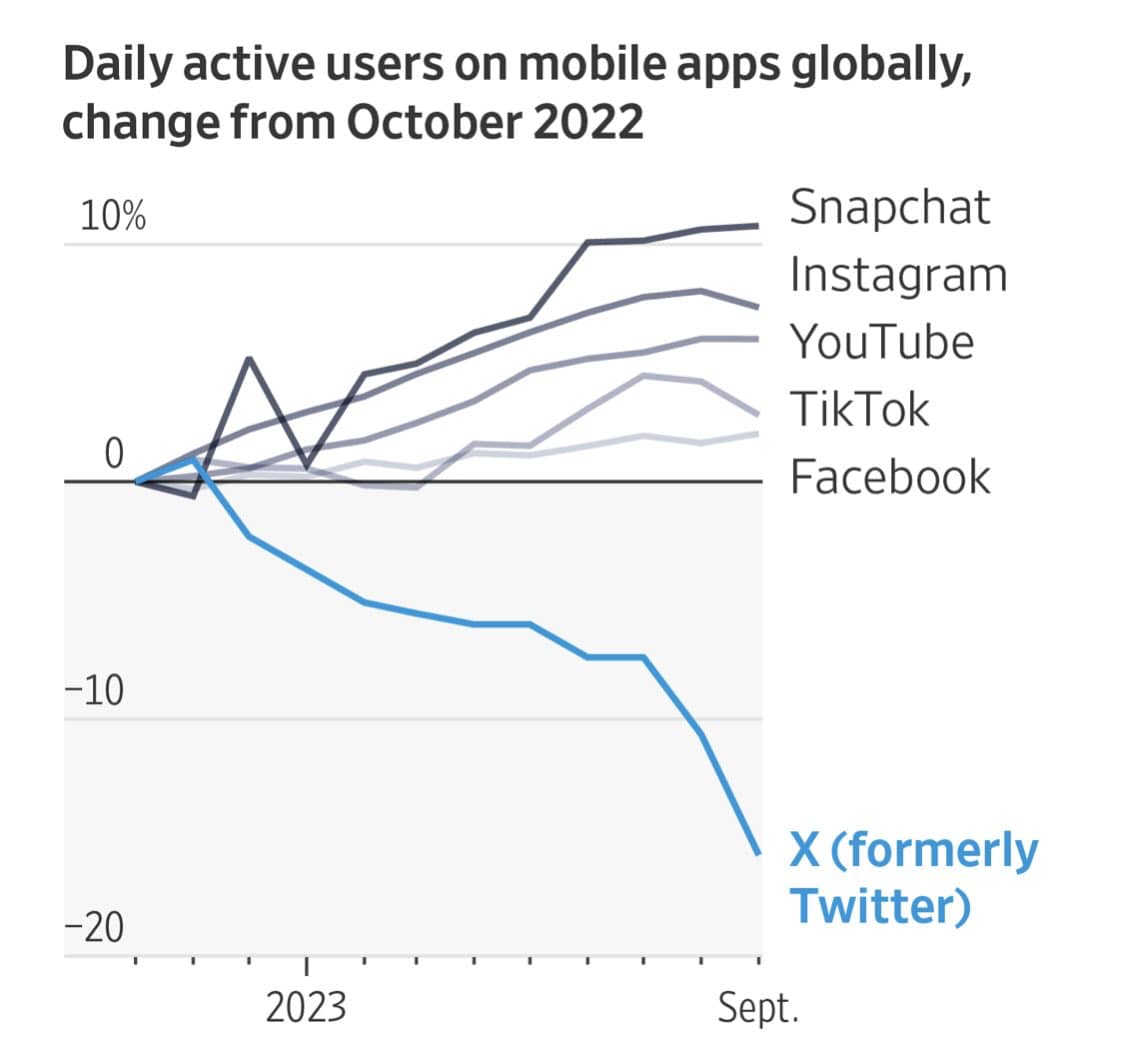
The meme is a graph showing the decline in popularity of various social media platforms, with a focus on the significant drop in user engagement for Twitter (formerly known as X). The graph illustrates how users have abandoned Twitter, with a steep decline in the number of daily active users, making it a "dead" platform.
detailed-analysis (gemma3-27b-vision)
Okay, let's break down this chart of daily active users on mobile apps, applying the requested theoretical frameworks where relevant.
Visual Description
The chart depicts the change in daily active users for six major mobile apps (Snapchat, Instagram, YouTube, TikTok, Facebook, and X (formerly Twitter)) relative to October 2022. The x-axis represents time, spanning from late 2022 through September 2023. The y-axis measures the percentage change in users, ranging from -20% to +10%.
Key Observations:
- X (formerly Twitter) is experiencing a significant and consistent decline in daily active users, dropping to approximately -15% by September 2023. This is the most dramatic trend in the chart.
- Snapchat, Instagram and YouTube demonstrate consistent positive growth overall, but the rate of increase appears to be plateauing, with Snapchat showing the highest positive growth.
- TikTok and Facebook exhibit a relative level of stability, hovering around 0% change. There's some fluctuation, but they don’t show the clear positive or negative trends of other platforms.
- The overall picture suggests a shifting landscape of social media engagement, with some platforms losing users while others gain or maintain stability.
Foucauldian Genealogical Discourse Analysis
Foucault's genealogical approach focuses on how power operates through discourse – the ways we talk about and understand things. Analyzing this chart through a Foucauldian lens, we can see how "user engagement" itself becomes a metric of power.
- Discipline & Normalization: The chart quantifies social interaction. It turns participation on these platforms into a measurable "active user" number. This measurement creates a norm – a benchmark for "successful" platforms. Platforms not meeting these metrics are implicitly positioned as "failing" or becoming obsolete. The constant tracking and reporting of these metrics disciplines the platforms to adhere to growth expectations.
- Power/Knowledge: The data is collected and presented by entities (likely market research firms) who hold the power to define what constitutes "engagement" and "success." This data isn’t neutral; it constructs a particular understanding of social media behavior. The knowledge generated from this data – the insights about platform performance – translates into economic and political power.
- Discontinuity & Historical Contingency: The chart shows a change in engagement. X’s decline doesn’t happen in a vacuum. It's linked to specific historical events: Elon Musk's acquisition, the rebranding, changes to content moderation policies, and resulting user perceptions. This highlights the contingency of these metrics; they are not fixed, but are shaped by specific events.
Critical Theory
Critical Theory emphasizes the role of ideology and power structures in shaping social reality. Applying this to the chart:
- Commodification of Social Life: The very act of measuring "active users" reinforces the commodification of social interaction. Social media platforms are not simply spaces for connection; they are products that are bought and sold based on their ability to attract and retain users. The chart highlights this by showing how platform value is tied to these numbers.
- Ideology & Control: Platforms influence users' beliefs, values, and behaviors. X’s decline could be seen as a rejection of the ideologies and policies associated with its new ownership.
- The Culture Industry: The trends revealed in the chart represent the ebb and flow of consumer preference within the "culture industry," a system that produces and distributes cultural products for profit. Platforms must adapt to maintain their share of attention, or risk decline, as seen with X.
Marxist Conflict Theory
From a Marxist perspective, social phenomena are driven by underlying class conflict and struggles for power.
- Capital Accumulation: The platforms are engaged in a constant competition for attention, which translates into data that is sold to advertisers. The chart reflects the struggle between these platforms for market share and dominance. The decline of X could be seen as a loss of capital for its owners.
- Alienation: The focus on "active users" and engagement metrics reinforces the alienation of individuals from authentic social connections. Social interaction is reduced to a quantifiable number, ignoring the qualitative aspects of human relationships.
- Hegemony: The chart illustrates the shifting dynamics of cultural hegemony. Certain platforms (e.g., Snapchat, Instagram) currently enjoy greater cultural influence, while others (e.g., X) are losing ground. This demonstrates the ongoing struggle between different ideologies and interests for control over public discourse.
Postmodernism
Postmodern thought questions grand narratives and emphasizes the fragmentation and instability of meaning.
- Simulacra & Simulation: The chart itself is a simulation of reality – a simplified representation of complex social interactions. It's a map, not the territory. The "active user" metric is a simulacrum – a copy without an original. It suggests engagement, but doesn’t necessarily reflect meaningful connection.
- Deconstruction of Meaning: Postmodernism would question the inherent value of "active users." What does it truly mean to be an "active user"? Is it a meaningful indicator of social well-being? The chart invites us to deconstruct the assumptions underlying this metric.
- Fragmented Identities: The shifting preferences reflected in the chart suggest that individuals are not fixed in their identities or platform loyalties. They move between platforms, constructing fluid and fragmented online personas.
Queer Feminist Intersectional Analysis
This lens focuses on how power operates through intersecting systems of oppression (gender, sexuality, race, class, etc.). This is potentially less directly applicable to the chart, but we can still explore some connections:
- Platformed Identities: Social media platforms provide spaces for marginalized communities to build networks, organize, and express themselves. The decline of a platform like X could disproportionately affect certain communities who relied on it for visibility and advocacy.
- Algorithmic Bias: Algorithms that prioritize engagement can reinforce existing social inequalities. Content that appeals to dominant groups may be amplified, while marginalized voices are silenced.
- Data Justice: The collection and use of user data raise concerns about privacy and surveillance, particularly for vulnerable populations. This analysis would ask who benefits from this data and at what cost to marginalized communities.
Important Note: These are interpretations, and other readings are possible. The richness of theoretical analysis lies in its ability to illuminate different dimensions of a complex phenomenon.
simple-description (llama3.2-vision)
The meme is a graph showing the decline in daily active users on various social media platforms from 2023 to 2024. The graph has a steep downward slope, with a sharp drop in mid-2023, and a significant decline in all platforms except TikTok. The text "X (formerly Twitter)" is highlighted in the graph, indicating that the platform has been rebranded as X, formerly known as Twitter.
tesseract-ocr
Daily active users on mobile apps globally, change from October 2022 10% Snapchat Instagram — YouTube 7 TikTok u =< Facebook -10 X (formerly -20 Twitter) 2023 Sept.