First Seen
2024-06-26T18:55:25.926413+00:00
simple-description (llama3.2-vision_11b)
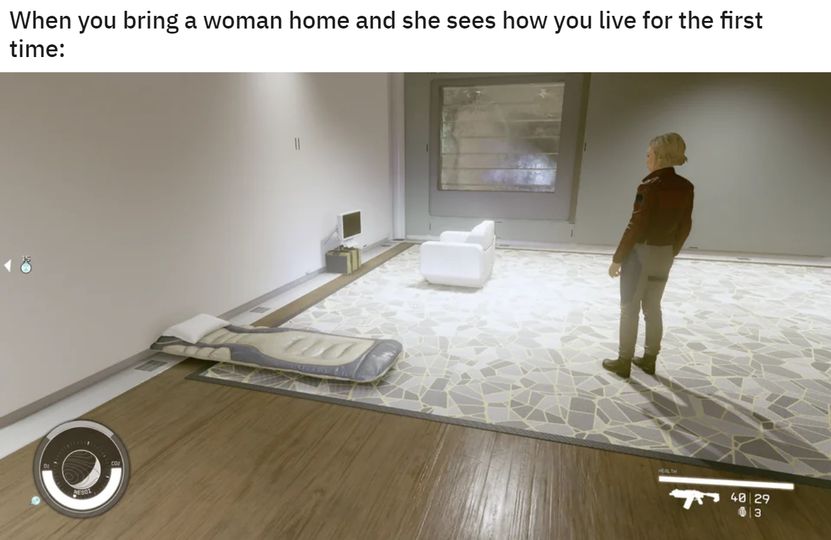
The meme is a screenshot from the game Starfield, showing a character's first-person perspective of a room. The text above the image reads: "When you're exploring a new planet and you finally find a place to rest...". The meme is humorous because it pokes fun at the idea of a character's first experience of finding a safe and comfortable place to rest, implying that it's a rare and exciting moment.
detailed-analysis (gemma3-27b-vision)
Okay, let's break down this image and its potential interpretations through the lenses you've provided. It's important to remember these are interpretations, and the image is purposefully open-ended, making multiple readings valid.
Visual Description
The image is a screenshot from a video game (likely Grand Theft Auto V, judging by the UI elements). The scene depicts a sparsely furnished, minimalist living space. The walls are pale and bare. A rolled-out sleeping bag, appearing to be the primary sleeping arrangement, dominates the central space. A single white chair stands as the only other furniture. A large window reveals a nondescript exterior scene. A figure, presumably a male character in a dark coat, stands with their back to the viewer, gazing at the scene. The floor is covered by a patterned rug. The UI elements at the bottom and sides of the screen—health bar, ammo count, mini-map—clearly indicate a gameplay context. The overall aesthetic is stark and conveys a sense of precarity or temporary living.
Foucauldian Genealogical Discourse Analysis
This image can be read through a Foucauldian lens as a demonstration of practices that construct a specific form of "masculine" subjectivity. The scene is not simply about a messy apartment; it's about the discourse surrounding what constitutes "proper" living, and how this character deviates from it.
- Power/Knowledge: The "normal" expectation of a lived-in space – furniture, comfort, domesticity – is absent. This suggests the character is operating outside of normative power structures. Is this a choice? A result of economic hardship? The absence speaks to a rejection or inability to participate in the discourses of "successful" adulthood, which are inextricably linked to property ownership and comfort.
- Genealogy: Tracing the history of expectations around "home" and "domesticity" reveals they aren't natural but historically constructed. The rolled-up sleeping bag evokes connotations of homelessness, transient lifestyles, and a rejection of conventional stability. It challenges the genealogy of the nuclear family and the associated ideal of the "home" as a secure, comforting space.
- Discipline & Normalization: The expectation of a conventionally furnished space acts as a disciplinary force. The character’s refusal to conform (or inability to conform) is visually highlighted by the stark contrast to what is considered "normal."
Critical Theory
This image lends itself well to a critical theoretical interpretation, particularly concerning alienation and social critique.
- Alienation: The scene evokes a sense of detachment and alienation—from material possessions, from social norms, and perhaps from a sense of self. The bareness of the space, combined with the figure’s isolated stance, underscores a feeling of being disconnected from society.
- Consumer Culture & Commodity Fetishism: The absence of commodities is significant. In a society obsessed with material possessions, this space rejects the logic of consumerism. It suggests a potential critique of the emptiness and superficiality of a culture driven by acquisition.
- Social Critique: The image subtly critiques the social pressures and expectations surrounding adulthood, stability, and domesticity. The sleeping bag becomes a symbol of precarity and the increasing challenges faced by individuals in navigating a late-capitalist society.
Marxist Conflict Theory
From a Marxist perspective, the image can be understood as a manifestation of class struggle and economic inequality.
- Material Conditions: The sleeping bag is a direct indicator of the character's material circumstances. It suggests a lack of economic resources and a struggle to secure basic necessities.
- Class Consciousness: The scene could be interpreted as a commentary on the lack of opportunities and the limitations faced by individuals within a particular class structure. The “woman” entering this space is witnessing a reality that is hidden from those in privileged positions.
- Exploitation & Alienation: The minimalist space and lack of comforts may reflect the alienation experienced by workers within a capitalist system, stripped of dignity and denied access to the fruits of their labor.
Postmodernism
The image exhibits several characteristics often associated with postmodernism:
- Deconstruction of Norms: The scene challenges conventional notions of “home” and “living space.” It actively dismantles the idea that these concepts are fixed or universally understood.
- Fragmentation & Simulacra: The bareness of the space creates a sense of fragmentation. The lack of personal touches and the absence of a coherent narrative contribute to a feeling of disorientation.
- Irony & Parody: The image subtly parodies the idealized depictions of domesticity often found in mainstream media. It exposes the gap between the "real" and the "representation."
Queer Feminist Intersectional Analysis
This is the most complex lens to apply, as the image doesn’t inherently present explicit queer or feminist themes. However, it can be interpreted intersectionally:
- Deconstruction of Gendered Space: Historically, domestic spaces have been heavily gendered—assigned to women as sites of care and emotional labor. The rejection of traditional furniture and the minimalist aesthetic can be seen as a disruption of these gendered expectations.
- Precarity & Vulnerability: The sleeping bag and lack of material comforts highlight the precarity and vulnerability that disproportionately affect marginalized groups, including women, queer individuals, and people of color.
- Intersectionality & Economic Disadvantage: The character's material circumstances likely intersect with other forms of oppression, such as sexism, racism, or homophobia, creating a complex web of disadvantage. The introduction of the “woman” allows for the interpretation of how differing social positions intersect in the same space.
Let me know if you would like me to expand on any of these interpretations, or explore other theoretical frameworks!
simple-description (llama3.2-vision)
This meme is a humorous take on a common experience of gamers. The top image shows a gamer's home, but it's a mess, with a bed, a TV, and a couch all in a small space. The text above it reads "When you invite a gamer over". The bottom image shows a gamer's home, but it's a futuristic, high-tech space with a bed, a TV, and a couch all in a small space. The text above it reads "When you invite a gamer over for the first time".