First Seen
2025-07-16T04:59:01+00:00
simple-description (qwen3.5_2b-q8_0)
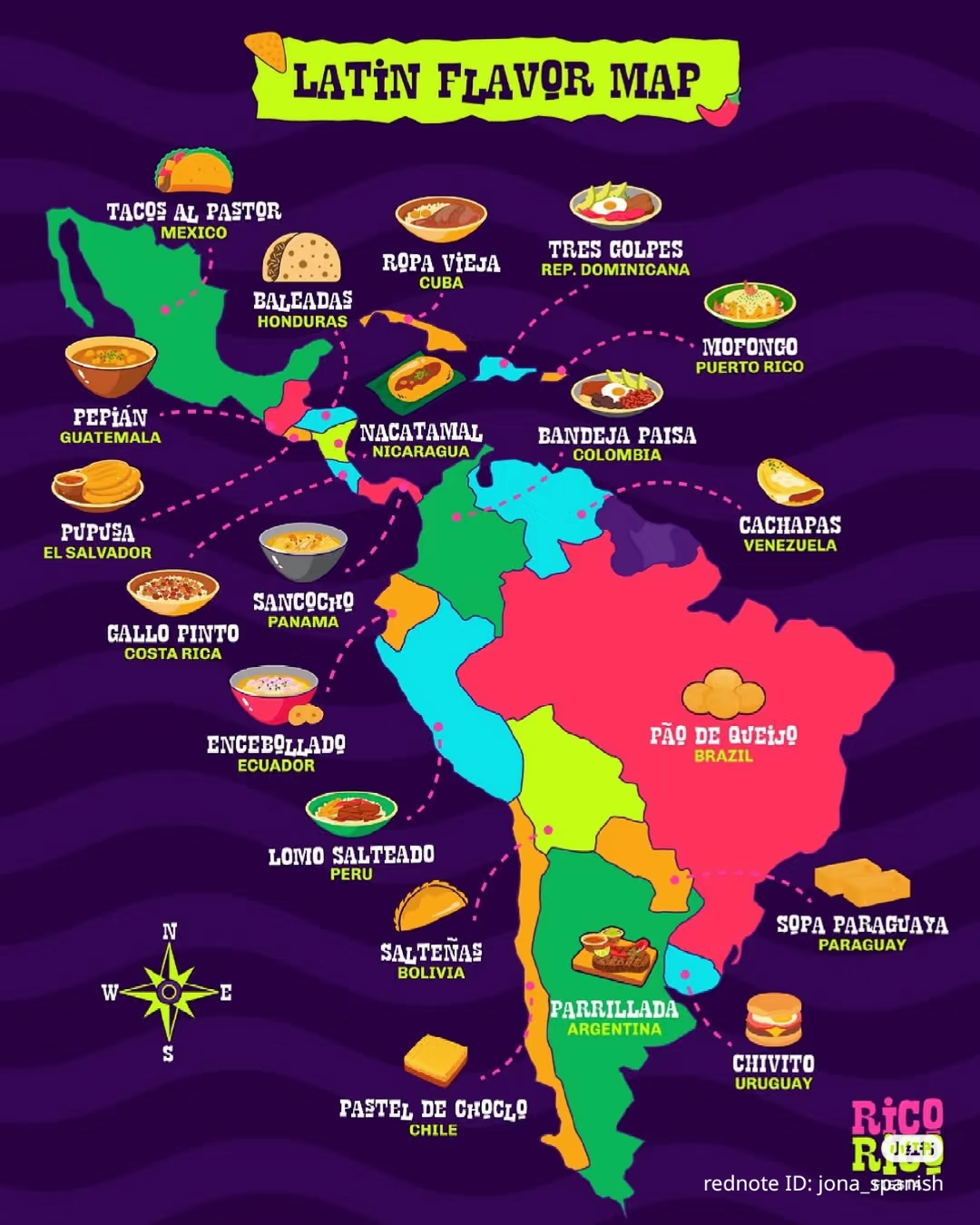
This infographic acts as a vibrant culinary guide that organizes traditional Latin American dishes by country using the continent's shape as its backdrop. It highlights specific regional specialties with icons and labels, such as identifying TACOS AL PASTOR in Mexico and ROPA VIEJA in Cuba, while also showcasing iconic items from other nations like BANDEJA PAISA in Colombia. By pairing text descriptions with colorful food illustrations, the map serves as a visual tour of diverse regional cuisine cultures across South America.
detailed-analysis (gemma3_27b-it-q8_0)
Okay, let's break down this "Latin Flavor Map" image from the perspective of the 'Food' category, applying relevant theoretical lenses where appropriate.
Visual Description
The image is a stylized map of Latin America, rendered in shades of purple and green. Instead of cities, each country is associated with a representative dish – a signature food often considered emblematic of its culinary identity. These dishes are depicted in small illustrations alongside the country name. The map utilizes a compass rose to indicate North, South, East, and West. The overall aesthetic is playful and geared toward a casual audience, likely aiming to spark interest in Latin American cuisine. A "Rico Rico" logo is present in the corner, suggesting a branding/promotional purpose. The map is clearly intended to be a lighthearted and visually engaging representation of diverse culinary traditions.
Foucauldian Genealogical Discourse Analysis
From a Foucauldian perspective, this map isn’t a neutral representation of “Latin American food.” It's a product of a discourse – a system of knowledge and power that shapes how we understand and categorize food.
- Historical Construction: The choice of dishes isn’t "natural" or self-evident. It's the result of historical processes: colonialism, trade, migration, and internal cultural dynamics. The map reflects a specific moment in the construction of what constitutes "Latin American" cuisine. Dishes that might have been more central in the past, or regional specialties, are omitted.
- Power/Knowledge: The map performs a categorization of flavors. By linking a single dish to each nation, it simplifies complex culinary landscapes, exerting a kind of power over how those cuisines are perceived. It reinforces a notion of national culinary identity, potentially obscuring internal diversity and hybridity.
- Genealogy of Flavor: Tracing the history of these dishes would reveal how ingredients, cooking techniques, and culinary traditions were exchanged, adapted, and reshaped over time. It shows that flavors aren't fixed but are continually evolving through social and political contexts. This map can be seen as a moment in that ongoing genealogy.
Critical Theory
This map evokes questions about representation and authenticity, cornerstones of Critical Theory.
- Essentialism: The map risks essentializing national cuisines. Assigning one dish to a country suggests that this food encapsulates the entire culinary identity of that nation. This ignores regional variations, the influence of immigrant cuisines, and the constant evolution of food traditions.
- Cultural Imperialism/Representation: The map is likely created by an outside perspective (the "Rico Rico" brand), raising questions about who gets to define and represent Latin American food. Is this a genuine celebration of diversity, or a form of cultural appropriation or simplification for consumption by a broader audience?
- The “Other”: The map implicitly positions “Latin American” cuisine as different from (presumably) a Western standard. This can contribute to the “othering” of culinary traditions, reinforcing existing power imbalances. It defines these cuisines through contrast rather than inherent value.
Marxist Conflict Theory
From a Marxist lens, the map can be analyzed through the lens of class and production.
- Commodity Fetishism: The dishes themselves become commodities, presented as appealing representations of entire cultures. The map obscures the labor, economic structures, and power dynamics involved in producing and accessing these foods. It glosses over issues of food security, agricultural policies, and the economic realities of food production in Latin America.
- Capital & Cultural Control: The branding ("Rico Rico") indicates a commercial intention. The map is a tool for marketing and profit, potentially exploiting cultural symbols for economic gain. It reinforces the idea that culture can be packaged and sold as a commodity.
- Class & Food Access: The map doesn't address the fact that the dishes featured might not be accessible to all within those countries, highlighting the class disparities related to food access and consumption.
Postmodernism
A postmodern reading focuses on the deconstruction of fixed meanings and the celebration of hybridity.
- Fragmentation & Pastiche: The map represents a fragmented, eclectic collection of dishes, rather than a cohesive narrative. It’s a “pastiche” of culinary traditions, reflecting the postmodern emphasis on borrowing, mixing, and recontextualizing.
- Rejection of Grand Narratives: The map avoids presenting a single, unifying story about Latin American cuisine. It acknowledges (implicitly) the diversity and complexity, rejecting the idea of a singular, essential "Latin American flavor."
- Simulacra and Simulation: The dishes themselves become simulacra – copies without originals. The map presents a stylized, mediated representation of food that may not correspond directly to the lived experiences of people in those countries.
In conclusion, the "Latin Flavor Map" is more than just a playful illustration. It's a cultural artifact that reflects power dynamics, historical processes, and ideological assumptions. By applying different theoretical lenses, we can understand how this map constructs meaning, shapes perceptions, and potentially reinforces existing inequalities.
simple-description (llama3.2-vision_11b)
The meme is a map of Latin America with various countries' traditional dishes listed. The text "Latin Flavor Map" is at the top, and the map is filled with colorful illustrations of food, such as tacos, empanadas, and chiles, that are associated with specific countries. The image is meant to be humorous, highlighting the diversity of Latin American cuisine and the many delicious foods that can be found in the region.