First Seen
2023-05-10T21:03:35+00:00
simple-description (llama3.2-vision_11b)
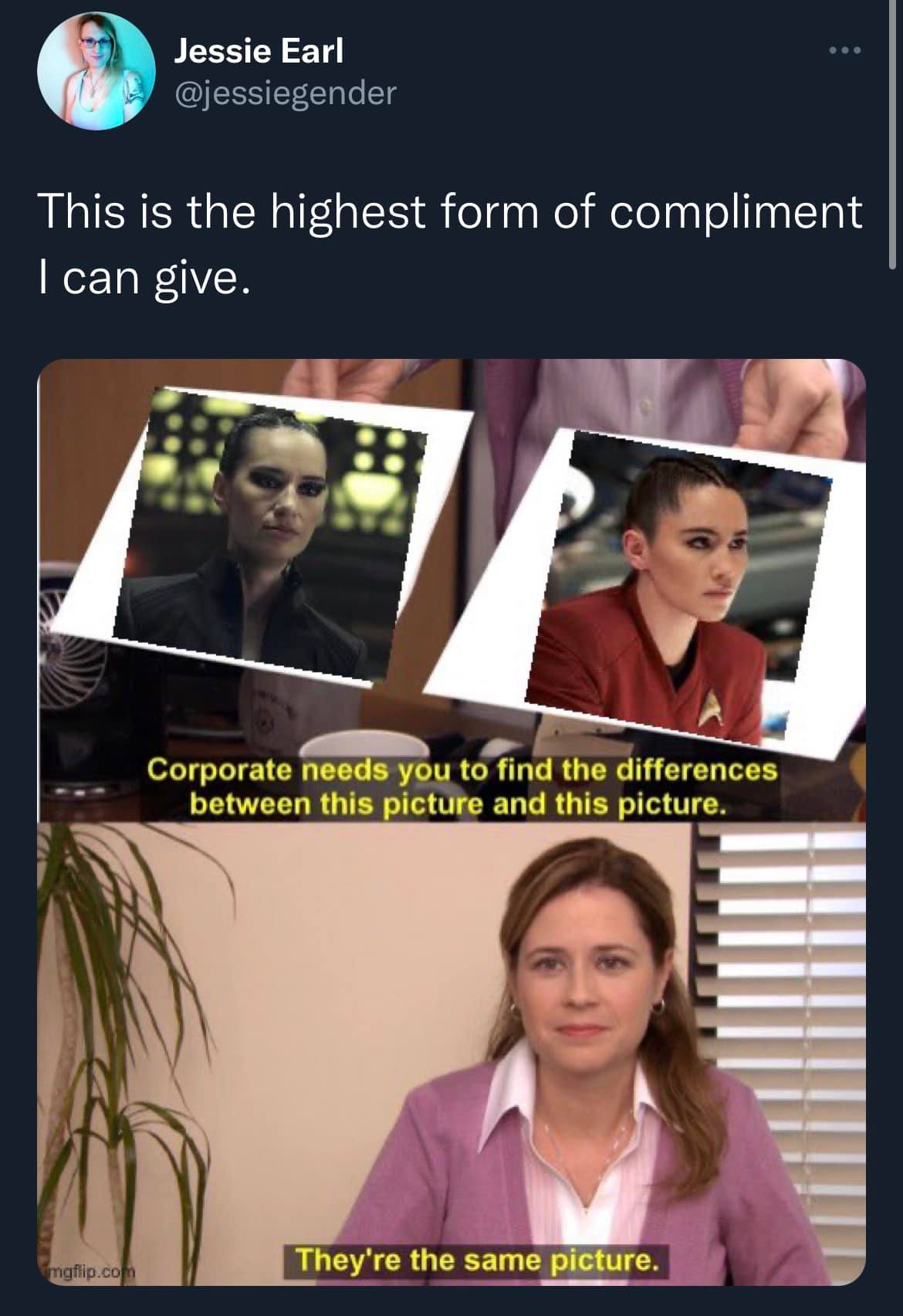
The meme is a humorous comparison of two characters from the Expanse series, making a point about how similar they are. The text "This is the highest form of compliment I can give" is a tongue-in-cheek expression of admiration, implying that the similarity between the two characters is so great that it's a compliment to be compared to them.
detailed-analysis (gemma3-27b-vision)
Okay, here's an analysis of the image/meme, broken down into sections as requested. I’ll only include sections where the framework is genuinely applicable and offers insightful interpretation.
Visual Description
The image is a meme comprised of three parts. The top two panels show a person (who appears to be a performer, possibly in a costume) holding up two identical photos, implying a request to "find the differences." The bottom panel features a still from the American version of The Office, showing Angela Martin looking deadpan with the caption "They're the same." The meme is captioned by Twitter user @jessiegender, who states it is the "highest form of compliment" they can give. The meme format utilizes irony and subverts expectation. It’s a deliberately non-answer/rejection of a pointless task.
---
Foucauldian Genealogical Discourse Analysis
This meme is interesting through a Foucauldian lens. The request to "find the differences" is reminiscent of the techniques of surveillance and normalization employed within institutional power structures. The exercise forces a comparison, a categorization, a judgment. Foucault argued power isn't simply top-down but is diffused throughout society, operating through discourses (ways of speaking and thinking). Here, the discourse of “optimization,” “improvement,” and constant assessment (like in corporate settings) is being ridiculed.
The response ("They're the same") is a refusal to participate in this discourse. It's a rejection of the demand to constantly analyze, categorize, and quantify—a move that disrupts the power dynamic. The "compliment" aspect suggests it’s a specific, pointed acknowledgement of seeing this dynamic in the recipient and subverting it with them. It suggests shared understanding of the oppressive, often meaningless, demands made by power structures.
---
Critical Theory
The meme clearly critiques the nature of labor and the demands of corporate culture. The request to “find the differences” functions as a metaphor for the incessant, often pointless tasks and metrics used in corporate evaluation. It’s a commentary on how work can become alienating and divorced from any real value.
The response, "They're the same," is an act of resistance against this alienation. It's a refusal to play the game, to participate in the absurdity. The "compliment" aspect is key here – recognizing someone gets this absurdity and is willing to see through it is a form of solidarity. The meme embodies a distinctly Adorno-esque negativity—finding value in pointing out the inherent flaws and irrationality of systems rather than attempting to improve them.
---
Queer Feminist Intersectional Analysis
While not immediately obvious, this meme can be seen through a queer-feminist lens. The demand to find difference—to categorize—is deeply embedded in systems of power that construct and enforce binaries (male/female, normal/deviant, etc.). The "compliment" is not about similarity, but about recognizing shared awareness of how these categorizations are used to control and marginalize.
The subversion of this categorization, declaring the images identical, can be a subtly defiant act. It destabilizes the expectation of difference and challenges the inherent logic of oppressive categorization. For marginalized individuals, being "different" is often a source of scrutiny and discrimination. Recognizing someone sees this dynamic and refusing to participate in it can be a powerfully validating experience. Recognizing someone's understanding is the compliment.
Let me know if you’d like me to expand on any of these interpretations or explore the image through a different theoretical lens!
simple-description (llama3.2-vision)
This meme is a humorous comparison between two actresses, one of whom is known for playing a character with a strong and confident personality. The meme is captioned "This is the highest form of compliment I can give." The image shows a split-screen comparison between two actresses, with the caption "They're the same person" above it, implying that the two actresses are identical in appearance.
tesseract-ocr
Jessie Earl eee @jessiegender This is the highest form of compliment | can give. 7 — = - bi x ir i cise f D ; => = Corporate oe you tofind the differences re between this picture and this picture. Wr. a \\ \S Wy \ 2 ' y k | Vl) il : They're the es ie