First Seen
2026-03-30T03:03:03+00:00
simple-description (qwen3.5_2b-q8_0)
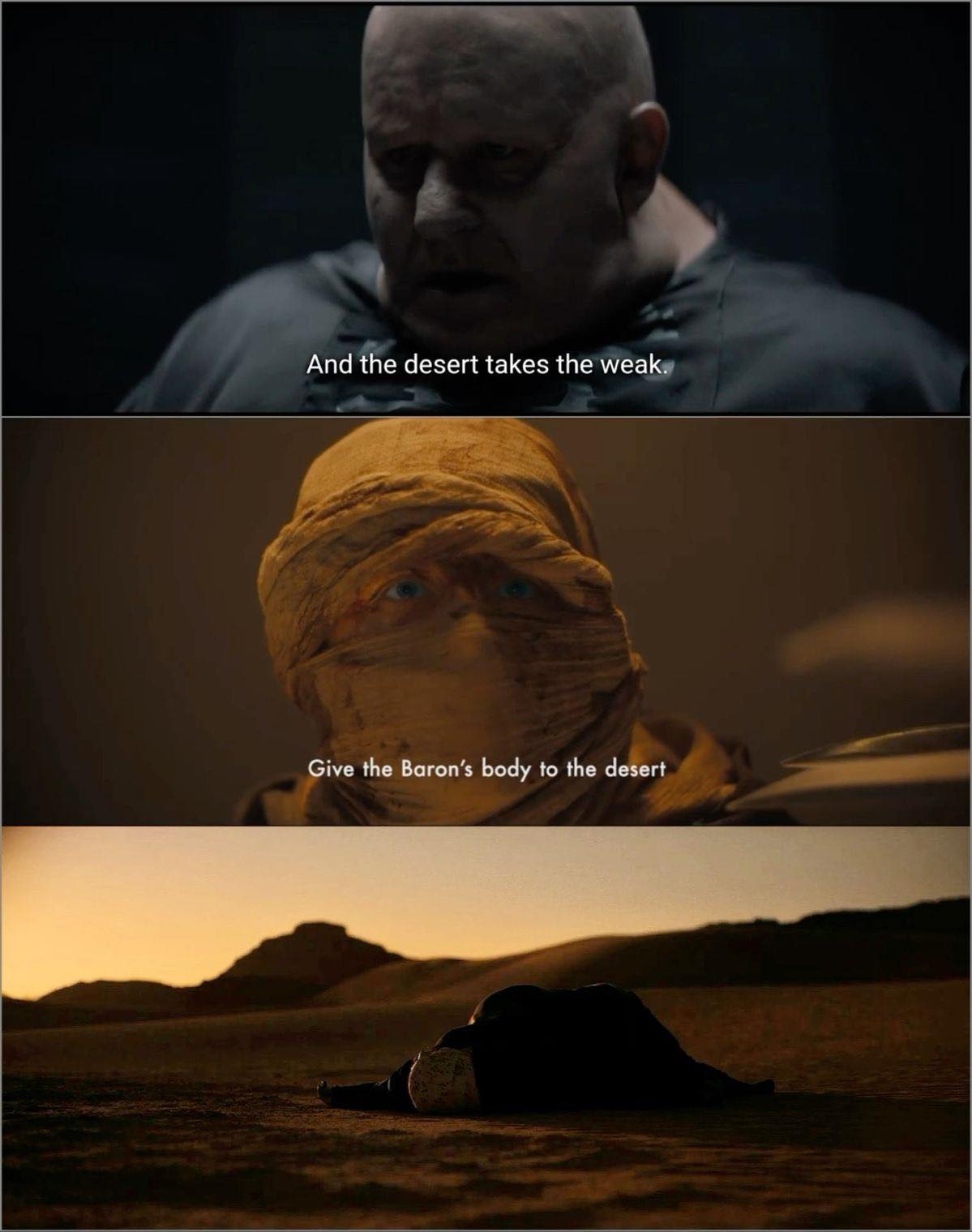
Based on the context of Frank Herbert's Dune series, this meme depicts a grim scene featuring Brian Drax (the bald leader) and Manderion (the bandaged warrior) lying on the sands of Arrakis at sunset. The text suggests a dark joke about denying resources: it implies that Drax is forcing his dying enemy, Baron Vladimir Harkonnen, to remain in the open desert, leaving his body lying motionless on the sand. The humor relies on the idea that by abandoning the corpse in the elements, he is ensuring the enemy loses access to valuable supplies like bodies, though the intent is likely just to make him feel superior by depriving him of what he wanted most—resources.
detailed-analysis (gemma3_27b-it-q8_0)
Okay, let's break down this Dune meme through various theoretical lenses. It's a rich image with layers of meaning, especially given the source material's complexity.
Visual Description
The meme is a two-panel image sourced from Denis Villeneuve's 2021 film adaptation of Dune.
- Top Panel: Features a close-up of Baron Vladimir Harkonnen (Stellan Skarsgård). He's depicted as monstrous, with a pale, bloated face, emphasizing his physical corruption and moral decay. The lighting is dark and stark, adding to his imposing, villainous appearance. A text overlay reads: "And the desert takes the weak."
- Bottom Panel: Shows a Fremen warrior, completely shrouded in a stillsuit, kneeling beside the deceased Baron Harkonnen, lying in the desert. The environment is vast and desolate, dominated by sand dunes. The image captures the Fremen's intimate, almost reverent, connection to Arrakis. The text overlay reads: "Give the Baron's body to the desert." The final image is a shot of the Baron's body, left to become a part of the desert, essentially being reclaimed by the ecosystem.
The visual contrast between the Baron's opulence/deformity and the Fremen's austere adaptation is significant. The desert itself is a silent character, presented as an active agent in this exchange.
Foucauldian Genealogical Discourse Analysis
This meme speaks directly to Michel Foucault's concept of power/knowledge. The Baron represents a system of oppressive power – the feudalism of the Great Houses, colonial exploitation of Arrakis, and a reliance on genetic manipulation (his reliance on consuming spice and suppressing his metabolism to prolong life). He embodies a discourse of domination.
The Fremen, and specifically their act of returning the Baron's body to the desert, disrupts this discourse. It's not merely a disposal of a corpse; it's a symbolic gesture rejecting the Baron’s logic and attempting to restore a natural order.
- Genealogy: We can trace the history of the Baron's power to its roots in lineage, resource control (spice), and technological manipulation. The Fremen action represents a rejection of this lineage, reclaiming resources, and asserting an alternate way of living in harmony with Arrakis.
- Power/Knowledge: The Fremen understand the desert intimately – its cycles of life and death, its scarcity, its power. This knowledge is power. Their act of leaving the Baron to the desert isn't a weakness, but a demonstration of their understanding and mastery of their environment, a rejection of the knowledge and power system the Baron represents.
- Discipline & Punishment: The desert is the ultimate disciplinary force in Dune. The Baron, who constantly sought to control and punish others, is now subject to the ultimate disciplinary process – dissolution into the very environment he sought to exploit.
Critical Theory (Frankfurt School)
From a critical theory perspective, the meme highlights the dehumanizing effects of late-stage capitalism/feudalism, embodied by the Baron. He represents the instrumentalization of life - using everything, including his own body, as a tool to maintain power.
The Fremen's action can be interpreted as a rejection of this instrumental reason. They aren’t interested in extracting value from the Baron's corpse; they allow it to return to the natural cycle of life, asserting the inherent worth of the environment. The meme subtly critiques the societal structures that allow for the creation of figures like the Baron – those who prioritize power and control above all else. It also questions the very idea of “progress” that drives such exploitative systems.
Marxist Conflict Theory
The meme embodies the core tenets of Marxist conflict theory. The Baron is the epitome of the ruling class - exploitative, decadent, and reliant on the labor of the oppressed (the Fremen and the laborers on Arrakis). The Fremen, as a marginalized group, represent the proletariat.
The act of “giving the Baron to the desert” can be seen as a symbolic act of revolution. It's a rejection of the economic and political structures that allowed the Baron to thrive. The desert, in this context, acts as a neutral force, indifferent to class structures, that ultimately levels the playing field.
The meme also touches upon the concept of "false consciousness." The Baron, blinded by his power, fails to understand the true forces at play – the resilience of the Fremen and the power of the desert itself.
Postmodernism
A postmodern reading focuses on the disruption of grand narratives and the deconstruction of meaning. The meme undermines the traditional heroic narrative. The Baron isn't defeated in a glorious battle; he's left to decompose in the desert.
The desert itself isn't presented as a benevolent force. It’s a neutral, uncaring environment. This challenges the idea of a moral universe where good triumphs over evil.
The meme also utilizes intertextuality, drawing on the audience's pre-existing knowledge of Dune to create meaning. The power of the meme resides in the audience's understanding of the source material. It's a self-referential commentary on the story.
Queer Feminist Intersectional Analysis
(This one is a little more nuanced, but still relevant)
The Baron’s body, distorted by genetic manipulation and his own greed, can be seen as a symbol of toxic masculinity and the destructive consequences of unchecked power. He actively rejects the natural cycles of life and death, attempting to transcend his own limitations through artificial means.
The Fremen, in contrast, represent a more fluid and adaptable way of being, embracing the harsh realities of their environment. Their stillsuits, blurring the lines between body and environment, can be interpreted as a rejection of rigid gender roles and societal norms.
From an intersectional perspective, the meme highlights the interconnectedness of power structures. The Baron’s oppression isn't just about class; it’s about gender, genetic privilege, and colonial control. The Fremen's resistance is a challenge to all of these systems. The reclamation of the Baron’s body by the desert is a symbolic act of returning power to the natural world, which transcends the boundaries of human constructs.
In conclusion, this Dune meme is a surprisingly complex piece of cultural commentary, offering multiple layers of meaning when analyzed through various theoretical lenses. It’s a testament to the depth and richness of Frank Herbert’s original novel and its continued relevance in contemporary society.
simple-description (llama3.2-vision_11b)
The meme is a still from the 2021 film adaptation of Dune, specifically a scene where a character is given a specific instruction. The image shows a character with a bandage over their face, with a quote overlaid: "And the desert takes the weak." Below this is another image of the same character, this time with a quote that says "Give the Baron's body to the desert." The meme is a humorous commentary on the harsh environment of the desert in Dune, where the characters are often forced to make difficult choices and the environment is often an enemy to them.