First Seen
2026-03-25T22:11:36+00:00
simple-description (qwen3.5_2b-q8_0)
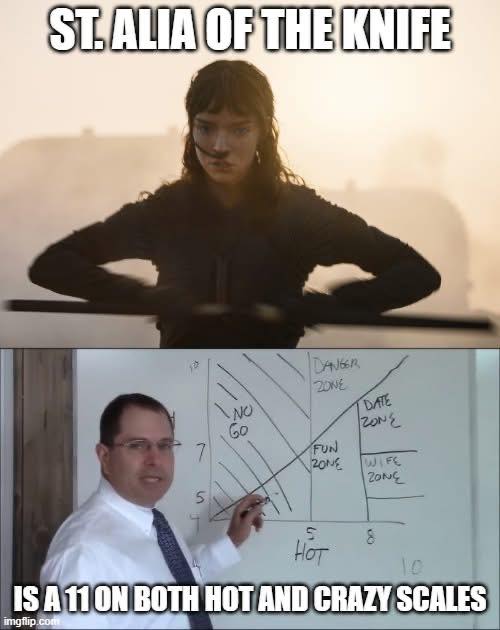
In the Dune universe, this meme plays on the relationship dynamics between General Thrawn and Stalagmites' daughter, Stalien (St. Alia).
The top image shows Thrawn treating Stalien as a weapon or prize—she was captured to help him achieve his Harkonnen plans by killing her as an obstacle. In this fan interpretation, he has taken her for his own gain.
The bottom graph is often used to analyze romantic chemistry (where "Hot" is physical attraction and "Crazy" is obsession/vulnerability). A score of 11 represents the highest intensity. The joke implies that because Thrawn took Stalien, he is now obsessed with her ("Crazy") to an extreme degree and views her as his personal weapon or object of desire ("Hot").
detailed-analysis (gemma3_27b-it-q8_0)
Okay, let's break down this Dune meme, pulling in those academic lenses where they fit. It’s a layered piece, tapping into the lore and character of Alia Atreides.
Visual Description
The meme is a two-panel format. The top panel features a still of Alia Atreides (played by Zendaya) from Denis Villeneuve’s Dune adaptation. She is depicted in a dark, imposing pose, looking directly at the viewer with a somewhat chilling expression. She is wearing the dark attire common to Bene Gesserit and Fremen culture in the film.
The bottom panel contrasts this with a stock image of a man, presumably a lecturer or consultant, standing in front of a whiteboard covered in somewhat absurd, hand-drawn "zones" labeled "Danger Zone," "Date Zone," "Fun Zone," "Wife Zone," and a scale with “Hot” and “Crazy” axis. He's pointing at the graph with a serious expression.
The text above reads “ST. ALIA OF THE KNIFE” and below it: “IS AN 11 ON BOTH HOT AND CRAZY SCALES”. The “imgflip.com” watermark suggests it's been created on that meme generator platform.
Critical Theory
This meme relies on a fundamental tension central to Critical Theory – specifically the problem of representation and the subversion of power structures. Alia Atreides is a character built on transgression. She’s a pre-born, fully conscious being, embodying a rejection of natural biological timelines. Her existence is essentially a manipulation of life itself via the Bene Gesserit breeding program.
The meme's juxtaposition of Alia with the 'hot/crazy' scale immediately satirizes attempts to categorize and understand complex individuals (especially powerful female ones) through reductive, patriarchal frameworks. The "hot/crazy" scale is a common trope used to dismiss women who don't fit conventional expectations. By applying it to Alia, the meme isn't asserting she is simply "hot" or "crazy", but mocking the impulse to simplify a character deeply steeped in political, religious, and biological complexity.
Alia’s power – derived from her Bene Gesserit training and the memories of her ancestors which she has access to– is threatening to established orders. The meme suggests that the viewer's reaction to her (attraction, fear, fascination) is precisely because she breaks those categories. She's too much, exceeding the bounds of neat classification. She is a destabilizing force.
Foucauldian Genealogical Discourse Analysis
From a Foucauldian perspective, this meme engages with the historical construction of “madness” and “desirability.” Michel Foucault argued that these concepts aren’t innate but are produced through discourses – systems of thought, language, and power.
The “hot/crazy” scale is a micro-discourse within broader patriarchal structures. It operates as a mechanism of control, regulating female behavior by labeling and punishing deviations from the norm. “Crazy” becomes a label to invalidate women who are assertive, independent, or challenge existing power dynamics. “Hot” becomes a way of objectifying women, reducing them to their physical appearance.
Alia, in the Dune universe, embodies a disruption of these discourses. Her very existence challenges the natural order. Her abilities (access to ancestral memories, prescience, heightened physical and mental prowess) position her outside of normalized categories. The meme highlights this by suggesting she surpasses the limitations of the “hot/crazy” scale, existing beyond its controlling logic. She isn’t just on the scale; she breaks it.
Postmodernism
The meme's self-awareness and irony are distinctly postmodern. It doesn't present a straightforward assertion; it's a commentary on commentary. The ironic juxtaposition of high-art (a character from a complex sci-fi universe) with a low-brow trope (the "hot/crazy" scale) embodies a postmodern tendency toward pastiche and parody.
The meme deconstructs the notion of "authenticity." It acknowledges Alia's constructed nature (through the Bene Gesserit program) while simultaneously highlighting her power and charisma. It doesn't claim to offer a definitive interpretation of the character, but rather plays with multiple readings.
Marxist Conflict Theory
Dune itself is deeply rooted in themes of resource control, imperialism, and class struggle. Alia, as a member of the ruling house Atreides, participates in these power dynamics. Though she often operates outside of typical aristocratic behavior, she is still a figure of privilege and influence.
The meme, within this framework, could be seen as a reflection of the anxieties surrounding female power in a patriarchal system. The “hot/crazy” scale can be viewed as a tool used to diminish and control women who challenge the status quo. It’s a way of discrediting their authority and reducing them to objects of male desire or fear. Alia, because of her unconventional power, becomes a target for such reduction. She challenges the established social hierarchy and is, therefore, perceived as dangerous.
In short, this meme is more than just a lighthearted observation about a character’s appeal. It’s a complex commentary on power, gender, and the limitations of language and categorization, filtered through the rich lore of Frank Herbert’s Dune.
simple-description (llama3.2-vision_11b)
This meme is a play on the character St. Alia of the Knife from the Dune series. The top image shows a still of the character, while the bottom image shows a scene from the TV series The Office, where a character is explaining a complex situation on a whiteboard. The text "St. Alia of the Knife is a 11 on both hot and crazy scales" is a humorous comparison to the character's personality, implying that she is both incredibly hot and crazy. The image is meant to be humorous and satirical, using the TV show's whiteboard scene to poke fun at the character's personality.