First Seen
2025-07-09T00:37:50.092704+00:00
detailed-analysis (gemma3_27b-it-q8_0)
Okay, let's break down this meme within the context of Dune, and analyze it through the requested theoretical lenses. It's a wonderfully absurd meme, which lends itself to a lot of interesting interpretations.
Visual Description
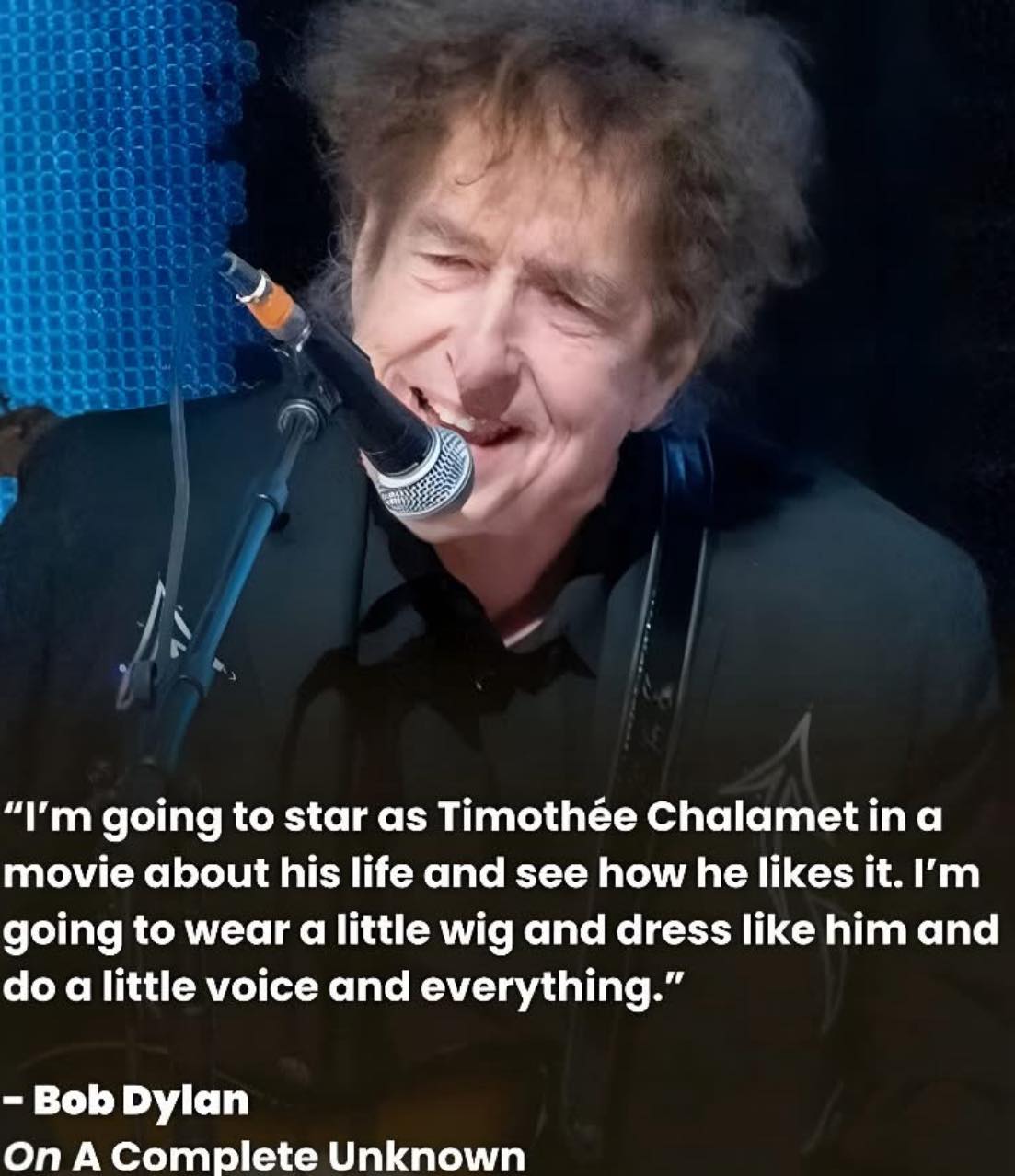
The image depicts Bob Dylan, a legendary folk singer, speaking into a microphone. He's on a stage with a dark backdrop. He has a somewhat grizzled, thoughtful expression. He's dressed in a dark, layered outfit – his typical stage attire. The text overlay is a quote attributed to him stating his intention to play Timothée Chalamet (who plays Paul Atreides in Dune) in a biopic, detailing his plans for meticulous method acting—dressing and mimicking Chalamet’s mannerisms. The meme’s context is a quote from an interview with Dylan regarding an "unknown" project.
Foucauldian Genealogical Discourse Analysis
This meme highlights the power dynamics surrounding celebrity and representation. Michel Foucault's concept of genealogy examines how concepts (like "stardom," "biopics," or even "masculinity") are not natural but are constructed through historical discourse.
- Discourse of Biopics: The biopic genre, as a discourse, functions to produce a specific understanding of a person's life. It seeks to contain and categorize a life narrative, often imposing a cohesive structure where one may not naturally exist. Dylan, an icon himself, suggesting he will dissect and embody another highly visible actor (Chalamet) is a disruption of this discourse.
- The Power of Imitation: Dylan's declaration isn't about artistic appreciation; it's about absorbing another's identity, even down to the superficial ("little wig"). This points to Foucault's idea of power as productive—it doesn't just repress, it creates. The imitation itself is an act of power, appropriating and redefining Chalamet’s image.
- Deconstructing Authority: The absurdity of Dylan, a figure so associated with authenticity and rebellious non-conformity, taking on this type of role, further destabilizes the authority inherent in both biographical representation and the celebrity persona. He's essentially poking fun at the whole process of constructing a narrative around someone's life.
Critical Theory
From a critical theory perspective (drawing on thinkers like Adorno and Horkheimer), this meme touches upon the "culture industry."
- Commodification of Identity: The meme satirizes how even personal identity, or the performance of identity, becomes commodified in our culture. Chalamet is a product, a brand—and Dylan's supposed biopic proposal highlights this by suggesting that Chalamet’s image can be dissected, replicated, and consumed.
- The Loss of Aura: Walter Benjamin's concept of the "aura" (the sense of uniqueness and authenticity in a work of art) is relevant here. The meme mocks the idea that a biopic can ever truly capture the essence of a person. Dylan’s intention to “mimic” Chalamet suggests a deconstruction of this aura, reducing the actor to a set of performative elements.
- Critique of Spectacle: The sheer weirdness of the scenario reflects a critique of the spectacle. We are constantly bombarded with images and narratives, and the meme highlights the absurdity of this endless cycle of representation.
Postmodernism
This meme is inherently postmodern.
- Self-Referentiality & Intertextuality: The meme layers references—Dylan, Chalamet, Dune, biopics—creating a self-referential and intertextual experience. It's a joke that relies on the audience’s understanding of all these elements.
- Simulation & Hyperreality: Dylan’s statement suggests a complete embrace of simulation. The idea isn't to understand Chalamet, but to become a simulation of Chalamet, blurring the lines between the real and the representation. This reflects Jean Baudrillard's concept of hyperreality, where simulations become more real than reality itself.
- Deconstruction of Grand Narratives: The meme destabilizes the "grand narrative" of the artist biopic—the idea that a life can be neatly explained and understood through a biographical film.
In relation to Dune Specifically:
- The Dune franchise relies heavily on the idea of identity, prophecy, and the construction of messianic figures (Paul Atreides). Dylan’s statement, therefore, feels particularly relevant. The idea of someone "becoming" Chalamet, mimicking his persona, subtly mirrors the pressures faced by Paul to become Muad'Dib, a predetermined figure.
- Dune explores themes of power, control, and manipulation. Dylan's intention to dissect and embody Chalamet can be seen as a playful, albeit absurd, commentary on these themes.
In conclusion, the meme is not just funny; it's a densely layered commentary on celebrity, representation, power, and the nature of reality. It’s a perfect example of how internet humor can engage with complex theoretical ideas.
simple-description (llama3.2-vision_11b)
The meme is an image of Dune's character Paul Atreides, with the quote "I'm going to star as Timothee Chalamet in a movie about my life, I'm going to wear a little wig and do a little voice and everything." The image is likely a humorous take on the idea of a biopic about Paul's life, with the quote poking fun at the idea of a biopic about Paul's life.
detailed-analysis (gemma3-27b-vision)
Okay, here's an analysis of the image and the quote, broken down into the sections you requested. Not all sections are relevant, so I've included only what applies.
Image & Quote Overview:
The image features Bob Dylan speaking into a microphone. The quote is a statement he made about starring in a biopic of Timothée Chalamet, detailing a planned imitation of Chalamet's appearance and mannerisms.
1. Visual Description
The image is a medium close-up shot of Bob Dylan. He appears to be in a performance or interview setting, standing before a dark, textured background (potentially fabric or a wall). The lighting is somewhat subdued, highlighting the lines and wrinkles on his face, indicating his age. He’s wearing a dark shirt, partially open at the collar, and is looking to his left, likely addressing an audience or interviewer. A microphone is positioned directly in front of him, emphasizing that the context is public speaking. His expression is relatively neutral, almost wry, with a slight upturn of the lips. The composition emphasizes his face and the communication occurring through the microphone, reinforcing the importance of the quoted statement.
2. Foucauldian Genealogical Discourse Analysis
This quote is fertile ground for a Foucauldian analysis, particularly regarding power dynamics, knowledge/power, and discourse surrounding celebrity and impersonation.
- Power/Knowledge: The statement is a performative utterance. By declaring his intention to play Chalamet as Chalamet, Dylan is asserting a power to define, represent, and even become another individual. The statement isn't about acting in a conventional sense, but about inhabiting a constructed identity. This highlights how power operates through discourses that shape perceptions of identity and authenticity. Dylan, as a cultural icon, wields significant power in defining narratives.
- Discursive Formation: The very idea of a biopic, and especially one that involves such a self-aware imitation, relies on a pre-existing discourse about celebrity, biography, and performance. The media and public demand a narrative "truth" about celebrities, which creates a space for biopics. Dylan's statement challenges this expectation by intentionally subverting the idea of capturing "truth," instead focusing on surface-level imitation.
- Genealogy of the ‘Actor’: Examining the historical construction of the actor as a role (pun intended!) would be relevant. Traditionally, actors become characters, but this statement proposes an actor becoming an actor, creating a strange doubling. This could be seen as a metacommentary on the increasingly manufactured and performative aspects of contemporary celebrity. The history of representation and mimicry would illuminate the power dynamics at play.
3. Postmodernism
The quote is deeply embedded within a postmodern sensibility.
- Simulacra and Simulation: Jean Baudrillard's concept of simulacra is highly relevant. Dylan is proposing a hyperreality where the distinction between the original (Chalamet) and the copy (Dylan portraying Chalamet) blurs. It's no longer about representing reality; it's about creating a simulation of a representation.
- Intertextuality & Pastiche: The statement is a playful act of intertextuality, referencing the conventions of biography and acting. It's a pastiche – a playful imitation that highlights the artificiality of representation. The lack of serious intent further emphasizes the postmodern rejection of grand narratives and authenticity.
- Deconstruction of Identity: The statement challenges the very notion of a fixed identity. Dylan is not aiming to understand Chalamet, but to reproduce his external characteristics. This focuses on the constructed nature of identity and the power of surface appearances.
Let me know if you'd like me to delve deeper into any specific aspect or if you have further questions.
simple-description (llama3.2-vision)
This meme features a photo of Bob Dylan, a famous singer and songwriter, with a quote from his song "On A Complete Unknown" superimposed over it. The quote says, "I'm going to star as Timothee Chalamet in a movie about my life and see how he likes it. I'm going to wear a little wig and dress like him and do a little voice and everything." The image is meant to be humorous, implying that Bob Dylan is going to play a role in a movie about his life and is using Timothee Chalamet's style as inspiration. The quote is meant to be satirical and is not meant to be taken seriously. The image is meant to be funny and is not meant to be taken as an actual statement.