First Seen
2024-12-30T15:00:44.204039+00:00
detailed-analysis (gemma3_27b-it-q8_0)
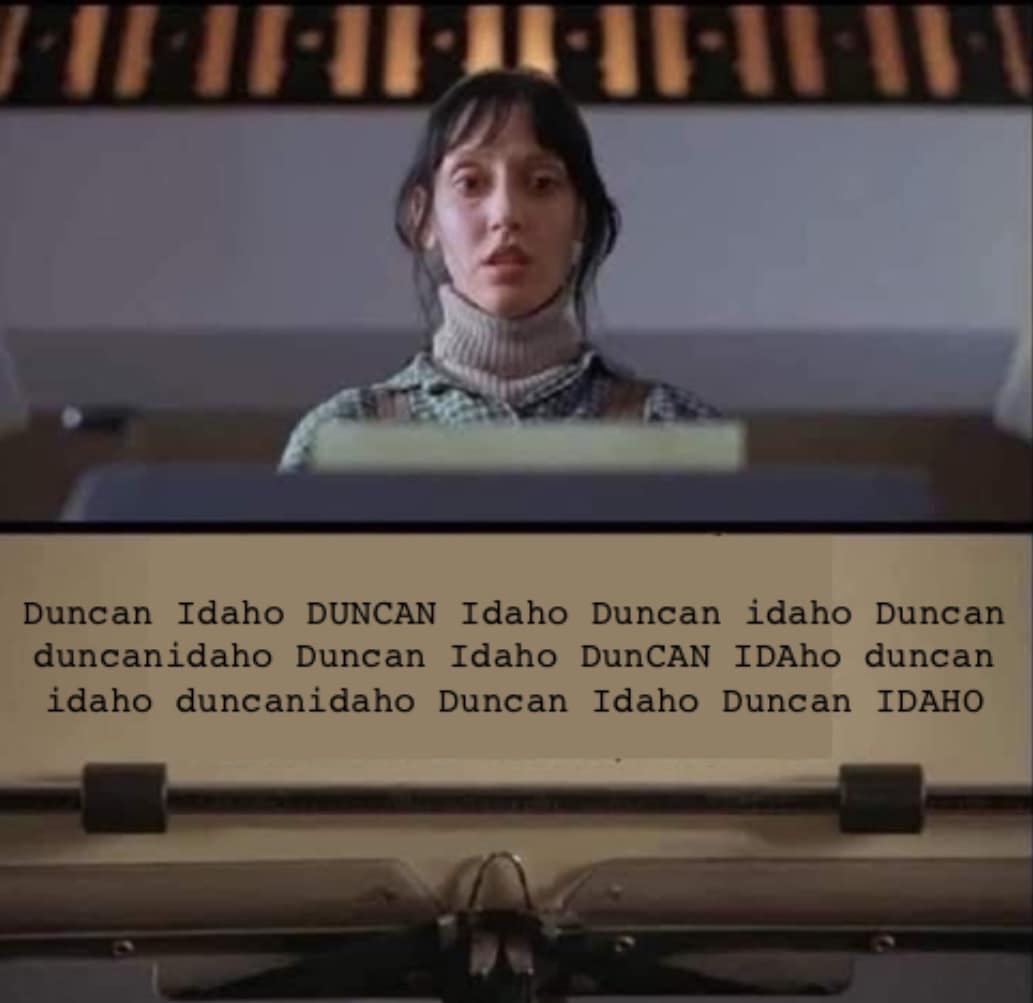
Okay, let's dissect this iconic Dune meme through the lenses you've requested. It's a rich image, so there's quite a bit to unpack!
Visual Description
The image is a screencap from Denis Villeneuve’s 2021 Dune adaptation. It features Timothée Chalamet as Paul Atreides, mid-scene in what appears to be a training exercise or perhaps a formal meeting. His expression is… intense, borderline panicked, yet attempting to maintain composure. He is wearing a grey, loose-fitting garment. Behind him are blurred, geometric shapes – likely architectural elements of a palace or stronghold on Caladan or Arrakis. Crucially, the bottom half of the image is dominated by a sleek, metallic tabletop.
The overlay text, repeatedly escalating in capitalization ("Duncan Idaho") alongside the word “Idaho”, is the core of the meme. It visually overwhelms the image and represents the obsessive, almost frantic questioning that fuels the joke.
Foucauldian Genealogical Discourse Analysis
This meme is a brilliant example of how power operates through discourse, a central tenet of Michel Foucault’s work. The "Duncan Idaho" repetition is not about the character himself, it's about the interrogation, the relentless desire for identification within the narrative structure of Dune. Let’s break it down:
- The Question: The question itself – “Is this Duncan Idaho?” – is a test of knowledge. It tests understanding of the complex plot device of Duncan’s many iterations (due to gholas and memory implants).
- The Power Dynamic: The questioner seeks to assert their understanding, their position within the in-group of Dune fans. By demanding confirmation, they exert a form of epistemic control.
- Genealogy: The meme's virality demonstrates the genealogy of the question. It wasn't born in isolation. It emerged from countless forum posts, comment threads, and discussions about Dune, solidifying into a recognizable trope. The "Idaho" repetition is akin to a mantra, endlessly repeating the demand for clarity.
- Discipline: The meme disciplines the viewer. To "get" the joke, you must possess a certain level of Dune literacy. This creates a hierarchical structure, separating those "in the know" from those who are not.
Critical Theory
Through a Critical Theory lens (drawing on thinkers like Adorno and Horkheimer), we can see the meme as a symptom of the culture industry and the commodification of narrative.
- Repetition & Standardization: The endlessly repeated text reflects the standardization of culture within the modern era. It is a mass-produced, digestible unit of humor. The meme is easily reproduced and shared, stripped of much contextual nuance.
- False Consciousness: The obsession with identifying Duncan Idaho could be interpreted as a diversion from deeper thematic concerns in Dune - the dangers of messianic figures, colonialism, the exploitation of resources, etc. The meme, as entertainment, can act as a form of "false consciousness," distracting audiences from more critical engagement with the source material.
- The Aura of the Artwork: Walter Benjamin would argue that the meme’s replication degrades the “aura” of the original film scene. It takes a moment of dramatic tension and transforms it into a readily accessible, consumable joke.
Postmodernism
The meme embodies several core tenets of postmodern thought:
- Intertextuality: The humor relies entirely on the viewer's existing knowledge of Dune. It's not self-contained; it references and builds upon a pre-existing text.
- Parody & Pastiche: The meme subtly parodies the earnest, high-stakes drama of Dune by reducing it to a single, repetitive question. The exaggeration (caps lock, repetition) is a form of pastiche, mimicking a frantic, almost desperate state.
- Deconstruction: It deconstructs the idea of a stable narrative identity. Duncan Idaho is multiple people, existing across time and bodies. The question constantly probes at this fractured identity.
- Simulation and Simulacra: The meme becomes a simulacrum, a copy without an original, circulating independently of the film scene. It exists as its own entity, referencing the film but operating beyond it.
In Conclusion
The "Duncan Idaho?" meme isn't just a silly joke. It's a complex cultural artifact that reveals underlying power dynamics, anxieties about narrative identification, and the impact of the culture industry on our consumption of art. It speaks to the passionate, and sometimes obsessive, fandom that has developed around Dune, and how that fandom reshapes and reinterprets the source material. The relentless repetition and escalation in capitalization capture the chaotic energy of the story, and the anxieties around the multiple "versions" of Duncan Idaho.
Let me know if you'd like me to expand on any of these points, or explore other theoretical frameworks!
simple-description (llama3.2-vision_11b)
This meme is a screenshot from the 2021 film "Dune" where a character, Dr. Liet Kynes, is trying to communicate with a native Fremen, but the language barrier is causing a misunderstanding. The meme shows the character's attempt to communicate with a Fremen, but the words "Dune" are being written in a Fremen language, causing the character to say "Dune" is "Dune", "Dune" is "Dune", "Dune" is "Dune", and so on.
detailed-analysis (gemma3-27b-vision)
Here's a breakdown of the image, examining it through the requested theoretical lenses where applicable.
Visual Description
The image appears to be a still from a film, likely David Lynch’s “Mulholland Drive.” It depicts a woman, Naomi Watts, seated in a dark interior, seemingly a car or another enclosed space. She’s wearing a light-colored, high-collared top. Her gaze is directed forward, but with an expression of stress, anxiety, or perhaps dissociation. The lighting is low-key, creating stark contrasts and focusing attention on her face. A repetitive text overlay "Duncan Idaho" is placed at the bottom of the frame. The background is dark and blurred, making it difficult to discern details, contributing to the sense of uncertainty and ambiguity.
---
Foucauldian Genealogical Discourse Analysis
The repeated inscription of “Duncan Idaho” is significant. Within a Foucauldian framework, this isn’t simply a name but discourse – a system of thought, ideas, and practices. The repetition acts as a marker of power and control.
- Discursive Formation: "Duncan Idaho" (a character from Frank Herbert's Dune) doesn’t belong inherently to the image’s immediate context. Its insertion creates a disruption, forcing a collision of different discourses (film noir, psychological thriller, science fiction). This forces the viewer to question the nature of reality within the film.
- Archaeology and Genealogy: A genealogical analysis would trace the history of the phrase "Duncan Idaho" – its origin in Dune, the cultural meanings associated with it (loyalty, warrior ethos, perhaps a coded reference to identity), and how its placement here alters or reinscribes those meanings. It questions why this particular phrase is being used as a signifier.
- Power/Knowledge: The repetition potentially functions as a mechanism of control. It might suggest an internal fragmentation of the character (Betty/Diane), a suggestion that her consciousness is being constructed by external forces or is struggling to create a cohesive narrative. The text doesn’t explain anything, but asserts itself, implying a power dynamic where knowledge is withheld.
---
Critical Theory
From a critical theory perspective (drawing from Frankfurt School thought), the image can be analyzed through the lens of:
- Mass Culture & Fragmentation: The image is from a film known for its dreamlike, non-linear narrative. The repetition of a science fiction name into a neo-noir structure suggests a fragmentation of meaning in contemporary media. The film itself is a commentary on the illusions constructed by Hollywood, and this repetition reinforces that deconstruction.
- Loss of Aura: The constant repetition of the phrase strips it of any original meaning or "aura" (to borrow from Walter Benjamin). It becomes a signifier without a signified, reflecting a broader cultural loss of authenticity and meaningful experience.
- Ideology Critique: The image can be seen as critical of the construction of identity, potentially challenging conventional ideas about selfhood and reality. By collapsing different genres and contexts, the film disrupts fixed meanings and exposes the ideological structures that underpin them.
---
Postmodernism
The image exemplifies key characteristics of Postmodernism:
- Intertextuality: The insertion of "Duncan Idaho" from Dune into the narrative demonstrates a deliberate mixing of different cultural texts and references. This is a hallmark of postmodern art, which often rejects the idea of originality and emphasizes the interconnectedness of all cultural products.
- Hyperreality: The film as a whole blurs the lines between reality and simulation. The repeated phrase contributes to this sense of disorientation, suggesting that meaning is not inherent in the world but is constructed through signs and images.
- Deconstruction: The image actively disrupts conventional narrative structures and challenges the idea of a unified self. It invites the viewer to question the nature of reality and the possibility of finding meaning in a fragmented world.
- Pastiche and Irony: The use of science fiction tropes in a neo-noir setting feels playful and ironic. It suggests that the film is not taking itself too seriously, but is instead commenting on the conventions of both genres.
---
Queer Feminist Intersectional Analysis
(While subtle in this single image, this perspective emerges strongly in the film as a whole.)
- Identity Fragmentation: The image, and the film itself, portrays a female character whose identity is fluid and unstable. This aligns with queer feminist theories that challenge essentialist notions of gender and sexuality.
- Gaze & Subjectivity: The female character is both the object of the gaze and the subject of her own desires and anxieties. This complicates traditional power dynamics and challenges the male gaze that often dominates cinematic representation.
- Intersectional Complexity: The film touches on issues of female desire, exploitation, and the construction of female identity within a patriarchal system. This aligns with intersectional feminism, which recognizes that women’s experiences are shaped by multiple forms of oppression. The character's fragmented identity and her struggles to navigate a male-dominated world reflect the complex challenges faced by women from marginalized groups.
It's important to note that these analyses aren’t mutually exclusive. They can and often do overlap, providing a richer and more nuanced understanding of the image and the film it's taken from.
simple-description (llama3.2-vision)
The meme is a screenshot of a character from the TV show "Stranger Things" with a caption of a seemingly random string of letters: "DUNCAN IS A JACKASS".