First Seen
2024-08-23T03:51:10.957699+00:00
detailed-analysis (gemma3_27b-it-q8_0)
Okay, let's break down this Dune meme through the requested critical lenses. It's a clever and layered meme that draws on a very specific, and crucial, element of the Dune universe.
Visual Description
The meme is a two-panel image.
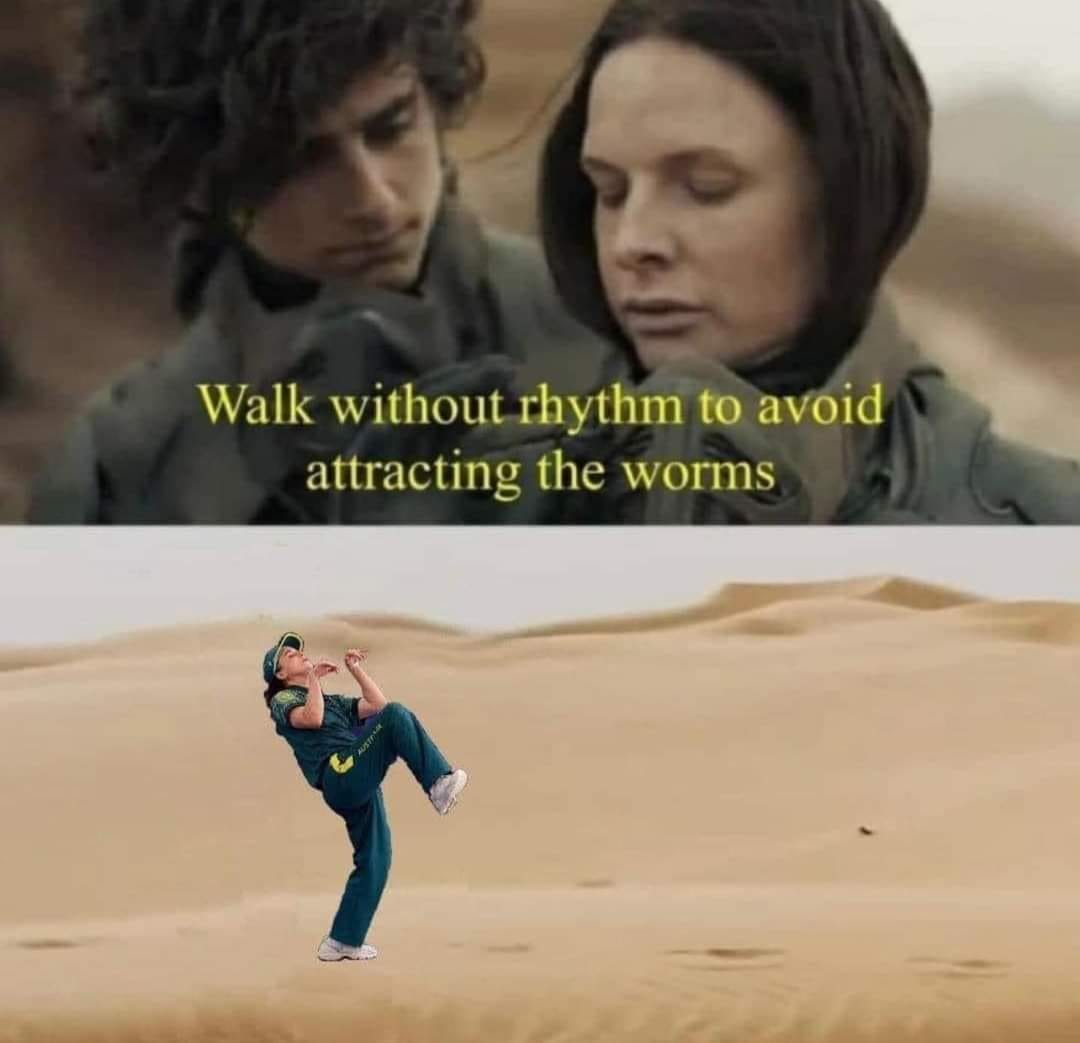
- Top Panel: Features a close-up of Lady Jessica (Rebecca Ferguson) from Denis Villeneuve's Dune (2021). Her expression is intense, thoughtful, and slightly somber. She's looking off to the side, creating a sense of foreboding. Text overlay reads: "Walk without rhythm to avoid attracting the worms."
- Bottom Panel: Shows a person (likely a cricket player, given the uniform) in mid-air, executing a very exaggerated, almost frantic, and un-rhythmic leap. They are positioned in a vast, sandy desert landscape evoking Arrakis.
The juxtaposition is the core of the humor. The solemn, serious delivery of the warning from Lady Jessica is sharply contrasted with the utterly chaotic, un-rhythmic movement of the person.
Foucauldian Genealogical Discourse Analysis
Michel Foucault would be interested in how the "truth" about sandworms and movement on Arrakis is produced and maintained through discourse. The Fremen understanding of how to avoid attracting the sandworms isn’t a naturally occurring revelation, but something that is constructed through generations of experience, training, and the transmission of knowledge.
The "walking without rhythm" rule is not an objective truth, but a regulatory practice. It shapes behavior, disciplines bodies, and establishes a power dynamic. Those who follow the rule survive; those who don't risk a swift, brutal end.
The meme’s humor derives from the failure of this discipline. The cricket player’s exaggerated movements are a breach of this norm, highlighting the power of the discourse by demonstrating the consequences (or potential consequences) of non-compliance. The meme underscores how knowledge is intertwined with power, and how even seemingly natural dangers are shaped by cultural and historical forces.
Critical Theory
From a Critical Theory perspective, the meme touches upon the concept of the sublime and how it is presented within the Dune universe. The sandworms themselves represent a terrifying, overwhelming power of nature—a sublime force that challenges human attempts at control.
The "walking without rhythm" rule is a human attempt to impose order upon this chaos, a strategy for mitigating the threat. However, the meme deconstructs this strategy by highlighting the absurdity of the effort. The cricket player’s wildly un-rhythmic jump reveals the inherent fragility of human control in the face of the sublime.
The meme also implies that there's an expectation of conformity and controlled movement that aligns with a larger societal structure on Arrakis. The character violating that expectation disrupts the norms of power.
Postmodernism
The meme is fundamentally postmodern. It engages in pastiche—mixing high culture (Dune, a complex sci-fi epic) with low culture (a cricket player). It relies on intertextuality, assuming the viewer already understands the context of the "walking without rhythm" line.
The absurdity of the imagery is a hallmark of postmodern humor. It subverts the seriousness of Dune by creating a jarring, nonsensical juxtaposition. The meme doesn’t explain the world of Dune; it plays with the viewer’s existing understanding of it. It's a playful acknowledgement of the artificiality of narratives and the constructed nature of reality.
In Conclusion
The meme's success stems from its distillation of a core principle of Dune—the need for adaptation, discipline, and respect for a harsh environment—into a single, absurd visual gag. By employing postmodern techniques of irony and juxtaposition, the meme effectively engages with the universe’s deeper themes while simultaneously creating a humorous commentary on its inherent strangeness. It's a meme that resonates because it understands and subverts the expectations of Dune fans.
simple-description (llama3.2-vision_11b)
The meme is a play on a scene from the movie Dune, where Paul Atreides is instructed to "walk without rhythm" to avoid attracting the sandworms. The image likely shows a person in a similar desert environment, with a caption that reads "walk without rhythm" and a humorous twist on the original instruction.
detailed-analysis (gemma3-27b-vision)
Okay, let's break down this meme through the lenses you've requested. It’s a fascinating combination of imagery and text that lends itself to some surprisingly robust analysis.
1. Visual Description
The image is a juxtaposition of two scenes. The top image is a still from Denis Villeneuve’s Dune (2021), featuring Lady Jessica (Rebecca Ferguson) in a stark desert landscape. Her expression is severe, her gaze distant. The lighting is muted, emphasizing the harshness and scale of the environment. Overlaid on this image is the text: "Walk without rhythm to avoid attracting the worms." The bottom image depicts a Pakistani cricketer in full uniform performing a celebratory jump in the middle of a sandy desert. The image is brightly lit and contrasts dramatically with the muted tones of the Dune still. The cricketer is dynamic, a burst of colour and energy in the vastness of the desert.
2. Foucauldian Genealogical Discourse Analysis
This meme operates powerfully through a discourse around control, danger, and the construction of norms. Foucault's work on Dune, specifically, notes how the Bene Gesserit (like Lady Jessica) actively manipulate ecological and social systems to exert power.
- Power/Knowledge: The instruction “Walk without rhythm” is not merely a practical survival tip; it’s a regime of truth imposed by the Bene Gesserit. This regime dictates how one moves (i.e., controls one’s body) as a means of navigating the dangerous desert ecosystem. Knowledge about the sandworms is intrinsically linked to power – the ability to survive and control the environment. The meme subverts this by placing the exuberant, rhythmic movement of the cricketer in this space, implicitly suggesting a resistance to the control.
- Disciplinary Power: The directive to "walk without rhythm" represents a form of disciplinary power. It’s about internalizing a rule that self-regulates behaviour. The cricketer’s rhythmic celebration defies this internalized control, suggesting an embrace of vulnerability and risk.
- Genealogy of Fear: The fear of the worms is not inherent, but produced through the Bene Gesserit’s narrative and practices. The meme implicitly questions this manufactured fear by positioning the joyous, rhythmic movement within the space of it.
3. Critical Theory
The meme touches upon several aspects of critical theory, particularly in relation to the construction of the ‘Other’ and the negotiation of power dynamics within an environment.
- Domination of Nature: The Dune image depicts a struggle to dominate a hostile environment, the desert. The imperative to avoid attracting worms suggests a need for strict control over one's own movement to survive. The cricketer disrupts this narrative.
- Subversion & Resistance: The meme can be read as a subversive act. The cricketer’s celebration of physical expression and rhythm directly opposes the mandated lack of rhythm. It proposes a different way of existing in the harsh environment. This can be seen as a form of resistance against the oppressive control implied by the Dune context.
- Spectacle & Authenticity: The meme questions what constitutes ‘authenticity’ in the face of constructed danger. The cricketer's performance, though visually striking, is a genuine display of joy, while the Dune scene implies a calculated restraint.
4. Postmodernism
This meme is inherently postmodern in its juxtaposition and irony.
- Pastiche: The combination of imagery from high-art science fiction and a sporting event is a clear example of pastiche – a playful blending of disparate elements.
- Intertextuality: The meme relies heavily on intertextuality – the relationship between the text/image and other cultural texts (Dune, cricket culture, memes). Understanding the reference to Dune is essential for understanding the meme's humour and deeper meaning.
- Deconstruction: The meme implicitly deconstructs the serious tone of Dune and the implied danger of the desert. By placing the joyful cricket image within that context, it highlights the constructed nature of that fear and control. It questions the ‘truth’ of the directive to avoid rhythm.
5. Queer Feminist Intersectional Analysis
While not immediately obvious, this meme can be read through a queer feminist lens, especially when considering the control of the body and the performance of gender.
- Control & the Body: The directive to "walk without rhythm" is about controlling the body’s natural movement. The cricketer’s exuberant, uninhibited movement can be seen as a reclaiming of bodily autonomy.
- Performance of Identity: The cricketer is performing a culturally-specific act of celebration, linking performance to identity. The meme could be read as asserting the right to express one’s identity even in a hostile environment.
- Gendered Regulation: The imperative to control movement can be tied to broader patterns of controlling women’s bodies through social norms and expectations. The cricketer’s assertion of freedom of movement can be interpreted as a challenge to these norms.
In conclusion, the meme is surprisingly rich in potential interpretations, drawing upon a variety of critical frameworks to comment on power, control, resistance, and the construction of meaning. The juxtaposition of Dune and cricket isn't merely humorous; it's a subtle critique of systems that seek to regulate and control our bodies and our expressions.
simple-description (llama3.2-vision)
This meme is a humorous take on the popular "Dune" movie, specifically the scene where Paul Atreides (played by Timothée Chalamet) is instructed by his mother, Lady Atreides, to "walk like a native" to avoid detection by the enemy. The meme shows a photo of a person walking in the desert, with the caption "walk without rhythm to avoid attracting the worms" in a playful nod to the movie's iconic instruction.