First Seen
2026-03-26T05:03:53+00:00
simple-description (qwen3.5_2b-q8_0)
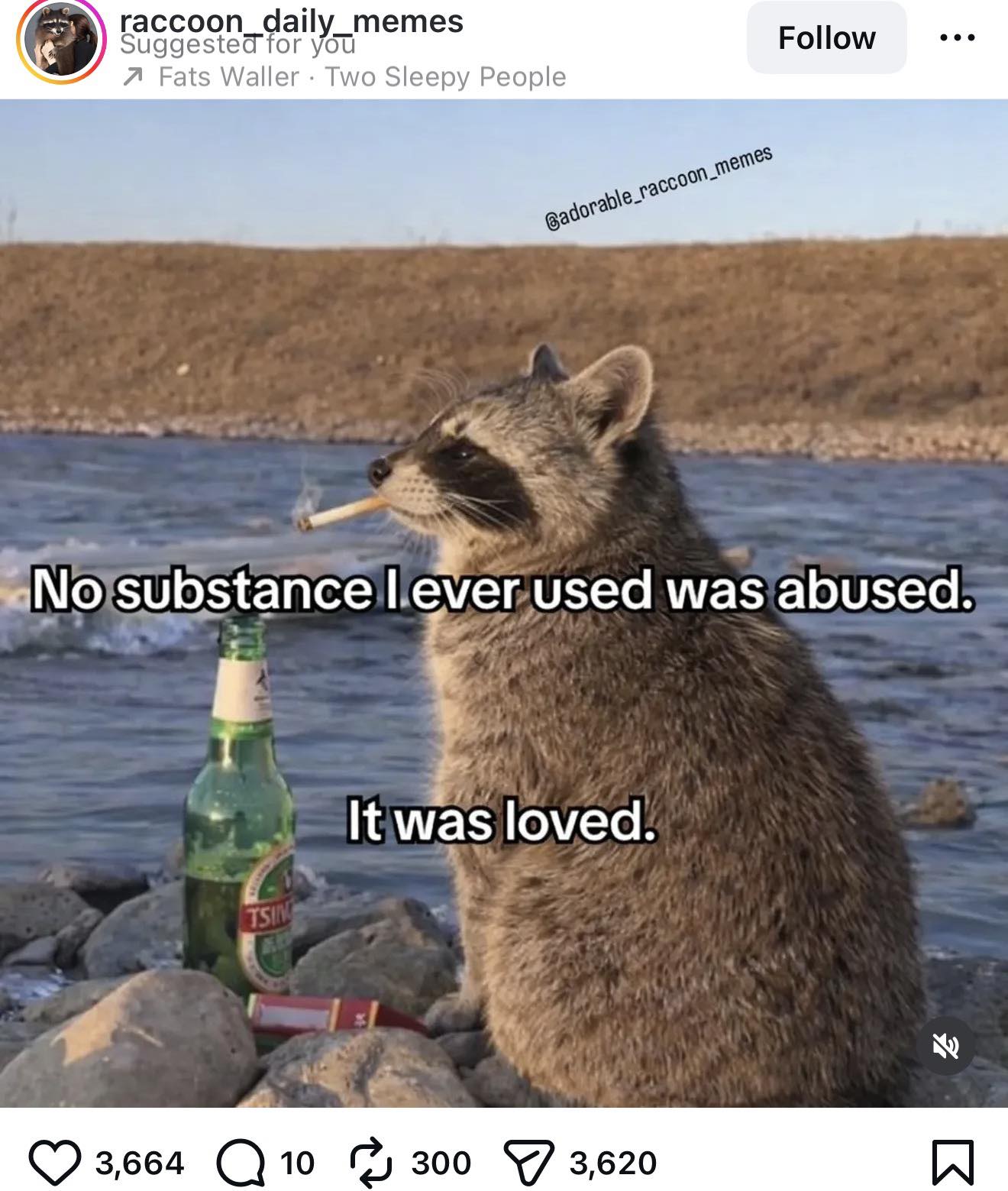
This meme visually depicts a raccoon holding a pipe with an empty bottle of beer next to it, implying that someone had access to drugs or alcohol without being forced into them. The text reads, "No substance I ever used was abused," followed by "It was loved," which humorously reclaims the act of using these items as a voluntary choice rather than an addiction or forced dependency.
detailed-analysis (gemma3_27b-it-q8_0)
Okay, let's break down this meme from a drug-related perspective using the requested theoretical frameworks.
Visual Description
The meme depicts a raccoon sitting with its back to the viewer, looking downwards. It appears emotionally distressed, or dejected. In front of it is a partially-finished bottle of Tsingtao beer. Text overlays the image: “No substance I ever used was abused. It was loved.” The overall aesthetic is a playful, relatable "sad raccoon" format. The setting is a natural environment – rocks and water – further distancing the raccoon from the human world.
Foucauldian Genealogical Discourse Analysis
From a Foucauldian perspective, this meme is fascinating because it subtly challenges the discourse around substance use. The typical discourse, heavily influenced by medical and legal power structures, frames substance use as abuse – a deviation from the norm requiring intervention, control, and labeling as a pathology. The raccoon’s statement actively rejects this framing.
- Genealogy: A genealogical approach would trace the historical shift in how we understand substance use. Historically, many substances were used ritually, medicinally, or socially without the same moral condemnation. The modern discourse of ‘abuse’ is a relatively recent construction, heavily shaped by the rise of medical expertise, moral panics, and legal systems.
- Power/Knowledge: The meme highlights how ‘knowledge’ about substances is often linked to power. The dominant understanding of "abuse" isn’t simply objective truth, but a way to exert control over bodies and behaviors. The raccoon’s declaration is a minor act of resistance to this power. The raccoon doesn’t recognize the judgement inherent in the word “abuse” because it relates to the substance in a fundamentally different way.
- Subjectivity: The meme emphasizes the subjective experience. "Loved" is deeply personal. It challenges the medical gaze that seeks to categorize and quantify experience. It centers the raccoon’s own feeling towards the substance rather than an external assessment of "harm".
Critical Theory
Critical Theory would analyze this meme in terms of the societal structures that contribute to problematic substance use and the way the meme potentially normalizes or critiques those structures.
- Alienation: The raccoon’s sadness and attachment to the substance can be seen through the lens of alienation. Modern life, as theorized by Marx and later Critical Theorists, often leads to feelings of isolation, meaninglessness, and disconnection. Substances can become a way to cope with this alienation, providing temporary relief or a sense of belonging.
- Ideology: The meme’s seemingly simple statement can be seen as undermining the dominant ideology surrounding addiction. The ideology presents substance use as purely negative, harmful, and a matter of individual weakness. By stating it "loved" the substance, the raccoon challenges this ideology and hints at the potential for substances to fulfill needs (social, emotional, psychological) that are not being met by society.
- Reason/Irrationality: The meme plays with the idea of rationality. The dominant view assumes substance use is irrational. The raccoon’s affection, though perhaps not conventionally “rational,” feels genuine and understandable. This challenges the assumption of inherent irrationality.
Postmodernism
A postmodern reading would focus on the meme’s playful deconstruction of meaning.
- Deconstruction: The meme deconstructs the binary opposition of "abuse" vs. "love." It refuses to neatly categorize the experience, highlighting the complexity and ambiguity of the relationship between a subject and a substance.
- Relativism: The raccoon’s perspective is presented as valid, even if it conflicts with dominant norms. There is no objective truth about whether a substance is "abused" – it depends on the perspective and the subjective experience.
- Simulacra and Simulation: The meme itself can be seen as a simulacrum – a representation of an experience that lacks a "real" original. It's a digitally mediated image representing a feeling that is inherently subjective and difficult to convey directly.
In summary:
The meme, while seemingly simple, is rich with potential for critical analysis. It subverts conventional understandings of substance use, highlights the importance of subjective experience, and challenges the power structures that define and control the discourse around drugs. It’s a clever piece of internet commentary that invites reflection on the complex relationship between individuals and substances.
Disclaimer: This analysis is for educational purposes only and does not constitute medical or professional advice. Substance use can be harmful, and if you or someone you know is struggling, please seek help.
simple-description (llama3.2-vision_11b)
The meme features a raccoon smoking a cigarette and holding a beer bottle, with the text "No substance I ever used was abused. It was loved." The image is meant to be humorous, suggesting that the raccoon's use of substances is not an abuse, but rather a love for them. The image is likely meant to be relatable and humorous for those who have used or are using substances in a non-abuse manner.