First Seen
2023-05-10T21:03:35+00:00
simple-description (llama3.2-vision_11b)
The meme is a screenshot of a tweet from singer Kenny Rogers, where he shares a humorous and unexpected song title that he came up with while experiencing the challenges of the COVID-19 pandemic. The tweet reads: "I've been thinking, and I've come up with a new song title: 'Dippin' Out in the Middle of an Apocalypse is the Most 'Know When to Fold 'Em' I've Ever Seen." The meme is a humorous take on the challenges of navigating life during the pandemic, and the unexpected title is a clever and witty commentary on the challenges of living through this time.
detailed-analysis (gemma3-27b-vision)
Okay, let's break down this seemingly absurd meme through various theoretical lenses. It's a bit of a ride, as the statement is intentionally jarring and invites a lot of interpretation!
Visual Description
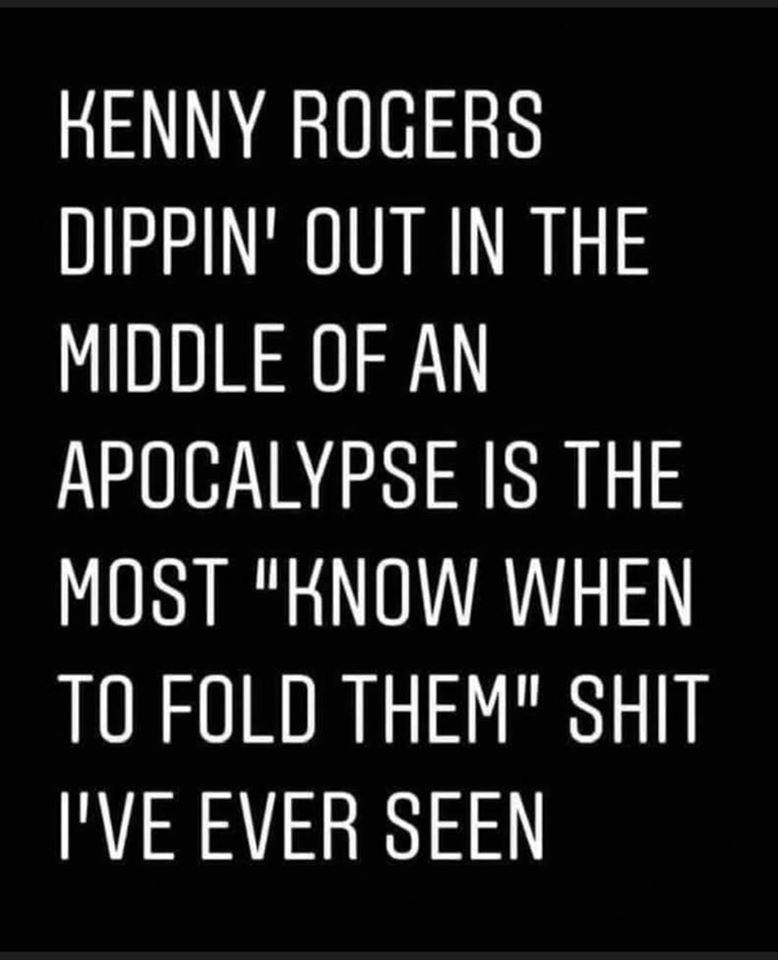
The image is a simple text-based meme. Black background with white text. The text reads: "KENNY ROGERS DIPPIN' OUT IN THE MIDDLE OF AN APOCALYPSE IS THE MOST 'KNOW WHEN TO FOLD 'EM' SHIT I'VE EVER SEEN." The font is straightforward and bold, conveying a directness to the message. There's a deliberate crudeness to the format, lending it a meme-like, internet-based aesthetic.
---
Foucauldian Genealogical Discourse Analysis
This meme’s impact rests on a pre-existing discourse about survival, risk assessment, and decision-making. A genealogical approach, following Michel Foucault, would examine the historical conditions that created the possibility of this statement meaning something.
- Power/Knowledge: The reference to Kenny Rogers' song "The Gambler" establishes a system of knowing. The song presents a set of rules (about life, card playing, and risk) that are presented as timeless and authoritative. This 'knowledge' becomes a means of navigating potentially dangerous situations. The meme draws on that established understanding of knowing when to leave a losing situation.
- Discourse of Apocalypse: The framing of the situation as an “apocalypse” taps into a long-running, culturally potent discourse about societal collapse and the need for pragmatism in the face of overwhelming odds. This discourse is often infused with narratives of survival, resourcefulness, and brutal decision-making.
- The Subject: The 'subject' positioned by this meme is someone who recognizes the absurdity of applying song lyrics to catastrophic scenarios, yet finds a strange logic in it. The meme’s effectiveness lies in recognizing the same incongruity.
- Disciplinary Practices: The song’s lyrics, while presented as entertainment, are also a kind of ‘rule book’ for navigating life’s challenges. The meme highlights that even in the most extreme circumstances, these rules (or perceived rules) still hold sway in our thinking.
---
Critical Theory
Drawing on the Frankfurt School, this meme can be seen as a commentary on the alienation of modern life and the commodification of wisdom.
- Culture Industry: The meme relies on pre-existing cultural products – a pop song, a trope of apocalyptic narratives – as its foundation. It doesn’t create meaning so much as re-contextualize it. This is a hallmark of the culture industry, which recycles and repackages existing symbols and narratives.
- Instrumental Reason: The act of applying a lyric about card playing to a life-or-death situation exemplifies the reduction of complex situations to simple, quantifiable rules. This can be seen as a manifestation of instrumental reason, where everything is evaluated based on its usefulness for achieving a specific goal (survival, in this case). The meme subtly critiques the limitations of this approach.
- Reification: The lyric “know when to fold ‘em” is reified - it's presented as an absolute truth, divorced from its original context. This reification reinforces the idea that life is a game of chance, and that success depends on making the right calculations.
---
Postmodernism
The meme perfectly encapsulates several core tenets of postmodernism.
- Hyperreality: The juxtaposition of a trivial pop song lyric with an extreme scenario creates a sense of hyperreality – a simulation of reality that is more real than reality itself. The meme doesn't offer a solution to the apocalypse; it comments on the absurdity of searching for solutions within established frameworks.
- Pastiche/Intertextuality: The meme is fundamentally intertextual, relying on the viewer’s knowledge of both the Kenny Rogers song and the apocalyptic genre. It blends these disparate elements in a way that creates a new, fragmented meaning.
- Deconstruction: The meme can be seen as a deconstruction of the idea of wisdom. It undermines the notion that there are simple rules for navigating life, even in the face of catastrophe.
---
Queer Feminist Intersectional Analysis
This lens is trickier to apply, but the meme can be read through this framework.
- Subversion of Masculinity: Kenny Rogers, as a prominent figure in country music, embodies a certain type of conventional masculinity. The meme's absurd pairing of this figure with an apocalyptic scenario can be seen as a subtle subversion of this masculinity, rendering it powerless or irrelevant in the face of real danger.
- Valuing “Folding”/Withdrawal: Feminist theory has often critiqued the emphasis on “fighting” or “conquering” as the dominant modes of resistance. The act of “folding” – withdrawing from a losing situation – can be seen as a form of self-preservation, particularly for marginalized groups who may not have the resources to engage in direct confrontation. This is, admittedly, a nuanced reading.
- Intersection of Risk and Privilege: In an apocalyptic scenario, access to resources and safety is rarely distributed equally. The meme, by focusing on individual decision-making, could be interpreted as glossing over the systemic inequalities that would determine who survives and who doesn't.
Let me know if you'd like me to elaborate on any of these sections! It's a surprisingly rich meme for what appears to be a simple joke.
simple-description (llama3.2-vision)
This meme is a humorous quote from the song "I Love You" by Kenny Rogers, but with altered lyrics to reference the COVID-19 pandemic. The text reads: "I love you, Kenny Rogers, you've got to know when to hold 'em, know when to fold 'em, know when to walk away, know when to run. You've got to know when to hold 'em, know when to fold 'em, know when to walk away, know when to run. You've got to know when to hold 'em, know when to fold 'em, know when to walk away, know when to run. I've never seen a man like you. You've got to know when to hold 'em, know when to fold 'em, know when to walk away, know when to run."
tesseract-ocr
name at) DIPPIN' OUT IN THE MIDDLE OF AN AV] Yes) oS MOST “KNOW WHEN TO FOLD THEM" SHIT a oes