First Seen
2023-05-10T21:03:35+00:00
simple-description (llama3.2-vision_11b)
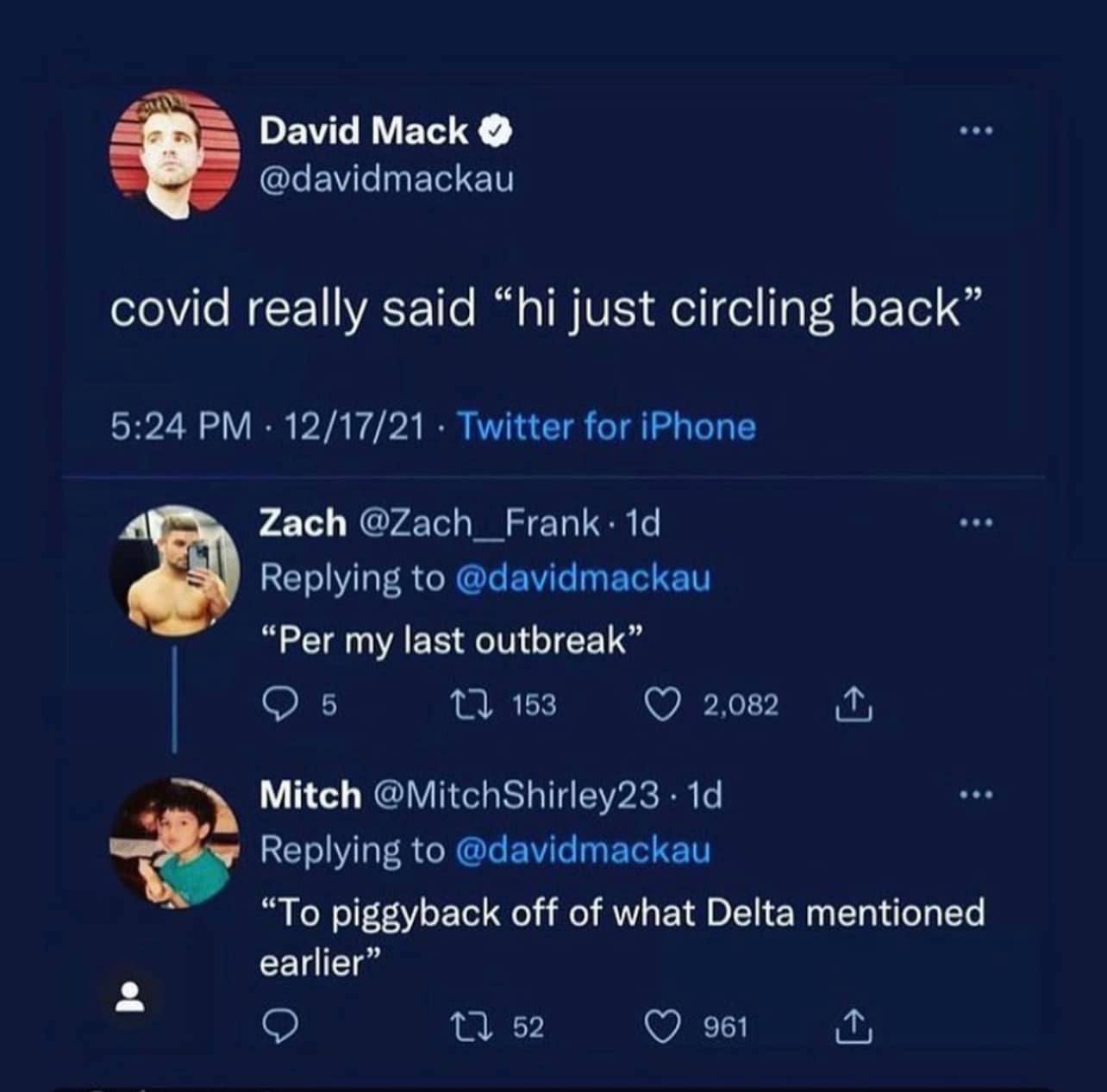
The meme is a screenshot of a Twitter conversation where a user (David Mack) is responding to a tweet from a user named "Zach" who is jokingly asking if he has COVID-19 after saying "covid" in a sentence. The user's response is a play on words, saying "covid" really said "hi just circling back" which is a common phrase used to check in with someone after a long time.
detailed-analysis (gemma3-27b-vision)
Okay, here's an analysis of the provided Twitter exchange, broken down into relevant theoretical frameworks, with headings only for sections that apply.
Visual Description
The image shows a Twitter exchange. The initial tweet, posted by @davidmackau on December 17, 2021, claims that "covid really said 'hi just circling back'." It's a playful claim as COVID-19 is not a sentient being capable of speech. The tweet is visually marked with a small profile photo of a man wearing a patterned shirt. Two replies are visible, also with profile photos of men wearing similar patterned shirts. The first reply, by @Zach_Frank, states, "Per my last outbreak" and the second from @MitchShirley23 states, “To piggyback off of what Delta mentioned earlier.” These replies continue the playful tone, framing COVID variants as conversational actors. Each tweet shows engagement metrics (replies, retweets, likes).
Postmodernism
This Twitter exchange is a perfect example of postmodern playfulness with language and the blurring of reality and simulation. Several aspects contribute to this:
* Irony and Parody: The initial tweet is inherently ironic. Attributing speech to a virus is absurd, but the use of corporate phrasing ("circling back") makes the absurdity more pointed. It’s a parody of professional communication styles applied to an epidemiological event.
Hyperreality: The replies ("Per my last outbreak," "To piggyback off...") take this further, constructing a hyperreal situation. They act* as if COVID variants are colleagues in a professional setting. This creates a simulation of communication that’s detached from any actual reality.
* Deconstruction of Language: The use of corporate jargon in the context of a deadly virus deconstructs the original meaning of the phrases. "Circling back" is meant to be a polite way of re-engaging, but here it’s imbued with the sinister implication of the virus’s persistent return.
* Playful Appropriation: The exchange appropriates the language of office culture and applies it to a dramatically different context, highlighting the constructed and arbitrary nature of language.
* Loss of Grand Narratives: The playful tone could be interpreted as a rejection of grand narratives, or unified explanations of events. There’s no attempt to provide a serious or definitive understanding of the pandemic, only a self-aware and ironic commentary.
Critical Theory
The exchange lends itself to a critical analysis of how language is used to manage and normalize difficult or frightening realities.
Hegemony and Normalization: The use of corporate phrasing ("circling back," "per," "piggyback") subtly normalizes the experience of the pandemic. It presents it as a problem to be managed* within established systems, rather than a fundamental disruption to life.
* Commodification of Crisis: The language reflects a tendency to treat even crises as opportunities for professional interaction or self-promotion. This can be seen as a symptom of late capitalism, where everything is viewed through the lens of efficiency and productivity.
* Distraction & Aesthesia: The playfulness may operate as a distraction from the serious consequences of the pandemic. The aesthetic focus on a clever turn of phrase may overshadow the real suffering and loss.
* Power Dynamics: The use of corporate jargon can be seen as a subtle assertion of power. Those who are fluent in this language are positioned as being "in control" of the situation, even in the face of a global crisis.
In Summary:
The Twitter exchange appears deceptively simple, but it is rich with meaning from multiple theoretical perspectives. It exemplifies postmodern playfulness, and offers fertile ground for a critical analysis of language, power, and normalization in the context of crisis. The use of language operates as a way to manage anxiety, normalize an abnormal situation, and subtly reinforce existing power dynamics.
simple-description (llama3.2-vision)
This meme is a screenshot of a Twitter conversation between two users, David Mack and Zachary K. (Zach), where David is responding to a tweet that says "covid really said 'hi just circling back'". Zach's response is "covid really said 'hi just circling back'". The conversation is a humorous take on the COVID-19 pandemic, exaggerating the idea that the virus is still active and is "circling back" to infect people again.
tesseract-ocr
David Mack @ oh : @davidmackau covid really said “hi just circling back” 5:24 PM - 12/17/21 - Twitter for iPhone A Zach @Zach_Frank: 1d eee Replying to @davidmackau “Per my last outbreak” | Om; 4 na sic) (9) hoy) iL , 7 Mitch @MitchShirley23 - 1d oe ar Replying to @davidmackau “To piggyback off of what Delta mentioned earlier” 2 QO aR ey Ov