First Seen
2023-05-10T21:03:35+00:00
simple-description (llama3.2-vision_11b)
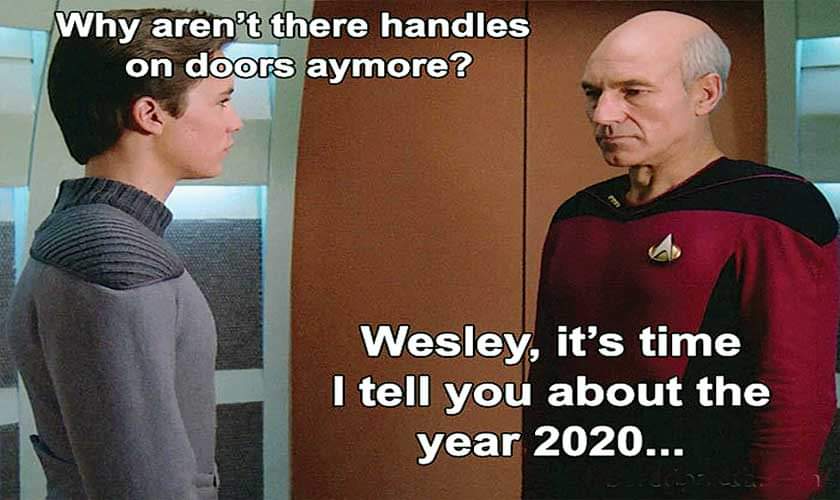
This meme is a play on a classic Star Trek: The Next Generation episode where Captain Jean-Luc Picard is asked by a young boy why there are no doors on the Enterprise. The meme replaces the boy's question with a question about the COVID-19 pandemic, and the captain's response is a humorous and unexpected answer about the pandemic's impact on the world in 2020. The meme is a lighthearted way to poke fun at the challenges of the pandemic.
detailed-analysis (gemma3-27b-vision)
Okay, here's an analysis of the image/meme, broken down into sections based on the theoretical frameworks you requested. I'll only include sections where the framework demonstrably applies.
Visual Description
The image is a still from the science fiction television show Star Trek: The Next Generation. It depicts a scene between Counselor Deanna Troi and Commander Wesley Crusher. Wesley is in a corridor, looking quizzically at something off-screen. Captain Picard stands before him, looking grim and solemn.
Overlayed text reads:
- Wesley (speech bubble): "Why aren't there handles on doors anymore?"
- Picard (speech bubble): "Wesley, it's time I tell you about the year 2020..."
The meme leverages a known and somewhat infamous moment of the show, often referenced as Picard's "tough talks" with Wesley. The image combines the science fiction setting of Star Trek (a future where presumably technology would eliminate the need for manual door handles) with a pointedly anachronistic commentary on the real-world changes introduced by the COVID-19 pandemic of 2020.
Foucauldian Genealogical Discourse Analysis
This meme provides fertile ground for Foucauldian analysis. The "disappearance of door handles" isn’t literally about door handles, but a stand-in for a whole constellation of changes brought about by the COVID-19 pandemic.
- Discourse & Power/Knowledge: The meme highlights how discourse around hygiene and safety shifted during 2020. Door handles became seen as vectors of disease, leading to the adoption of automatic doors, foot pedals, and other "touchless" technologies. This wasn't a natural progression, but an application of medical and scientific knowledge to exert power over bodies and spaces, aiming to control transmission. The meme subtly reveals how knowledge (about viruses) became intertwined with power (the ability to regulate access and movement).
- Archaeology of Knowledge: Foucault’s “archaeology” aims to uncover the historical layers that define a particular discourse. Prior to 2020, door handles were largely taken for granted as a neutral, functional element of architecture. The meme suggests that 2020 disrupted this normalized assumption, creating a "rupture" in our understanding of everyday objects.
- Genealogy: A Foucauldian genealogy would trace the historical contingency of this shift. It wouldn’t ask why door handles were removed, but how this came to be accepted as a solution. This involves looking at the social, political, and economic forces at play – the pressure on businesses to reopen safely, the media’s focus on sanitation, the adoption of new technologies, and the acceptance of heightened surveillance.
Postmodernism
The meme engages with postmodern themes in several ways:
- Hyperreality & Simulation: The combination of a futuristic Star Trek setting with a very contemporary, real-world problem creates a sense of “hyperreality.” The boundaries between simulation (the futuristic setting) and reality (the pandemic) blur. It's a comment on how technology intended to solve future problems is being used to address very immediate present-day concerns.
- Irony and Pastiche: The meme is inherently ironic. It juxtaposes the seemingly utopian future of Star Trek (where technology should have eliminated such mundane problems) with a regression to a hyper-awareness of hygiene and disease. This pastiche (mixing elements from different contexts) is a hallmark of postmodern art.
- Deconstruction of Grand Narratives: The meme subtly critiques the "grand narrative" of technological progress. While Star Trek often presents a hopeful vision of the future, the meme suggests that "progress" isn't always linear or beneficial. Sometimes, it leads to the loss of simple things (like door handles) and a constant fear of contamination.
Let me know if you'd like me to elaborate on any of these points or explore different aspects of the meme.
simple-description (llama3.2-vision)
This meme is a joke about the difference in time perception between a young person and an older person. The top image shows a young person, Wesley, asking why there are no doors on a spaceship. The bottom image shows an older person, Captain Jean-Luc Picard, responding with a humorous and ironic comment about the year 2020. The text in the image reads: "Wesley, it's time to go out for the evening. It's time for me to go out for the evening. It's time to go out for the evening."
tesseract-ocr
Ve teens there handles oe on doors aymore? a Ow = aan ~ Sey — ap. 22g | oe | a a f Wesley, it’s time ai, I tell you aboutthe | e { year 2020...