First Seen
2023-05-10T21:03:35+00:00
simple-description (llama3.2-vision_11b)
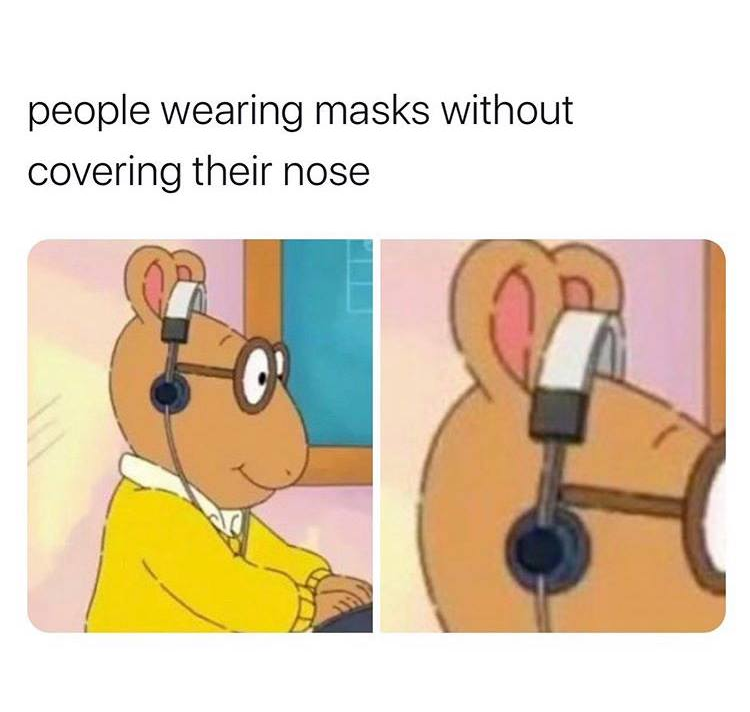
This meme is a humorous commentary on the COVID-19 pandemic, specifically the widespread use of face masks to prevent the spread of the virus. The image features a character from the popular children's TV show "Arthur" wearing a mask, with the text "people wearing masks without covering their nose" above it. The meme is poking fun at the common mistake of wearing a mask without properly covering the nose, which is a crucial aspect of mask-wearing to prevent the spread of the virus.
detailed-analysis (gemma3-27b-vision)
Okay, let's break down this meme (featuring Arthur) through a few different theoretical lenses.
Visual Description
The image is a side-by-side comparison, formatted as a meme. On the left is a scene of Arthur, an anthropomorphic aardvark, wearing headphones and a yellow sweater. The right panel shows the same character but now wearing a face mask over his mouth, leaving his nose exposed. The meme’s text reads: “people wearing masks without covering their nose”. The format relies on the implied comparison, and the presumed humor stems from the common observation of individuals during the pandemic not wearing masks correctly. The simple character design and familiar cartoon aesthetic contribute to the ease of comprehension and broad appeal of the meme.
Foucauldian Genealogical Discourse Analysis
This meme can be analyzed through a Foucauldian lens by examining the "discourse" around mask-wearing and public health. Foucault would be interested in how the practice of wearing masks became regulated – not simply as a medical recommendation, but as a social expectation. The meme highlights a failure in that regulation. It points to a gap between the intended practice of mask-wearing (covering both nose and mouth) and the actual practice.
The meme subtly critiques the power dynamics embedded in these public health discourses. Who defines what "correct" mask-wearing looks like? What mechanisms are in place to enforce this? The meme suggests that these mechanisms have been imperfect. It’s not merely about individual compliance, but the broader power relations at play – the attempt to control bodies through medical directives and the resistance or disregard of those directives. The meme functions as a micro-level examination of a larger system of control.
Critical Theory
From a Critical Theory perspective, the meme touches on the idea of instrumental rationality. The purpose of masks is presented as purely functional—to protect against a virus. However, the meme subtly suggests that the implementation of this "rational" solution has been flawed. The implication is that the focus on the technical aspect of mask-wearing (the material object) has overshadowed the underlying social and behavioral factors that contribute to its effectiveness.
The meme can also be seen as a commentary on the way seemingly “rational” public health measures can become entangled with political ideologies and social norms. Perhaps the incomplete mask-wearing is a form of subtle defiance, a rejection of authority, or a symptom of a broader cultural distrust. Critically, the meme exposes the gap between stated intentions (public safety) and actual outcomes.
Postmodernism
Through a postmodern lens, the meme can be understood as a demonstration of the breakdown of grand narratives and the prevalence of subjective experience. The "correct" way to wear a mask—covering both nose and mouth—can be seen as a metanarrative imposed by public health authorities. However, the meme undermines this narrative by highlighting the common practice of wearing masks incorrectly. This can be interpreted as a rejection of universal truths and a celebration of individual agency.
The meme also embodies the postmodern fascination with simulation and hyperreality. The mask itself is a symbol of protection and safety, but its incomplete application subverts this meaning. The meme suggests that the mask has become a superficial signifier, divorced from its intended function. It is a gesture, a performance of conformity, rather than a genuine attempt to prevent the spread of disease.
Let me know if you’d like me to expand on any of these analyses, or if you’d like me to explore other theoretical frameworks.
simple-description (llama3.2-vision)
This meme is a humorous take on the COVID-19 pandemic, where people were required to wear masks in public to prevent the spread of the virus. The image features a character from the animated TV show "Arthur" wearing a mask, but with a twist: the mask is so large that it covers his entire face, including his eyes. The text above the image reads "people wearing masks without covering their nose".
tesseract-ocr
people wearing masks without covering their nose @ | A | Oe | ( » \ = WH /